Chapter XI
A welcome peace treaty with Massasoit
It promises longterm security for their colony;
and Squanto's teaching, so crucial to the settlers,
points the way to eventual prosperity.
The surprise visitor,
an impressive figure of "seemly carriage," was Samoset, an Algonquin
sagamore (a chief) from Pemaquid Point in Maine.
The astounded Pilgrims did not invite him inside the common house
lest they reveal their limited numbers. It was a fair, warm day,
and they questioned him until night was coming, for Samoset was
the first native "we could meet withal."
He was "free in speech," though somewhat difficult to understand
because, said Bradford, he spoke "in broken English."
Samoset had learned the tongue from sailors who had been coming
for years to Monhegan Island, about 10 miles off Pemaquid Point,
to fish and trade. He had come to the Plymouth area some eight
months earlier with Capt. Thomas Dermer.
Accustomed to English ways, Samoset asked for some beer. The Pilgrims
had none, and instead gave him some "strong water (liquer)...biscuit
and butter and cheese and pudding and a piece of mallard." And
when the wind began to rise a little, they solicitously "cast
a horseman's coat about him."
Samoset had quite a bit to offer. He recounted the names of ships,
captains and mates who had visited Monhegan, and gave details
about the "east parts where he lived, which was afterwards profitable
to them." From Samoset the Pilgrims also, at last, received information
about their Indian neighbors, and about this place where they
were busy constructing their dwellings.
Its Indian name was Accomack and the clearings that had been made
for cornfields were those of the local Patuxet tribe, whose members
had perished in the plague four years past. The nearest neighbors
to the Pilgrims now were the Wampanoag Indians, whose great sachem,
Masssasoit, lived 40 miles away at Sowams, in what is now Warren,
R.I., on the Narragansett Bay. Massasoit had 60 warriors, while
the Nausets on Cape Cod, who had escaped the plague, had 100--all "ill
affected towards the English" since the villainous Capt. Hunt,
reviled equally in England and the New World, kidnapped "20 (Patuxets)
out of this very place we inhabit and seven men from the Nausets...and
sold them for slaves."
As night came the Pilgrims, out of caution, would gladly have
had Samoset leave, but he wanted to stay the night. Ultimately
he was lodged with Stephen Hopkins, the only Pilgrim with prior
knowledge of Indians, whose house was directly across Leyden street
from Elder Brewster's.
With gifts of "a knife, a bracelet and a ring," Samoset departed
next morning, first making a promise that he would be back again
with other Indians and "with such beavers' skins as they had to
truck."
The Indians, of course, had quite naturally been watching the
newcomers, probably from the time they first dropped anchor off
the coast. Recently, as Bradford observed, the Indians had been
coming closer and even deliberately revealing their presence.
This wary reconnaissance was now approaching what would be a very
dramatic climax.
Samoset was back the next day, a Sunday, with "five other tall,
proper men."
As the Pilgrims had instructed them, the Indians left their bows
and arrows a quarter mile from the settlement. Some wore deerskins,
some wildcat skins or fox tails, and some "had their faces painted
black, from forehead to the chin, four or five fingers abroad."
"We gave them entertainment as we thought was fitting them," the Pilgrims reported
in Mourt's Relation. "They did eat liberally of our English victuals.
They made semblence unto us of friendship and amity." Indeed, they brought
back the tools that Capt. Standish missed the previous month in the woods.
And, said Mourt's, "they sang and danced after their manner, like
antics."
Samoset and his friends had brought along, as he had promised,
some beaver skins. But anxious as the Pilgrims were to initiate
trade, they still would not barter on the Sabbath. In fact, because
of Sabbath obligations, they were eager for the Indians to depart.
They did urge the Indians to come again and bring more skins, "and
we would truck for all." Each Indian was given a gift--"some trifles"--but
then it developed that Samoset wanted to stay. The rest left.
Samoset was "either was sick or feigned himself so," said the
Pilgrims. The Indian, it would appear, was merely trying to see
what further he might learn about these Europeans. He stayed the
first days of the week, which were so fair and warm that the Pilgrims
dug ground and planted more garden seed. These were British seed--wheat
and beans--and some of them, said Bradford, "came not to good," having
become defective.
It was during this week, on March 21, that the Mayflower voyage
came finally to an end for the last of the passengers. The carpenter,
recovered from scurvy, completed some repairs to the shallop and
it went "to fetch all from aboard."
This day Samoset departed. The Pilgrims gave him some English
clothing--a hat, shoes, stockings and a shirt--and, showing their
anxiety to trade, asked him to learn from his companions why they
had not returned.
With Samoset gone, the Pilgrims once again resumed discussion
of their military organization. They had talked for only an hour
when they were again interrupted, this time by two or three Indians--"daring
us, as we thought"--who appeared on Watson's Hill just across
Town Brook. Capt. Standish and a companion, with muskets, ran
toward them. But as they drew near the Indians "made show of defiance"
and fled.
The next day--"a very fair, warm day"--would be one of the most
important in the entire life of the plantation.
Again the men assembled to discuss their public business. [And
amazingly enough, the Lord was about to show them that the defense
of their colony was to depend largely upon the man whom he was
about to bring to them.] And again, they had scarcely an hour
together when Samoset returned. With him was the only
remaining Patuxet, Squanto, one of the Indians kidnapped
by the notorious Capt. Hunt. Having lived in England, Squanto,
said Samoset, could speak better English than himself.
The Indians had "some few skins to truck and some red herrings,
newly taken and dried, but not salted." They also had sensational
news: The great sagamore, Massasoit, was hard by, with
Quadequina, his brother, and all their men!"
Samoset and Squanto could not have been far ahead of the Indian
chief and his entourage--warriors and "their wives and their women"--for
hardly an hour passed before "the king came to the top of the
hill over against us, and had in his train 60 men, that we could
well behold them, as they us."
The sight atop Watson's Hill was spectacular. Massasoit's attire
differed little from that of his warriors save that he had "a
great chain of white bone beads about his neck." And, in Indian
fashion, he was "oiled both head and face...All his followers
likewise were in their faces, in part or in whole, painted, some
black, some red, some yellow, and some white...some had skins
on them, and some naked; all strong, tall men in appearance."
The Pilgrims, looking at the warrior array, could readily see
that the Indians outnumbered them nearly three to one. For their
part, the Pilgrims sought to be as impressive as their resources
would permit.
Both Pilgrims and Indians were wary. When neither group gave a
sign of sending its leader, Squanto went across the brook and
returned with the word of Massasoit desired that "we should send
one to parley with him."
The choice for this crucial diplomatic task was Edward Winslow--25
years of age, courageous, innovative, a future governor. Winslow
took gifts: a pair of knives and a copper chain with a jewel in
it for Massasoit; a knife and "a jewel to hang in his ear" for
Quadequina; and "a pot of strong water, a good quantity of biscuit
and some butter."
Though Pilgrim Winslow was hardly on speaking terms with the king
of England, he began his speech to Massasoit with the assurance "that
King James saluted him with words of love and peace, and did accept
of him as his friend and ally; and that our governor desired to
see him and to truck with him and to confirm a peace with him
as his next neighbor."
The Pilgrim food furnished a hilltop repast, with Massasoit much
taken by Winslow's sword and armor. Winslow then remained as hostage
with the sachem's brother while Massasoit and twenty of his warriors
crossed the brook. They did leave their bows and arrows behind,
though the sachem kept "in his bosom, hanging in a string, a great
long knife." Six or seven of the warriors became hostages for
Winslow.
Massasoit was met by Standish, an aide and six musketeers. After
an exchange of salutes, he was taken to a house then being built
in which the Pilgrims had placed a green rug and three or four
cushions for their visitor. Gov. Carver then entered, to the sound
of drum and trumpet. Behind him came a few musketeers.
There were official salutations. Carver kissed Massasoit's hand,
Massasoit responded in kind, and they sat down. When the governor
called for strong water and drank to him, Massasoit responded
by taking "a draught that made him sweat all the while after." They
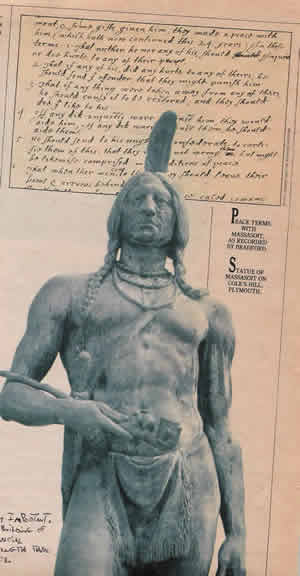
ate a little fresh meat; and thereupon concluded a six-point treaty
that the Pilgrims assured Massasoit would make King James "esteem
of him as his friend and ally."
The Pilgrims then conducted Massasoit back to the brook. There,
instead of receiving Winslow, they were greeted by Massasoit's
brother. Quadequina--"a very proper, tall young man of a very
modest and seemly countenance"--was also well entertained. On
Quadequina's return to the brook, the Indians released their hostage.
The peace treaty was expressed in simple, direct terms: Neither
people was to harm the other. Each would punish their own offenders
against the other's people. If anything was stolen, it would be
returned. Each would aid the other in the event "any did unjustly
war against him." Each would seek to have the other's "neighbor
confederates" join in the treaty. Each would leave any weapons
at a distance when making visits.
That night Massasoit and his men camped in the woods a half mile
away. Only Samoset and Squanto stayed with the Pilgrims, "who
kept good watch" but found
"no appearance of danger." Massasoit and his people departed the
next morning, leaving behind a promise that they would come again.
The treaty, now mutually confirmed, offered a prospect of peace and
security for the religious haven the Pilgrims were creating. In fact, the
Pilgrims felt that the treaty could be decisive as to whether or not the
plantation would have a future here at all. And as it turned out, the agreement
made possible the fulfillment of other pressing needs of the settlers: an
adequate food supply, and development of the trade that would permit the
Pilgrims to free themselves from Old World debts.
At the moment, though, the Pilgrims had no way of knowing whether
this far-reaching treaty would last. Massasoit had hardly taken
his leave, after giving some ground nuts and tobacco to Standish
and Isaac Allerton, when the Pilgrims started speculating on the
chief's motivation for making the treaty.
They could not "conceive but that he is willing to have peace
with us," because Indians had had numerous opportunities to injure
Pilgrims working or fowling in the woods and yet had "offered
them no harm." The Pilgrims had also observed that Massasoit "trembled
for fear" while the governor, and that of his brother had made "signs
of dislike" until the Pilgrims' weaponry was removed. "Our pieces,"
they noted, "are terrible unto them."
ABOVE ALL, THE PILGRIMS HAD LEARNED OF AN Indian
menace confronting Massasoit. It came from the powerful tribe that lived
on the west side of Narragansett Bay--a tribe that had sustained no losses
from the dreadful pestilence back in 1616-1617. Massasoit, concluded the
Pilgrims,
"hath a potent adversary, the Narragansetts, that are at war with
him, against whom he thinks we may be some strength to him." They
would be--and very soon.
That Friday, March 23, Squanto, following up on his vital contribution
as interpreter-diplomat during Massasoit's visit, launched on his role as
instructor to the Pilgrims--a service that would lead a grateful Bradford
to describe Squanto as "a special instrument sent by God for their good beyond
their expectation."
That spring, said Bradford, Squanto "directed them how to set their corn,
where to take fish, and to procure other commodities, and was also their
pilot to bring them to unknown places for their profit, and never left
them till he died."
Right after Massasoit departed, Squanto showed the Pilgrims how to catch
eels. Presumably he went to a stream just south of Plymouth Harbor,
the one now called Eel River. "He trod them out with his feet, and so caught
them with his hands, without any other instrument." The eels were "fat
and sweet" and everyone felt glad when Squanto came back that night "with
as many as he could well lift in one hand."
Meanwhile Standish, in the meeting so often interrupted, finally
completed the Pilgrims' military arrangements. With March 25,
their New Year's Day, only two days away, the Pilgrims held an
election, and again chose John Carver as governor. Carver, like
Brewster, was in his mid-50's. He was the oldest of the surviving
Pilgrims--and he had but a few weeks of life remaining.
Some laws were also adopted that Friday, and they were most timely.
Shortly thereafter a lawful order of Standish brought a torrent
of abuse from one Londoner, John Billington, a man of violent
nature. As punishment he had "his neck and heels tied together." His
humble plea for pardon brought this first offender in the colony
a quick, compassionate release--but produced no reform in him.
April 5 was finally chosen as the day the Mayflower was to begin its return
voyage. As the day came there was not a single Pilgrim--despite the suffering,
hardship and death that had been their lot since coming to the New World--who
gave the slightest sign of wishing to go back with the surviving crew.
Bradford went to unusual lengths in explaining the ship's delayed
departure:
"The reason on their (the Pilgrims') part why she stayed so long,
was the necessity and danger that lay upon them; for it was well
towards the end of December before she could land anything here,
or they able to receive anything ashore. Afterwards, the 14th
of January, the house which they had made for a general rendezvous
by casualty fell afire, and some were fain to retire aboard for
shelter; then the sickness began to fall sore amongst them, and
the weather so bad as they could not make much sooner any dispatch.
"Again the Governor and chief among them, seeing so many die and fall down
sick daily, thought it no wisdom to send away the ship, their condition considered
and the danger they stood in from the Indians, till they could procure some
shelter; and therefore thought it better to draw some more charge (debt) upon
themselves and friends than hazard all.
"The master and the seamen likewise, though before they hasted the passengers
ashore to be gone, now many of their men being dead...and the rest many lay
sick and weak; the master durst not put to sea till he saw his men begin to
recover, and the heart of the winter over."
For Master Jones, the Mayflower's return voyage would
be his last. Like so many of his crew, he might have "taken the
original" of his death in the exposure and strain that contributed
to the General Sickness. The Mayflower reached London in roughly
a month, May 6, a quick passage. But in just a few months more
Jones' widow and their two young children buried him in the churchyard
in Rotherhithe, on the south bank of the Thames River. [It goes
without saying, but I'll say it. We owe Master Jones a special
debt of gratitude for all he did, which ultimately cost him his
life.]
Massasoit-PeaceTreaty
Massasoit & Gov. Carver Make Peace Agreement
