Chapter V
In search of peace and spiritual comfort
The self-exiles find friendship, homes and jobs
in charming Leyden; however, a vengeful
King James continues to harass them.
Still in the Archives
in Leyden is a record of the official action taken on the undated
memorial, written in Dutch, that Rev. John Robinson sent to the
Leyden magistrates and that stated respectfully:
"Some members of the Christian Reformed religion, born in the kingdom
of Great Britain, to the number of 100 persons or thereabouts, men
and women, represent that they are desirous of coming to live in
this city by the 1st of May next; and to have the freedom thereof
in carrying on their trades, without being a burden in the least
to any one."
On Feb. 12, 1609, over the signature of one of their most respected
leaders, Jan van Hout, the Leyden magistrates hospitably declared
by way of response:
"They refuse no honest persons free ingress to come and have their
residence in this city, provided that such persons behave themselves,
and submit to the laws and ordinances; and therefore the coming
of the memorialists will be agreeable and welcome."
Not so to King James.
The Pilgrims had hardly bundled up their belongings and come the
canal route to Leyden--a passage westward toward Haarlem and then
southwest to Leyden--when the king's ambassador at The Hague, only
eight miles southwest of Leyden, informed the Leyden magistrates
of King James' displeasure.
In straight-faced, diplomatic manner, the magistrates sent the ambassador
copies of the correspondence with Rev. Robinson, and claimed that
they had acted
"without having known, or as yet knowing, that the petitioners had
been banished from England, or belonged to the sect of the Brownists...and
request that we may be excused by...His Majesty."
This reaction was in the well-known liberal spirit of van Hout.
The Leyden magistrates, of course--long accustomed to furnishing
haven to religious refugees and supporting the reformist activity
of their already famous university--well understood the plight of
the Pilgrims. Also, a 12-year truce the Dutch signed with Spain
in the spring of 1609 made the subservience to the wishes of His
Britannic Majesty less imperative.
King James, however, would be playing a strongly punitive role against
the Pilgrims during their stay in Leyden.
"Leyden...a fair and beautiful city and of a sweet situation, but
made more famous by the university wherewith it is adorned, in which
of late had been so many learned men." In those words Bradford pinpointed
the community's chief attractions, particularly the renown of its
professors. One of them, Johannes Polyander--who would play an important
part in the Pilgrims' dealings with King James--in telling friends
of his house beside one of Leyden's numerous, Venice-like canals
lined with linden trees, concluded: "I am lodged in the most beautiful
spot in the world."
Leyden, like much of Holland, has the appearance of a low-lying
meadow save for an artificially raised hill at the point where two
branches of the Old Rhine, flowing in from the east, join near the
city center and flow as a broader stream westward out of the city.
On the hill, called the Burgh, was in early times a fort and later
a castle.
Quick employment was a critical need for the Pilgrim newcomers.
Leyden had long been a center of the fine-cloth trade. A lot of
the wool goods exported from England, enriching ports like Boston
[England], were manufactured into cloth in Leyden. In those days,
however, this did not mean that there were immense mills. Manufacturing
mostly meant work on handlooms in individual houses, with the clothing
entrepreneur furnishing the working materials, and warehousing and
trading the finished products.
Most of the Pilgrims got jobs in the cloth industry, the greatest
number of weavers in wool, silk, linen, fustian or bombazine (a
form of silk with a special weave). Some were wool combers and wool
carders. Some made gloves, ribbon and twine. A few were merchants.
Some tried several jobs, from baker to printer.
"They fell to such trades and employments as they best could," said
Bradford, "and at length they came to raise competent and
comfortable living, but with hard and continual labor."
At first their lodgings were in the newer part of Leyden, a city
which, like Amsterdam, was expanding as it prospered. Costs were
lowest there, in the northwest area of the community, and so there
the Pilgrims "pitched" (settled). Above all, they valued peace,
said Bradford, and "their spiritual comfort above any other riches
whatsoever.
"They continued many years in a comfortable condition, enjoying
much sweet and delightful society and spiritual comfort together
in the ways of God, under the able ministry and prudent government
of Mr. John Robinson and Mr. William Brewster who was an assistant
unto him in place of an Elder, unto which he was now called and
chosen by the church.
"Such was the true piety, the humble zeal and fervent love
of this people, whilst they thus lived together, towards God and
His ways, and the singleheartedness and sincere affection one towards
another, that they came as near the primitive pattern of the first
churches as any other church of these later times have done...."
On May 5, 1611, Rev. Robinson and some members of the church, including
his brother-in-law, completed the purchase of a house "formerly
called Groene Port (Green Gate)," which had a garden and a big vacant
parcel of land in the rear. The purchase was on behalf of the entire
church, the price 8000 guilders (equal then to 1400 pounds [British
pound of 1850 was equal to $5] ), with one-fourth down and an annual
mortgage payment of 500 guilders--a big debt.
Green Gate, which was used as a parsonage for Rev. Robinson and
his family, is the place most associated with the Pilgrim stay in
Leyden, though long since demolished. It was here that the Pilgrim
congregation met and held its divine services. The house was located
in the old center of Leyden on the south side of the hof (square)
surrounding the foremost landmark in the city, St. Peter's Church,
a former cathedral built in the early thirteenth century.
The house faced Bell Alley [a 1660's Sabbatarian Christian congregation
was located in Bell Lane, London and was called the Bell Lane Church
of God, from which Steven Mumford and his wife came from before
they settled in Providence, Rhode Island.] The entrance to the old
cathedral was just across the alley. A visitor leaving the house
and turning left would very quickly arrive at the linden-bordered
canal outside Professor Polyander's house, and by then crossing
the bridge over the canal, would arrive directly at the University
of Leyden. A right turn on leaving Green Gate, and a walk of similar
distance and another landmark, the Stadhuis (City Hall), an ornate
medieval structure.
The house, under lease when purchased, was not available for another
year. But the big parcel of land was accessible and a carpenter
member of the congregation, William Jepson, began construction of
21 shall dwellings for members of the church.
Rev. Robinson moved into Green Gate on May 1, 1612. None of the
Pilgrims has left a description, but we can readily imagine their
thanksgiving service or their springtime gathering in Green Gate's
garden, with its well that was the watering place for all those
small dwellings built by Jepson. Bradford has left a happy picture
of Robinson and his flock:
"His love was great towards them; and his care was always lent for their best
good, both for soul and body. For besides his singular abilities in divine
things, wherein he excelled; he was also very able to give directions in civil
affairs, and to forsee dangers and inconveniences: by which means he was very
helpful to their outward estates; and so was, every way, as a common father
unto them."
The many extant records at City Hall--public records of marriages,
citizenship, real estate, mortgages--furnish vivid glimpses of Pilgrim
life in Leyden.
Bradford became a citizen of Leyden in the year Rev. Robinson took
over Green Gate. Bradford, now of age, had come into an inheritance
from his family estate back in Austerfield. He arranged to acquire
a house of his own and the following year walked with his witnesses
up the magnificent staircase of City Hall for his marriage to Dorothy
May, 16-year-old daughter of the elder of the Ancient Church in
Amsterdam. The groom was 23.
Bradford told how "many came unto them (the Pilgrims) from divers
parts of England; so as they grew to a great congregation." In all,
the congregation grew during the Pilgrims' time in Leyden to some
300 parishioners. Word of the Pilgrims had gone far beyond the "eminent
places"
near Scrooby--Boston, Hull and Grimsby. Newcomers came from Amsterdam's
Ancient Church, from London, and from shires from Yorkshire to Kent.[Their persecution and steadfastness in endurance won many souls, which swelled their ranks.]
The new members included some of the most prominent of the Pilgrims.
There was Isaac Allerton, a London tailor, who would become a merchant
and magistrate in the New World. There were three who would become
deacons in Leyden: Robert Cushman, a wool comber from Cantebury;
Samuel Fuller, a maker of silk, satin and serge from London; and
John Carver, a Yorkshire merchant and brother-in-law of Rev. Robinson.
And there was Edward Winslow, a London printer and a future colonial
governor.
The names of all of these, save Carver, are among those on the marriage
rolls, which record nearly 50 Pilgrim weddings in Leyden. Carver,
who would be the first governor of the Pilgrims in the New World,
had married the older sister of Rev. Robinson's wife before coming
to Holland.
THERE WERE NEARLY 100 CHILDREN
IN THE PILGRIM church during the time in Leyden--a pleasant, family
picture. They were contemporaries of the artist Rembrandt, a child
in Leyden in those years.
But there was a sad side, too. Childbirth was often fatal in those
times, and burial records tell mournful tales. The saddest is of
a friend of Brewster, Thomas Brewer, who within two months lost
a child, and then his wife and another son in childbirth.
The Pilgrims' simple, steadfast, industrious way of life
brought "good acception" from their neighbors.
"Though many of them were poor," said Bradford, "yet there was
none so poor but that if they were known to be of that congregation
(Brownists), the Dutch, either bakers or others, would trust them
in any reasonable matter, when they wanted money; because they
had found by experience, how careful they were to keep their word;
and saw them so painful (painstaking) and diligent in their callings.
Yes, they would strive to get their custom (business); and to
employ them above others in their work, for their honesty and
diligence."
In back of the land where the Pilgrims built 21 small houses was
the former Veiled Nuns' Cloister. The Leyden magistrates assigned
the lower floor as the gathering place of the Reformed Scotch Church.
The broad-minded pastor of the Pilgrims, Rev. Robinson, was friendly
with the minister and members of this church, and they would at
times hold communion together.
The clergyman's scholarship, like his tolerance, attracted many
admirers, especially in the university. Soon after his arrival in
Leyden Rev. Robinson, like many other exiled clergy on coming to
Holland, published his opinions. He wrote a book A Justification
of Separation, that was a theological defense of noncompliance
with England's state church. He frequented the library of the university,
conveniently located in the upper floor of the nearby Cloister.
In the fall of 1615 Rev. Robinson was admitted to the university
as a student of theology. Many advantages accompanied this honor:
Tax exemption, exemption from the service in the city guard, and
allowances of 10 gallons of wine every three months and 126 gallons
(half tun) of beer every month--very welcome in an era without tea,
coffee, soft drinks or a generally safe water supply.
"Great troubles" that "greatly molested the whole state" arose at this time,
Bradford said, over what was called the Arminian controversy--a hot religious
dispute that attracted the heavy hand of King James.
Jacobus Arminius, who up to his death was a professor of theology
at the university, had preached that individuals by their own action
can win salvation. This went against the rigid teaching of the Calvinists
that man's salavation was a matter of heavenly predestination. The
university had professors on both sides of the controversy and Rev.
Robinson attended their rival lectures despite his heavy schedule
of writing "sundry books" and giving three lectures a week to his
congregation.
King James went so far as to persuade the Dutch authorities to influence
the university to reject the candidate chosen to succeed Prof. Arminius.
Rev. Robinson was brought into the controversy by his friend Prof.
Polyander, orthodox advocate of the Calvinist doctrine. The clergyman,
said Bradford, "was loath, being a stranger." But the professor
anxiously importuned Rev. Robinson with the appeal that "such was
the ability and nimbleness of the adversary that the truth would
suffer if he (Rev. Robinson) did not help..."
The Pilgrim pastor ultimately delivered three university lectures
and won "much honor and respect." But the grateful university refrained
from heaping any "public favor"
on Rev. Robinson to avoid "giving offense to the state of England"--namely
King James.
In later developments in the controversy--developments that gravely
endangered the unity of Holland--King James got the Dutch government
to further twist the university's arm and prevent the famous English
divine, Rev. William Ames, from joining the university's faculty.
Rev. Ames was a friend or tutor to all the clergy who would fill
the first pulpits in New England. Only his death prevented him from
coming to the New World in later years. But his teaching--his use
of direct, forceful language--shaped the sermons preached to early
New Englanders. And his book for long was the principal theological
text at the first training ground for New England clergy, Harvard
College.
Harsher tactics than those used against Rev. Ames were employed
by King James against William Brewster and his underground press.
Brewster, who had suffered the "greatest loss" in the flight from
Scrooby to Holland, had financial difficulties that were the more
burdensome because of his age. In those early years "he suffered
much hardship," said Bradford. "[as] he had spent the most of his
means, having a great charge (expense) and many children; and, in
regard of his former breeding and course of life, not so fit for
many employments as others were; especially such as were toilsome
and laborious. But yet he ever bore his condition with much cheerfulness
and contentation (contentment)."
Brewter's schooling at Cambridge came to his aid. He could speak
Latin, the scholar's language. The University of Leyden drew many
students from Denmark and Germany. Brewster prepared a book of rules,
in the style of Latin grammar books, and taught English in his dwelling. "Many
gentlemen, both Danes and Germans," said Bradford, "resorted to
him, as they had time from other studies; some of them being great
men's sons."
BREWSTER'S GREATEST SOURCE OF HELP HOWEVER,
was Thomas Brewer, a wealthy gentleman from Kent who came to live in
Leyden, in a house he purchased in Bell Alley just a door but one from
Rev. Robinson's Green Gate. It was called Green House.
Brewer, a man in his late 30s, about 10 years younger than Brewster,
was a member of the Reformed Scotch Church. He was a Puritan zealous
to spread the gospel. He made his house a center for students, among
them a doctor and a future minister of his church. Brewer himself
was enrolled in the University of Leyden as a scholar in literature.
Chiefly with Brewer's financing, Brewster was able late in
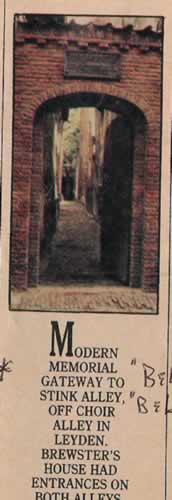
1616 to make arrangements for publishing from his dwelling on Stink
Alley, a narrow passageway off Choir Alley, which runs from the main
city street with its City Hall to the square surrounding St. Peter's
Church, entering the square toward the rear of the church. Brewster's
L-shaped, three-family house also had an entrance on Choir Alley.
Brewster and his helpers had "employment enough," said Bradford; "and
by reason of many books which would not be allowed to be printed
in England, they might have had more than they could do."
Financial aid made it possible for Brewster, who was not a printer
himself, to secure a master printer from London, John Reynolds. With
Reynolds came an apprentice printer, or assistant, who would become
a most prominent Pilgrim. He was Edward Winslow, then 21 years of
age. They both lived in Brewster's house, and, when they
soon went with their brides to be married at City Hall, members
of the Brewster family went as attendants.
Brewster's publications were far more religious than commercial
in nature. The first few books, in Latin and Dutch, bore his name;
the date, 1617; and the words In Vice Chorali, which is the Latin
translation of Choir Alley and the name most often associated with
Pilgrim activities. The fact that none of the first three books
was in English and that only those bear the Brewster imprint indicates
that they were intended to provide later printing with protection.
Eventually some dozen-and-a-half books came from Choir Alley,
which would keep such a small enterprise very busy. Later events,
when the authorities raided the premises, suggest that no press
work was done there and that the type, when set, was taken for
printing to Dutch shops.
Significantly, Prof. Polyander wrote a preface to Brewster's first
book, a Latin commentary on religious proverbs. Brewster's printing
had other associations with the university, including tracts on
the Arminian controversy. One of his other earliest books
was a polemic by Rev. Ames, who was such a personal source of irritation
to King James even though the clergyman was one of those Puritans
who wanted to stay within the state church.
Late in 1618, with Europe about to be plunged into the devastation
and agony of the Thirty Years War, and with Prince Maurice of Orange
eager for English assistance, King James was able to get the Dutch
ruler to issue an edict that prohibited foreigners in Holland from
printing books objectionable to friendly foreign countries.
King James had reason. Earlier that year, in August, he
had called a church synod at Perth, the ancient capital of Scotland,
in an effort to impose a hierarchical structure of bishops over
the presbyters, the elders, of the Scottish church.
The Scots were unalterably opposed. The historian of the Scottish
church, nonconforming David Calderwood, wrote a tract denouncing
the Perth Assembly. To get it printed, he fled to Holland, and
in a few months Perth Assembly, printed with type from Brewster's
fonts, appeared in Scotland. It had been smuggled into Scotland
concealed in wine vats. King James was incensed. [PERTH ASSEMBLY
denounced efforts by King James to impose a hierarchy of bishops
on the Scottish church.]
The captain of the guard in Edinburgh, on the king's orders, searched
the "booths and houses"
of three booksellers there but found neither Perth Assembly nor
the author.
An innocent Scottish bookseller who happened to be in London was
seized and brought before the angry king. "The devil take you away,
both body and soul," raged King James to the kneeling bookseller, "for
you are none of my religion." As for his Scottish subjects in general,
the king added: "The devil rive (split) their souls and bodies all
in collops (slices), and cast them into hell!" The bookseller was
unjustly kept in prison for three months.
In July 1619 His Majesty's ambassador at The Hague, Sir Dudley Carleton,
came across some copies of Perth Assembly and some clues.
He hurried off a message to King James' secretary of state, Sir
Robert Naunton, at Whitehall Palace: "I am informed it is printed
by a certain English Brownist of Leyden, as are most of the Puritan
books sent over, of late days, into England." In view of the new
Dutch edict, Carleton said that he would complain to the Dutch authorities.
Five days later Carleton hustled off another note to Naunton
in which he said that the culprit was "one William Brewster, a Brownist,
who hath been, for some years, an inhabitant and printer at Leyden;
but is now within these three weeks...gone back to dwell in London...where
he may be found out and examined." If Brewster was not the printer,
advised Carleton, "he assuredly knows both the printer and the author."
Carleton was right. Brewster was already in England and some three
months earlier--doubtless aware of the royal manhunt--had, as
Pilgrim Deacon Robert Cushman, then in England, wrote the Pilgrims
back in Leyden, gone
"into the north" of England. Brewster, sought by the authorities
in three countries--England, Scotland and Holland--had gone underground.
Now began something of a comedy of errors. The sleuths were unquestionably
misled by friends of Brewster, particularly his friends at the University
of Leyden, where his tutoring of scholars had made him quite popular.
Naunton wrote Carleton that Brewster was not to be found in London
and that he must be somewhere in Holland. Carleton wrote back that
he was informed Brewster was not only not in Leyden but unlikely
to be there any time soon, "having removed from thence both his
family and goods..."
From King James came something more menacing for the Dutch, eager
for his good will. The king had commanded him, Naunton said, to
tell Carleton to
"deal roundly with the State-General (the Dutch central government)
in his name, for the apprehension of him, the said Brewster, as
they tender (value) His Majesty's friendship."
Carleton began to get hints that Brewster was in Leyden...no maybe
Amsterdam. He had searches made, keeping Naunton (and, of course,
the irritated king) informed.
Then, suddenly, Carleton triumphantly informed them that Brewster
had been taken in Leyden. But Carleton was quickly forced to get
off another message explaining that he was in error--an error caused
by a bailiff, "a dull, drunken fellow (who) took one man for another."
The man under arrest was Brewster's benefactor, Thomas Brewer.
Brewer told the authorities that "his business heretofore had been
printing, or having printing done," but he blandly explained that
he had quit any printing the prior December because of the edict
making it illegal. He identified Brewster as "his brother," but,
by way of throwing the pursuers off scent, said that Brewster was "in
town at present, but sick."
The bailiff, now certainly sober, rechecked and reported that Brewster "had
already left" Leyden. Brewer, being "a member of the university," was
now transferred to the university authorities. When the bailiff
asked assistance from the university in seizing the illegal printing
supplies, university officials--most likely with tongue in cheek--appointed
Prof. Polyander, Brewster's friend, to help him.
THEY FOUND "THE TYPES" IN
THE GARRET OF Brewster's former dwelling in Stink Alley. They made
a catalogue of the books found. Then the bailiff had "the garret
door nailed in two places, and the seal of the said officer, impressed
in green wax over the paper, is placed upon the lock and the nails..."
Naunton wrote consolingly to Carleton:
"I am sorry that Brewster's person hath so escaped you; but I hope Brewer will help you find him out."
Brewer did no such thing.
It was now, however, that Rev. Ames' desire for appointment at the
University of Leyden was wrecked. In going over the catalogue of
Brewster's books, Carleton noticed that Rev. Ames
"hath his hand in many of these." Carleton told Naunton he therefore "desired
the curators of the University of Leyden not to admit him (Rev.
Ames) to a place of public professor...until he hath given His Majesty
full satisfaction."
That, given the king's attitude, was impossible.
The king's request ran headlong into difficulties raised by the
university. Its officials were unwilling to remand Brewer, and felt
they should be the ones to try him. Carleton got the Prince of Orange
to speak personally with the university rector. Finally Prof. Polyander
arranged a compromise: Brewer was to go
"voluntarily" to England, with the assurance that he could return
to Holland within three months free of expenses, and unharmed.
Carleton called Brewer "a professed Brownist" who had "mortgaged
and consumed a great part of his estate...through the reveries (dreams)
of his religion." Questioning of Brewer in London proved futile.
Naunton wrote Carleton that Brewer "did all that a silly creature
could to increase his (the king's) unsatisfaction."
Brewer was discharged. But he did not return to Holland.
A few years later Brewer, persecuted by the bishops for aiding gatherings
of nonconformists in Kent, was fined 1000 pounds and imprisoned.
He remained in King's Bench Prison for 14 years, until he was released
by act of the Long Parliament, on the eve of the civil war against
King James' son and successor, Charles I.
Brewster, in heading "into the north," may well have avoided
a much worse fate than Brewer's, with King James--called "the wisest
fool in Christendom" by the chief minister of a French monarch--thirsting
for his arrest.