Chapter VII
Setting sail towards a little-known land
The Mayflower starts across the ocean, but 'to most
of these essentially plain farm folk, their real transport
was more their faith in God than their vessel.'
Prayer--an appeal
for God's guidance--came first into the minds of the Pilgrims upon
receipt of the news that their migration to the New World was finally
to get under way.
"They had a solemn meeting and a day of humiliation [fasting], to
seek the Lord for his direction," said Bradford. Their pastor, Rev.
Robinson, preached a sermon recounting the biblical story of how "David
asked counsel of the Lord." The clergyman then spoke comforting
words, "strengthening them against their fears and perplexities;
and encouraging them in their resolutions."
Even if the Pilgrims were all ready to go together, however, they
lacked the "means to have transported them." They decided that if
a majority were to have their affairs in order, and thus be able
to leave, Rev. Robinson would accompany them as their pastor; if
not, they desired that Brewster should go as their elder.
Those going would "be an absolute church of themselves, as well
as those that stayed: seeing, in such a dangerous voyage and a removal
to such a distance, it might come to pass they should, for the body
of them, never meet again in this world." Still, all would continue
as members of the faith, whether in Holland or the New World, "without
any further dismission (dismissal) or testimonial."
Winslow told of two other major decisions made by the congregation
at this time: "They that went should freely offer themselves" and "the
youngest and strongest part" should go first.
Another day of solemn humiliation was held when notice came from
Delftshaven--a port near Rotterdam on the River Maas that was a
little more than 20 miles to the southwest by canal--that the Speedwell
with its new masts and sails, was ready.
Rev. Robinson, the beloved pastor, preached his final sermon for
the departing Pilgrims. He read a lesson from the Bible that to
seek God was "a right way for us and for our children. He spent
a good part of the day very profitable and suitable to their present
condition," said Bradford, and there were fervent prayers "mixed
with abundance of tears."
Winslow later recalled some of the clergyman's words: "Whether the
Lord had appointed it or not, he charged us before God and His blessed
angels, to follow him no further than he followed Christ."
The broad-minded pastor exhorted them that "if God should reveal
anything to us by any other instrument of His, to be as ready to
receive it as ever we were to receive any truth of his (Rev. Robinson's)
ministry; for he was very confident the Lord had more truth and
light yet to break forth out of His holy word.
"Another thing he commended to us, was that we should use all means
to avoid and shake off the name of Brownist, being a mere nickname
and brand to make religion odious...and to that end, said he, I
should be glad if some godly minister would go over with you before
my coming."
The clergyman, who would be frustrated from ever going to the New
World, told them, "Be not loath to take another pastor or teacher...for
that flock that hath two shepherds is not endangered but secured
by it." The Pilgrims would hope for years that Rev. Robinson would
rejoin them, but in vain. Meanwhile, his robe as teacher would be
filled by Elder Brewster.
Next day most of this close-knit fellowship made the canal passage
together, moving through Delft, the Dutch capital and burial place
of the martyred champion of religious freedom, William the Silent,
and on to Delftshaven.
In a final remark on their departure from Leyden, Bradford gave
them the name by which they would generations later become known
to history:
"They know they were Pilgrims," he said, "and they looked
not much back on the pleasant city that had sheltered them, but
lift up their eyes to the heavens, their dearest country, and quieted
their spirits." Their final hours with their friends--for
most would never again see one another on earth--were poignantly
described by Bradford:
"When they came to the place (Delftshaven), they found the ship
and all things ready; and such of their friends as could not come
(to the New World) with them, followed after them; and sundry also
came from Amsterdam to see them shipped, and to take their leave
of them.
"That night was spent with little sleep by the most; but with friendly entertainment,
and Christian discourse, and other real expressions of true Christian love.
"The next day, the wind being fair, they went aboard and their friends
with them; when truly doleful was the sight of that sad and mournful
parting. To see what sighs and sobs and prayers did sound amongst
them; what tears did gush from every eye, and pithy speeches pierced
each heart: that sundry of the Dutch strangers that stood on the
quay as spectator, could not refrain from tears.
"But the tide, which stays for no man, calling them away that were
thus loath to depart: there reverend Pastor, falling down on his
knees, and they all with him, with watery cheeks, commended them,
with most fervent prayer, to the Lord and his blessing. And then,
with mutual embraces and many tears, they took their leaves one
of another; which proved to be the last leave to many of them."
A martial touch--for all ships, in fear of pirates, traveled armed
in those days--was recalled by Winslow:
"We gave them a volley of small shot (musket fire) and of three
pieces of ordnance. And so lifting up our hands to each other; and
our hearts for each other to the Lord our God, we departed--and
found His presence with us, in the midst of our manifold straits
that He carried us through."
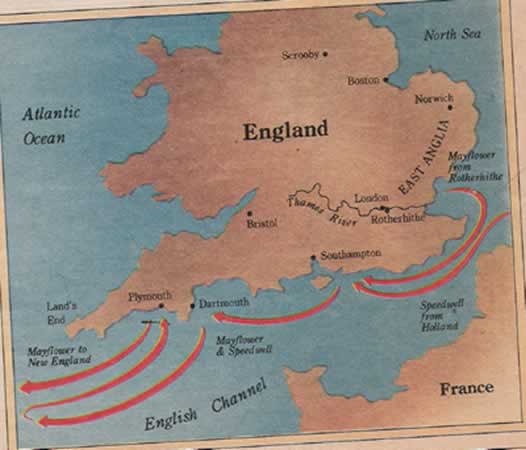
It was Saturday, July 22, 1620. The Speedwell went past the Hook
of Holland" at the mouth of the Maas, and across the North Sea to
the English Channel. They had a "prosperous wind" and in a short
time the small ship entered the great harbor of Southampton, where
the Pilgrims found the Mayflower from London already berthed, and
the Strangers who would make up the rest of their company.
There was "a joyful welcome and mutual congratulations," said Bradord, "with
other friendly entertainments..."
There were familiar faces: Carver and Cushman, so long away on months
of negotiation and preparation; and most of all there was their
elder, Brewster--though he was constrained to some disguise until
distance should give him a feeling of security from sudden arrest.
This was the first meeting of the Pilgrims and the Strangers--men,
women and children recruited mostly in and about London, East Anglia
and the southeastern section of England.
For most of the Strangers, though they would become known as Pilgrim
forefathers, the attractions offered by the adventurers were chiefly
economic--a chance to own land, and to escape the poverty being
spread in England by inflation and by farmers being forced from
their land for the more profitable raising of sheep.
If all the hired hands and servants were excluded, the Strangers
would come close to outnumbering the Pilgrims.
One of the Strangers was Capt. Myles Standish--in his mid 30s,
a short man with a florid countenance, a man who had served with
the English volunteers fighting in Holland to aid the Dutch, and
who would become the Pilgrims' celebrated military right arm in
the New World. Two other Strangers would become assistant governors:
Stephen Hopkins, who had already made one trip to the New World
and had been shipwrecked in Bermuda; and Richard Warren, a London
merchant.
The Strangers brought problems, too--in the form of the profane
John Billington of London, whom the Pilgrims would have to hang
a decade later for murder; and of two of Hopkins young servants,
who would fight a duel.
There were five hired hands: a cooper and four sailors. The cooper,
a 21-year-old blond man from East Anglia, was John Alden. Alden
would settle in the New World and marry the daughter of a Stranger,
Priscilla Mullins, who would utter the legendary words to her hesitant
lover, "Why don't you speak for yourself, John?"
The lean purse of the Pilgrims and the tightfisted behavior of the
adventurers underscored money problems at Southampton. These were
compounded by differences that arose among the three men who had
obtained the provisions--at three different places, a fact that
had evoked the disapproval of Thomas Weston.
Especially disturbing to Cushman, who played the impossible role
of diplomat, was the attitude of Christopher Martin, named a purchasing
agent to represent the Strangers, had been chosen treasurer by the
adventurers.
A stubborn man, Martin purchased freely, without consulting the
Pilgrim agents, and drove the Pilgrims' financing into a muddle
that years of effort would fail to clarify or correct.
Cushman said that nearly 700 pounds had been spent at Southampton, "upon
what I know not." Martin, Cushman protested, "saith, he neither
can, nor will, give any account of it. And if he is called upon
for accounts, he crieth out of unthankfulness for his pains and
care, that we are suspicious of him: and flings away...Who will
go and lay out money so rashly and lavishly as he did, and never
know how he comes by it?"
Ominously the Speedwell, which had shown some sailing quirks on
the passage from Holland, cut into the Pilgrims' skimpy funds. It
had to be "twice trimmed at Southampton."
The worst moments at Southampton, though, came with the arrival
of Thomas Weston, and with his efforts to get the emigrants to agree
to the altered terms demanded by some of the adventurers in the
seven-year contract. On this, the irascible Martin felt like the
people from Leyden: The adventureres, Martin told Cushman, "were
bloodsuckers!" (Martin must have meant this for all the others,
for he had ventured 50 pounds himself.)
CAPT. JOHN SMITH, IN HIS
GENERALL HISTORIE wrote that the adventurers were about 70 in number--"some
gentlemen, some merchants, some handycrafts men, some adventuring
great sums, some small, as their estates and affection served." They
were a voluntary combination, not a corporation, and "dwelt mostly
about London."
The adventurers well knew, Smith said, that establishing a plantation
could not be done "without charge, loss and crosses." Many would "adventure
no more,"
because the general stock had already cost 7000 pounds.
Weston, clearly not an entirely free agent, was "much offended when
the Pilgrims told him that he knew right well the original terms,
and that their agents had been enjoined when they left Leyden not
to agree to any new terms "without the consent of the rest that
were behind." And when they told him that the enterprise needed "well
near 100 pounds" to clear Southampton, Weston told them that he
would not dispense another penny. He promptly headed back to London,
telling the Pilgrims angrily that they could now "stand on their
own legs."
After a discussion, the conscientious Pilgrims wrote a letter to
the merchants and adventurers making a new offer.
They expressed their sorrow that "any difference at all be conceived
between us." They said that the possibility of owning their own
houses and lands "was one special motive, amongst many others, to
provoke us to go," and that they had never given Cushman assent
to make the change designating such property part of the company's
stock. Still, they offered, "that if large profits should not arise
within the seven years, that we will continue together longer with
you, if the Lord give a blessing."
They understood, they said, that three-fourths of the adventurers
were not insisting on the harsher terms; and as for their own plight:
"We are in such strait at present as we are forced to sell away
60 pounds worth of our provisions, to clear the haven (the port);
and withal put ourselves upon great extremities; scarce having any
butter, no oil, not a sole to mend a shoe, nor every man a sword
to his side; wanting (lacking) many muskets, much armor, etc. And
yet we are willing to expose ourselves to such eminent dangers as
are like to ensue, and trust to the good Providence of God..."
Capt. Smith, a tireless promoter of plantations in New England,
later put in perspective what the Pilgrims were about to do. Since
his explorations of New England in 1614, Smith wrote, the region's
fame had grown so "that 30, 40 or 50 sail went yearly only to trade
and fish.
"But nothing would be done for a plantation till about some 100
of your Brownists of England, Amsterdam and Leyden, went to New
Plymouth: whose humorous ignorances caused them, for more than a
year, to endure a wonderful deal of misery with an infinite patience;
saying my book and maps were much better cheap to teach them than
myself."
Smith had offered his services to the Pilgrims and had been turned
down. After all, they did not think they were headed for New England;
and Weston and Cushman had already hired pilots who had been to
America. Anyway, they did indeed have Smith's book and maps.
Departure this time included no farewells from friends.
A governor, with two or three assistants, was chosen for both of
the vessels "to order the people...and to see to the disposing of
provisions and such like affairs." All this was agreeable to the
skippers of the ships. Martin was chosen for the Mayflower,
Cushman for the Speedwell.
About the only ceremony was a calling together of all the company
to hear a letter that had arrived from Rev. Robinson. He wished
he could be with them. He had final words of advice, especially
that, since they were about to govern their own affairs, they choose
people who "do entirely love and will promote the common good...yielding
unto them all due honor and obedience in their lawful administrations..."
The two vessels sailed Aug. 5--belatedly, but not yet disastrously
late if all would soon go well. [1st try]
But they had not gone far before Master Reynolds found the Speedwell so
leaky that "he durst not put further to sea till she was mended." He
signaled Christopher Jones of the Mayflower, and came aboard
the larger vessel to confer, and they decided to put into the port
of Dartmouth for repairs. Reynolds had abundant grounds for concern.
Cushman, feeling ill, was deeply disturbed about trying to justify
his actions accepting the oppressive seven-year contract, and further
upset by Martin's high-handed treatment of the Pilgrims and sailors
aboard the Mayflower. He wrote of his troubles to a friend
in London, and also told about the Speedwell's shocking
condition:
"She is as open and leaky as a sieve; and there was a board two
feet long, a man might have pulled off with his fingers, where the
water came in as at a mole hole...If we had stayed at sea but three
or four hours more she would have sunk right down."
Earlier, the need to trim Speedwell twice at Southampton
had consumed an extra week of fair weather. "Now we lie here waiting
for her in as fair a wind as can blow...Our victuals will be half
eaten up, I think, before we go from the coast of England, and if
our voyage last long, we shall not have a mouth's victuals when
we come in the country."
Bradford said that the Speedwell was "thoroughly searched
from stem to stern, some leaks were found and mended, and now it
was conceived by the workmen and all, that she was sufficient, and
they might proceed without either fear or danger." They
set out again on Aug. 23 "with good hopes." [2nd try.]
But all was not well. By the time they were more than 100 leagues
(roughly 300 miles) at sea--well into the Atlantic and far beyond
Land's End--Master Reynolds again signaled for a conference. Frantic
pumping could "barely keep up with the leaks" in the Speedwell.
Reynolds said he must "bear up or sink at sea." So they turned back
and put into the nearest big port. Plymouth Harbor, where they were
certain to obtain expert help.
This harbor, in the western part of England and the English Channel,
had long been famous in England's wars, seafaring and worldwide
exploration. The governor of both the fort and port was a man of
ancient English lineage, Sir Fernando Gorges, one of the foremost
champions of plantations in the New World.
Gorges, now in his mid-50s, was a soldier--knighted by the earl
of Essex on the battlefield--and a courtier with considerable influence
with King James. At the very moment the Pilgrims arrived in the
port, Gorges had pending before the Privy Council his request for
a new charter to convert the old Virginia Company of Plymouth into
the Council for New England.
No one would be happier than Gorges at the sight of these two vessels
entering his harbor--vessels intending to voyage to the New World
to begin a plantation. This was something Gorges had been trying
to achieve since the beginning of the century, when a returning
explorer, George Wymouth, presented him with some Indians--an event
that aroused Gorges' hopes of using the Indians as interpreters
and guides in founding colonies.
Gorges, who would become know as the "Father of Maine" though he
would not personally ever set foot in America, had steadfastly persisted
in his efforts despite repeated and costly failures. Right now,
he was being forwarded reports from the explorer-trader-agent, Capt.
Thomas Dermer, whom he had sent to the Plymouth area marked on Capt.
Smith's map--the identical area where these Pilgrims would by chance
[where God is involved, rabbi's say the word coincidence (or
chance) is not a Kosher word] establish New England's first
permanent English plantation.
The Pilgrims were well-received by Gorges' people and by the townspeople
while Speedwell was examined once again. The finding, though,
was not good.
"No special leak could be found," said Bradford, "but it was judged
to be the general weakness of the ship, and that she would not prove
sufficient for the voyage. Upon which it was resolved to dismiss
her and part of the company, and proceed with the other ship. The
which, though it was grievous and caused great discouragement, was
put in execution."
Provisions and supplies had to be transferred from the Speedwell's
hold to the Mayflower. The worst wrench was that the number of passengers
had to be reduced by 20. Still, Bradford observed, "those that went
back were for the most part such as were willing to do so, either
out of some discontent or fear they conceived of the ill success
of the voyage..."
Among them was Cushman, still ill, and feeling the unmerited harassment
that he was bearing "like a bundle of lead...crushing my heart." Bradford
in his journals quoted Cushman, in a letter to a friend in London,
as seeing "the dangers of this voyage [as]...no less deadly...If
ever we make a plantation, God works a miracle!" Such, said Bradford,
were Cushman's fears at Dartmouth; and, he added, "They must needs
be much stronger now..."
This was severe on Cushman. Bradford was equally severe on Master
Reynolds. Bradford agreed that overmasting--putting excessively
large masts into the reconditioned Speedwell--had naturally opened
its seams when the ship was under heavy sail. But he suspected that
Reynolds had done this deliberately when supplies seemed to be falling
low, so that he and the crew, signed on for a year, could get out
of their contract. In after years, Bradford noted, once the Speedwell
was refitted she "made many voyages...to the great profit of her
owner..."
Overall, the Speedwell venture had turned out ruinously
in loss of time; and this loss, protracting the Pilgrims' passage
into the raging autumnal storms of the Atlantic, would contribute
to exacting a dreadful toll in lives of the brave men and women
and children--and tragically as well in those of the crew.
Already it was some 45 days since they had left Holland--sufficient
time to have completed a normal crossing of the Atlantic--and the
Pilgrims only now saw the sails raised and the vessel about to depart
from Plymouth Harbor.
It was Sept. 6. [3rd try, final departure.]
They had, said Bradford, "a prosperous wind which continued divers
days together" as their passage resumed. Many, though, were shortly "afflicted
with seasickness."
Soon they again passed Land's End and the Isles of Scilly. They
were beyond the English Channel. Ahead of them--the only thing between
them and the New World--was the Atlantic Ocean, a vast, awesome
expanse.
To most of those essentially plain farm folks, their real transport
was more their faith in God than their vessel.
And of this faraway land they hoped to reach, their future home,
what was known to these Pilgrims in the year 1620? What had been
discovered?
IN HIS DIARIES, BRADFORD TOLD OF EXPLORATIONS
in future New England, in particular mentioning explorers Bartholomew
Gosnold, who in 1602 christened Cape Cod--where the Pilgrims would
make their first New World landfall--and Thomas Dermer, who visited
the future Plymouth at Gorges' behest "but four months" before the
Pilgrims would arrive there. [If this wasn't a Providential setup,
I'll eat my hat!]
One explorer, 23-year-old Martin Pring, began voyaging to America
in 1603. He made landfall in present Maine, then came down the coast
to future Plymouth, which the Patuxet Indians called Accomack. Unlike
the Pilgrims, he found no dearth of Indians. They came, he said
in a later account, "sometimes 10, 20, 40 or threescore, and at
one time 120 at once..."
By the time the next major English explorer, Capt. Smith, came to
the same harbor in 1614, England had its first colony in North America,
struggling and suffering Jamestown. Smith had been part of that
colony, serving as its governor and, later, as its historian.
Now, however, he was on an expedition of two ships, financed by
four London merchants, with orders "to take whales and make trials
of a mine of gold and copper." They chased, but could catch no whales.
There were no mines, either, so they turned to fish and furs. While
thirty-seven of his crew fished off Maine's Monhegan Island, Smith
and eight or nine of his sailors ranged the coast, trading for beaver,
marten and otter skins.
On his famous exploration of the coast from the Penobscot River
in Maine to the tip of Cape Cod, Smith found the Indians were friendly
in general: and even after a scrap at future Plymouth, all again "became
friends." In his search he found, he said: "Not one Christian in
all the land."
Smith's records have told us of "a vile act" that occurred after
he started back to England. The captain of the other ship in the
expedition, Thomas Hunt, tried slaving on his own. He took seven
Nauset Indians and twenty Patuxets, the latter at future Plymouth,
and sold them as slaves in Spain. (Monks at Malaga later purchased
the Indians their freedom.)
Although he was blacklisted from future employment in England, Hunt's
slaving brought retaliatory misery to later seafarers coming to
the New England coast. For the Pilgrims six years later, it would
bring difficulty and anxiety.
Ironically, though, Hunt's despicable behavior preserved the
life of an Indian vital to the Pilgrims, Squanto, later described
by Bradford as "a special instrument sent by God" to help the new
inhabitants. Squanto, also known as Tisquantum, was among the Patuxets
kidnaped by Hunt--and thus was saved from the plague that would
destroy all other members of his tribe.
[The Divine setup continues, full force now.] In 1617 Capt. Dermer,
who had been on several voyages to the New World, was in Newfoundland
as Gorges' agent when he encountered Squanto, who was trying to
get back to his kin at Accomack (Plymouth). Dermer at once saw an
opportunity to help colonization. With consenting Squanto, he headed
back across the Atlantic to Plymouth, England, to consult Gorges.
[Had Squanto made it back to Accomack at this time, he probably
would have died with the rest of his tribe in that plague.]
As Bradford would at a later date, Gorges saw Squanto as help from
Heaven. "It pleased God so to work for our encouragement again,"
said Gorges, "as he sent into our hands Tisquantum...formerly betrayed
by this unworthy Hunt." Thus, said Gorges, "there was hope conceived
to work a peace between us and his friends, they being the principal
inhabitants of that coast..."
Gorges accordingly dispatched Dermer in 1619, along with Squanto,
to join others of Gorges' ships in New England. While most of his
men and boys fished off Monhegan Island, Dermer set off on May 19
in a five-ton pinnace to explore the coast. He took five or six
crewmen with him, and Squanto as his guide.
"I passed alongst the coast where I found some ancient plantations,
not long since populous, now utterly void; in other places a remnant
remains, but not free of sickness. Their disease: the plague, for
we might perceive the sores of some that had escaped, who described
the spots of such as usually die," Dermer wrote to England.
Smith, telling of Dermer's experience and of the reports had received--presumably
from some of Dermer's crew--saw the effect of the mysterious plague
as an advantage to prospective planters. "God," said Smith, "had
laid this country open to us, and slain most part of the inhabitants
by cruel wars and a mortal disease; for where I had seen 100 or
200 people there is scarce 10 to be found.
For Squanto, there were to be no kin to give him a homecoming.
When he and Dermer arrived at the seat of the Patuxet tribe, where
the Pilgrims would finally find asylum, they found "all dead." Their
cleared land, untended lands at the head of Plymouth Harbor, as
Smith suggested, awaited newcomers.
Of this place Dermer--who after wintering in Southern Virginia made
a second trip to future Plymouth just a few weeks before Pilgrims
left Delftshaven--wrote to Gorges: "I would that the first
plantation might here be seated."
Below: A map of sailing routes