VI. Earth’s Big Heat Bucket, or Where the Missing
BTU’s Are Going
“The ocean is Earth’s “biggest
heat bucket.”…the ocean is filling up with the heat that increasing
levels of greenhouse gases are preventing from escaping to space. By comparing computer simulations of Earth’s
climate with millions of measurements of ocean heat content collected
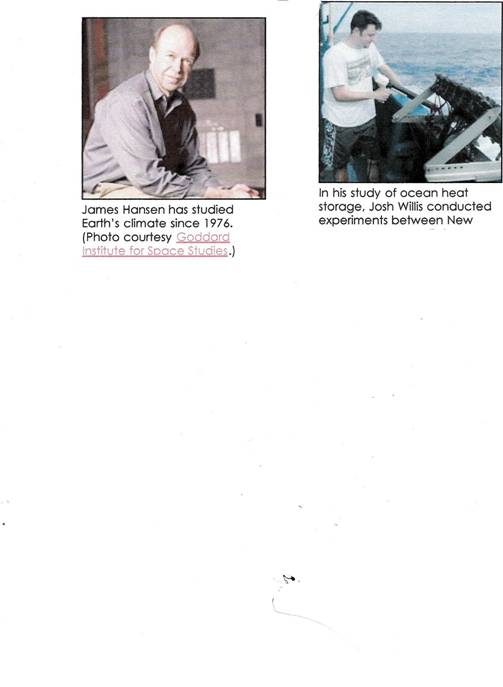
by satellites and in-the-water sensors…climatologist James Hansen along
with a team of others has discovered what he calls “the smoking gun”
of human caused global climate change. They have successfully modeled a prediction of Earth’s energy
imbalance that closely matches real world observations (ocean temperature
readings around the world). Where does the greenhouse heat hide? Earth absorbs some radiation and emits some
back into outer-space. If the
amount of energy the Earth emits back into outer-space matches what
it absorbs, the planet’s “energy budget” is in balance, and its global
mean temperature remains the same, steady. If the incoming and outgoing heat energy do not match, the planet
is either warming or cooling over time, even if the change isn’t immediately
obvious. If greenhouse gases
are forcing Earth to absorb more energy than it emits, why wouldn’t
global surface temperatures increase right away?” asks Hansen. Most excess energy must be hiding elsewhere. It can’t be in the atmosphere, as air can’t hold that much heat,
it has a very low heat capacity. But if you put heat into the ocean, it’s temperature
only changes slightly. Why? The ocean heats more slowly because of its mass. What this means is that the excess energy might not make itself
immediately obvious by strongly warming the atmosphere, but instead
this energy is being hidden (absorbed more gradually) in the form of
warmer ocean temperatures. [ http://earthobservatory.nasa.gov/Study/HeatBucket/ ]
In 1992 NASA and the French Centre National d’Etudes Spatiales
launched the TOPEX/Poseidon oceanography satellite; in 2001 they launched
the successor, Jason 1…The Jason-1 doesn’t work alone, the international
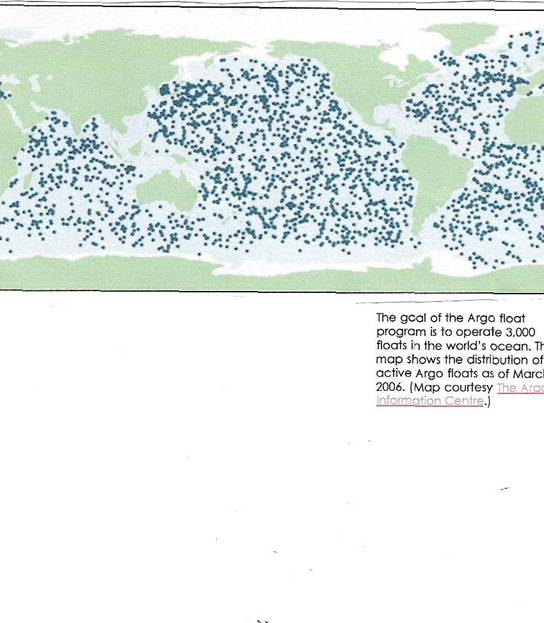
Argo float program compliments the satellite’s observations. By the end of 2006, the Argo program is expected to operate 3,000
floats, mechanical devices that measure temperature and salinity, drifting
at specified depths and spaced roughly every 3 degrees (at the Equator,
this equals 360 kilometers, or 120 miles apart)…After combining all
this information, Willis, a partner with Hansen, found that between
mid-1993 and mid-2003, the heat content of the upper 750 meters of Earth’s
global ocean increased at an average rate of 0.86 watts (plus or minus
0.12 watts) per square meter (measuring an area of 337 trillion square
meters, 93 percent of the ocean).
Two Categories of Ocean Temperatures: Ocean temperatures actually
fall into two categories, “It’s important to make a distinction between
warming at different depths. People are most familiar with sea surface temperature
because that’s where we live. But a lot of this action and this heat-content
signal are really beneath the surface of the ocean, and you have to
go hundreds of meters in depth to measure it. And what’s going on right at the surface and what’s going on
at depth can sometimes be different.” Sea surface temperature is a bigger driver of weather, but ocean
temperature at depth tells researchers more about the planet’s energy
imbalance.” [ http://earthobservatory.nasa.gov/Study/HeatBucket/heatbucket2.html ] In 1988 Hansen testified before
Congress, describing how different levels of greenhouse gases might
effect future temperatures. Over
the next 17 years, observed temperatures closely agreed with Hansen’s
1988 predictions…Hansen explains, if increasing greenhouse gases are
exerting pressure on the planet’s climate, the gases should create an
energy imbalance in which the Earth absorbs more energy than it radiates
back to space. Because most of the planet is ocean-covered
and because those oceans have a high heat capacity, excess energy should
show up in the oceans”—and at first be hidden within them. “Hansen and his collaborators ran five climate
simulations covering the years 1880 to 2003 to estimate change in Earth’s
energy budget. Taking the average
of the five model runs, the team found that over the last decade, heat
content in the top 750 meters of the ocean increased by 6.0 watts-years
per square meter (plus or minus 0.6 watt-years). (A watt-year is the amount of energy delivered by one watt of
power over one year.) What kind
of energy imbalance would it take to generate that much heat? The models predicted that as of 2003, the Earth would have to
be absorbing about 0.85 watts per square meter more energy than it was
radiating back into space—an amount closely matched by measurements
of ocean warming that Willis had compiled in his previous work. The Earth, they conclude, has an energy imbalance. “I describe this imbalance as the smoking gun
or the innate greenhouse effect,” Hansen says. [ http://earthobservatory.nasa.gov/Study/HeatBucket/heatbucket3.html ]
Bad News, Good News: If Earth’s oceans are soaking up the excess heat
energy caused by greenhouse gases, then exactly what is the problem? The problem—and perhaps part of the solution
as well—is thermal inertia. Inertia
is the tendency of an object [or body of water in this case] to resist
change in its current state. The
huge heat capacity of the oceans creates thermal inertia in the climate
system. Just as a speeding car can take some time to
stop after the driver hits the brakes, the Earth’s climate system may
take awhile to reflect change in its energy balance. i.e. There’s a time lag between when the Earth begins to experience
an energy imbalance and when the climate fully responds to it. Willis explains, “If we stopped burning all
fossil fuels today, the Earth would still warm up a little bit. It would
continue absorbing excess energy until it reached [a new] equilibrium
point. But if we keep doing what
we’re doing, the equilibrium point is going to move further away.” Hansen remarks, “We’re putting in the pipeline
additional change that will occur over the next several decades, and
which will be difficult if not impossible to avoid.” [ http://earthobservatory.nasa.gov/Study/HeatBucket/heatbucket4.html ] Hansen and his colleagues identified 2005 as the warmest year on record…“Nineteen
ninety eight leaped far above any previous temperature because it coincided
with the El Nino of the century. Now
we’ve got back to approximately the same temperature without the help
of an El Nino, so it just confirms the strong underlying global warming
trend.” [ http://earthobservatory.nasa.gov/Study/HeatBucket/heatbucket5.html ]
Other links to check out:
Making a model of Global
Warming: http://earthobservatory.nasa.gov/Library/GlobalWarming/warming4.html
The Skeptics: http://earthobservatory.nasa.gov/Library/GlobalWarming/warming5.html
NASA’S Missions to Study
Climate Change: http://earthobservatory.nasa.gov/Library/GlobalWarming/warming6.html
VII. The Earth’s “Global Heat Engine”
The oceans of the world
are coupled to the atmosphere in two major ways—heat and chemical. We’ll look at heat first. (This will be a fascinating study to all you
students headed into meteorology or oceanography. Remember that link on page one showing you the
U.S. Government’s baseline course requirements for a meteorologist? That’s just what gets you started. So be strong in math and the sciences.)
1. Exchange of heat into water: The
exchange of heat, the radiant energy of the sun absorbed into the Earth’s
oceans, creates momentum. This is a solar-fluid drive engine which pumps
gigawatts of energy both in BTU’s and kinetic energy. Let’s see how
this works. Most of the radiant
energy (heat of the sun) is absorbed all across the Earth’s equatorial
latitudes. Remember, the oceans absorb a full 90 percent
of all the radiant energy that hits them. This incoming radiant energy is double what is absorbed at the
polar regions. The oceans and
atmosphere move (via ocean currents and wind) because they are both
fluid. (Fluid dynamics is a major pre-requisite for
you future oceanographers and meteorologists.) As the equatorial ocean surfaces warm the air is warmed above
it. Most of the sun’s radiant energy passes through
the atmosphere without warming it. It
doesn’t really warm the air directly. When sunlight radiation (especially infrared) hits a solid (or
liquid) object that contains color (usually the darker shades from green
to black) it is absorbed and what absorbs it is heated and then radiates
off heat to its surroundings. It
is surface ocean temperatures we are most concerned with, because it
is the surface temperatures that interface back into the atmosphere. As heat rises from the ocean’s surface and eventually escapes
the ocean (especially in the equatorial regions) it warms the air above
it. This creates temperature gradients, which creates
winds. These winds (in conjunction
with the Earth’s rotation) “talk back” to the ocean in the form of creating
major warm-water surface currents. These
currents hit adjacent continents and tend to flow out of the equatorial
latitudes northward or southward toward the cold polar regions. The Gulf Stream is one major warm-water example
of this. As these major warm-water
currents flow north or southward, eventually nearing the cool polar
regions, they cool and as they cool the water within these currents
gets denser and heavier and start to sink toward the bottom. As they sink they get cooler still. Since this is a part of a flowing current these
cooler waters form into cold-water return currents that flow back to
the equatorial regions. This
happens because as warm surface water flows out of the equatorial regions,
water from below the surface must rise up to replace the water that
is flowing northward. Thus an unbroken “circuit” is created, as deep
cold water flows up to replace exiting warm surface water.
[see http://www.physicalgeography.net/fundamentals/8q.html for an excellent description of the Earth’s cold and warm water current
loop system for heat transference from Equatorial latitude to polar
regions.]
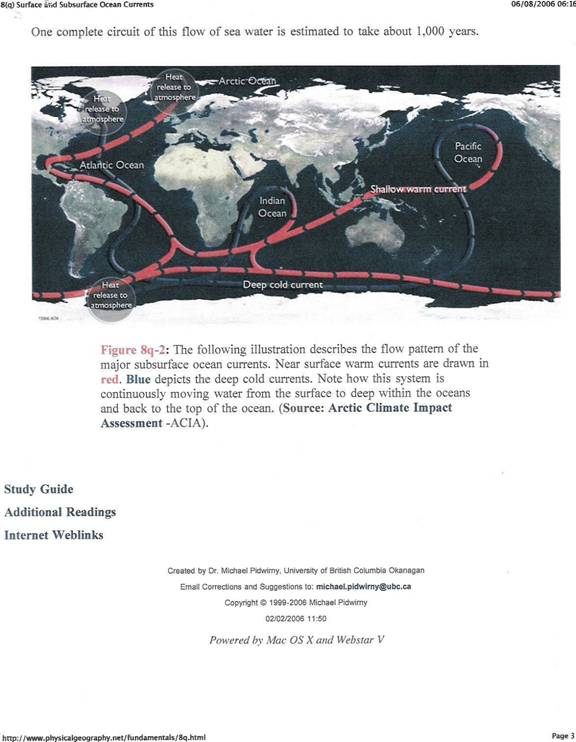
This complex current system
transports immense amounts of heat toward the polar regions, where it
is radiated back into outer-space. Thus
this giant heat engine balances Earth’s climates in a very nice way,
even making the equatorial regions livable (some people like them, I
don’t). (If all this heat where trapped there, well,
you can imagine.)
But compared to the atmosphere which can respond to temperature
changes which convert to winds and storms within days and even hours,
the ocean’s response to heat absorption can be measured only in months,
years and decades. Thus the interaction between oceans and atmosphere
is what scientists term “nonlinear” and occur over decades. That is precisely why these interactions are
so hard to interpret. As oceans
heat, atmospheric weather patterns are created. So in essence the atmosphere is the means by which the oceans
“extend” their reach globally and set off “meteorological events.” Some of these “events” can be quite destructive. i.e. El Nino is a recurring ocean current that creates destructive
weather and climate change “events.” It is the oceans which drive and will drive climate change. Scientists have labeled the oceans as “The Global Heat Engine.” [see http://earthobservatory.nasa.gov/Library/OceanClimate/ocean-atmos_phys.html ]
2. Chemical coupling with the atmosphere: The second major link between atmosphere
and ocean is the chemical link. As
we have seen previously in this article the oceans are a major “sink”
for atmospheric C02. Here is
another interaction. Water vapor
is a major greenhouse gas. As
water evaporates from the ocean’s surface and becomes water vapor, it
raises the amount of greenhouse gases in the atmosphere. But water vapor is different. It can have either a positive or negative feedback effect on
warming. If it remains invisible water vapor, yes, it
adds its positive feedback effect to overall warming by helping reflect
infrared heat-waves back into the lower atmosphere, so it acts as a
heat trap, along with the other greenhouse gases. But if the water vapor turns into clouds, which have a high reflective
quality on incoming sunlight, then this water vapor goes from having
a positive feedback to atmosphere and oceanic warming to a negative
feedback effect. These two qualities tend to neutralize themselves,
over the long term, unless something would prevent cloud formation (maybe
further warming would do that, raising atmospheric dew points, I don’t
know, I’m not a meteorologist).
So C02 remains the highest priority greenhouse gas on the list,
maybe with methane being next. Remember,
since the start of the Industrial Revolution (1750), atmospheric C02
levels have risen by 31 percent, while global temperatures have risen
by 0.5 degrees Centigrade over the past 100 years. On average, C02 remains in the atmosphere for about 100 years
before the oceans “scrub” it out, in conjunction with land plants, especially
forests. The oceanic removal of C02 has a net cooling effect. Remember, when absorbed heat is radiated back up into the lower
atmosphere (troposphere) from both land and seas, some of it is reflected
back, trapped back downwards by greenhouse gases, C02, water vapor and
methane. Higher concentrations
trap more heat, lower concentrations trap less heat and let more escape
into outer-space. Greenhouse
gas levels regulate temperatures in the troposphere either upward or
downward. That’s the key to this
whole thing.
First, a huge amount of atmospheric C02, when it comes in contact
with the oceans goes into solution with the seawater, especially in
the colder regions. It passes directly into solution and is held
there in both polar regions and in the colder depths of the oceans.
Over the vast expanse of geologic time most of the world’s C02
has been converted to biomass through photosynthesis or conversion to
calcium carbonate (CaC03) via both land plants, and mainly through phytoplankton
and zooplankton, which deposit these two items on the ocean’s floor. Through this living “biomass-carbonate” chemistry processes much
of the atmospheric C02 flows on a one-way journey into the sea and then
onto the seabed as sediment.
Going back to the C02 being held in solution in the world’s colder
sections of the oceans, if for some reason the oceans were to become
thoroughly “mixed” from top to bottom, as could happen if its thermohaline
(heat & salt) circulation system was disrupted—much of the C02 being
held in solution inside the cold deeper ocean levels would percolate
back out into the atmosphere—with catastrophic effects on global temperatures. This could happen due to massive ice-sheet melt-offs, say in
Greenland (remember those glacier speeds doubling over the past 10 years
in lower Greenland?).
One other chemical interchange: One
other chemical interchange in this equation is that of airborne dust
deposits over the ocean. Winds
transport about 10 to the 10th power kilograms, or what would
fit into three supertankers, of iron and mineral rich dust onto the
surface of the worlds oceans, especially adjacent to deserts. This is “fertilizer” to phytoplankton. Models show that as global temperatures rise, and increased desertification
results, more wind-borne iron-rich dust will be deposited on the oceans,
causing massive phytoplankton blooms, which will help lower atmospheric
C02 levels. But what the models
fail to point out is that if Global Warming has caused this much increase
in desertification, widespread famine will have occurred as well, long
before this negative feedback system has had a chance to correct C02
levels. Don’t forget, the oceanic
C02 scrubber system scrubs excesses of C02 levels down to normal levels
over 100 year time-spans.
|


