




|
Genesis 1:1-31, Earth
& Universe Created In Six Days? “There are many fine men of God who teach that the
earth is young, having only been created less than ten thousand years ago. I respect these men and appreciate all they
have done to combat the godless evolutionary theories that dominate our world
today. One of their strong arguments in
favor of a young earth comes from Exodus 20:11, which says: “For in six days
the LORD made the heavens and the earth, the sea, and all
that is in them.” While I see how this
verse can be used in arguing for a young earth, I do not necessarily agree with
their position of a young earth, nor do I believe that the Scripture
necessarily supports a young earth. I do believe that there is much credence to what is
known as “the gap theory,” which is the suggestion that between verses 1 and 2
in the first chapter of Genesis, there is a gap of time that could extend even
to several billion [3.5 billion, anyone?] years. In the beginning God created the heavens and
the earth, but the earth became wasted and desolate [Hebrew Tohu and Bohu]. Darkness
was upon the face of the deep. So sometime between Genesis 1:1, when God
created the heaven and the earth, and Genesis 1:2, when the earth was [became]
wasted and desolate, or without form and void, perhaps there was some
cataclysmic happening in the universe that brought the earth into a chaotic
state; an ice age, perhaps. And I think
that this could extend over millions of years, even into billions. Those who contend for a young earth would cite
verse 11 [of Exodus 20] and say, So I do not believe that from the Scriptures, you
have to argue for a young earth of, say, ten thousand years or less, though
there may be some scientific evidence for that, and you really can’t prove it
either way. But I don’t think a young
earth is necessarily a Scriptural position.
Also, the young earth position does not explain when the angels were
created or when Satan fell from heaven, which had to be before the Genesis
creation account.” [That quote was taken
directedly from the late Pastor Chuck Smith, former senior Pastor of Calvary
Chapel, Costa Mesa, California, in a comment section of The Word For Today
Bible, New King James Version, page 107. Pastor Chuck Smith
was used by God to start the JESUS movement, within his tiny 25 member Calvary
Chapel in the late 1960s (see The
JESUS Revolution: https://www.youtube.com/watch?v=8vmHFvnjPDw
)]. So I would say it’s a good guess that many of
the Calvary Chapel congregations, which tend to be semi-autonomous, agree with
their former senior Pastor, Chuck Smith on this Biblical interpretation of
Genesis 1:1-31, which follows, some don’t, and that’s ok. Following that explanation below, is the
Theistic interpretation for Genesis chapter 1, which I feel also needs looking
at. Genesis 1 is not and can never be
used as a proof for God’s existence or the veracity of the Bible, only
fulfilled prophecy can do that. Genesis
1 is merely God’s statement that “I did it, I created it all,” and it doesn’t
even get into the science of how God did it.
Let’s make that clear. The Genesis 1:1-31
Six Literal Day Template From The Gap Theory Interpretation How do we reconcile the Periods of Time (POTs), Epochs,
previously explained in The Genesis Code section, with the apparent literal
creation of all the animal and plant life, and ocean life that we see on earth
today, the life that is relevant to man, what mankind has been familiar with
for the past 6,000 years of his written history? First, we must come to see that Genesis
1:1-31 is a “Template” which can be used for the larger explanation given to us
in The Genesis Code, involving epoch-length periods of time, taking into
account Einstein’s Relativity-based time dilation laws, and also this template
can be used for a literal six-day creation.
If one assumes that all life died during these E.L.E.s, then one would
have to assume that specific creations took place throughout all the larger
epochs, usually after an E.L.E., extinction level event had occurred. After the massive and all-encompassing KT
extinction level event, God certainly could have started another creation of
his, which specifically fit the six literal day “Genesis 1:1-31 Template”
(assuming all life did die off during the KT-barrier extinction level
event). This is what has been termed
“the Gap Theory,” which is a fairly recent (100 years or more) explanatory
theory to take into account the geologic record that the earth and heavens are
much, much older than 6,000 years. This
Gap Theory allows for the literal six-day creation of all the plant and animal
life man is now familiar with, this “template” fitting neatly inside the larger
template, the epoch-sized one, including the POTs taking us through the entire
15.75 billion years of the universe’s existence. One fits right within the other like those
Russian dolls go inside one another. I
will now proceed to show you how Gap theorists believe this is possible. What follows is the Gap Theory explanation
for Genesis 1:1-31. What
Do The E.L.E’s Show Us, According To Those Who Promote ‘the Gap Theory’? “But first we must establish
something. What do these E.L.E.’s, “extinction
level events,” show us? They throw a
huge monkey-wrench into the theory of evolution, and the KT-barrier E.L.E.
conclusively does this. For all life to
have been wiped out, right down to the plankton and single-celled life-forms on
land and sea, and then for the sudden appearance of different life-forms within
a period of time viewed as insufficient for the evolutionary process spells the
deathblow for evolutionary theory. Does the
geologic record back up what I have just said?
I will give just two quotes, in the interest of brevity, which the Gap
Theory proponents like to use “The
history of most fossil species includes two features particularly inconsistent
with gradualism [gradual evolution from one species to another]: [1] Stasis. Most species exhibit no directional
[evolutionary] change during their tenure on earth. They appear in the fossil record looking
pretty much the same as when they disappear; morphological [anatomical or
structural] change is usually limited and directionless. [2] Sudden
appearance. In any local area, a
species does not arise gradually by
the steady transformation of its ancestors: it
appears all at once and ‘fully formed.’” (“Evolution’s Erratic Pace,” Natural History, May 1977, pp. 13-14,
emphasis added). Francis Hitching, a
member of the Prehistoric Society and the Society for Physical Research has
this to say, “There are about 250,000 different species of fossil plants and
animals in the world’s museums,” “This
compares with about 1.5 million species known to be alive on Earth today. Given the known rates of evolutionary
turnover, it has been estimated that at least 100 times more fossil species
have lived than have been discovered…But the curious thing is that there is a
consistency about the fossil gaps: the
fossils go missing in all the important places. When you look for links between major groups
of animals, they simply aren’t there; at
least, not in enough numbers to put their status beyond doubt. Either they
don’t exist at all, or they are so
rare that endless argument goes on about whether a particular fossil is, or
isn’t, or might be transitional between this group and that…There ought to be
cabinets full of intermediates---indeed, one would expect the fossils to blend
so gently into one another that it would be difficult to tell where the
invertebrates ended and the vertebrates began.
But this isn’t the case. Instead, groups of well-defined, easily
classifiable fish jump into the fossil record seemingly from nowhere:
mysteriously, suddenly, full-formed, and in a most unDarwinian way. And before them are maddening, illogical gaps where their ancestors should be.” (The Neck of the Giraffe: Darwin Evolution
and the New Biology, 1982, pp. 9-10, emphasis added.) [This is where
evolutionary scientists stood in the 1980s, scratching their heads. The evidence in the fossil record is now far
more complete now in 2020, pointing powerfully to a theistic “evolutionary”
creation, which is not blind evolution by any stretch of the imagination. More on that later.] The
KT-Barrier Extinction-Level Event Now getting back to where we were in
Genesis 1:1, the record of the rocks shows that after these two global-killer
asteroids hit (65-66 million years ago), huge clouds of dust, volcanic smoke,
ash and debris filled the skies, blocking out all light. The geologic record shows 500,000 years of
serious volcanic activity on the Indian sub-continent right after the KT-barrier
E.L.E. Anything that survived those two
huge blasts and resultant shock waves of searing steam and heat, and oncoming
tidal waves flying out from the blast sites for hundreds, even thousands of
miles, and then buckling the Earth’s crust creating volcanic eruptions and
fissures around the world---the life that was left alive---plant life from
giant Cycads down to the tiny diatoms, plankton and single-celled life stopped
photosynthesizing and soon died. Any
dinosaurs that had survived died of starvation within weeks, on a darkened
planet. The huge chalk cliffs, the White
Cliffs of Dover being just one example, are dead diatoms, nannoplankton, piled
high, from the K/T Barrier E.L.E. dated 65 to 66 million years ago. For a complete description of this event,
including geologic proofs, see, http://www.unityinchrist.com/dinosaurs/dinosaurs.htm.
Six
Literal Day “Template” For Genesis 1:1-31 So, fitting the Genesis 1:1-31
“template” into the timeframe of the KT-barrier E.L.E. to present, and seeing
clearly in the geologic record that specific “creations” of animal, dinosaur
and what not, and plant life have come and gone (via the E.L.E’s), with no sign
of evolutionary processes involved, let’s now look at Genesis 1:1-31 starting
from that frame of reference. “In the
beginning God created [Hebrew: bara,
to create from nothing] the heaven and the earth.” (Genesis 1:1) God created the heavens and the earth, and we
saw how this was done in the Genesis Code article in the Does God Exist section
of this website, via the Big Bang 15.75
billion years ago. But then, using this
as a template for the time from the KT-barrier E.L.E. to now, Genesis 1 now
shows us “And the earth was [can
also be translated “became”]
without form, and void; and darkness was
upon the face of the deep. And the
Spirit of God moved upon the face of the waters.” (Genesis 1:2) This would show us that huge KT-barrier
E.L.E. had taken place. Nothing lived,
the geologic record shows us that [according to those who believe this Gap
Theory interpretation]. Now lets see
what God did. So in Genesis 1:2a+b we see “Now
the earth became formless
[Hebrew Tohu] and empty
[Bohu], and darkness was
upon the face of the deep.” So the earth is in darkness, and as we’ve seen,
this darkness could have lasted for millions of years after those asteroid
impacts. Then God steps in (as he’s
obviously done after the past E.L.E.’s). “And
the Spirit of God moved upon the face of the waters.” (verse 2b) So the earth is in darkness under this thick
cloud of debris and volcanic ash, and the Spirit of God, it says, is hovering
over the waters. God is ready at this
point in time to start re-creating new life-forms. Let’s continue reading and see what
happens. Remember the paleontologists
quoted in the article “The Day the
Dinosaurs Died” said, “It was as if a huge curtain was wrung down on the
Dinosaurs, and when it lifted the whole stage had changed. Nothing of the Dinosaur age was to be
seen. Now everything that had to do with
man and man himself was on the stage, and reptiles were mere supernumeraries
[bit part actors].” Day
One
“And
God said, Let there be light: and there
was light. And God saw the light, that it was good: and God divided the light from the
darkness. And God called the light Day, and the darkness he
called Night. And the evening and the
morning were the first day.” (Genesis 1:3-5)
And
don’t forget, if God could create the whole universe, and create species
suddenly, as the geologic record shows, this could have been done in six days,
whether they were time-dilated days from the KT-barrier event to now or not. On the first “day” of reforming earth’s
surface God introduces periods of night and day by clearing away much of the
smoke, ash and atmospheric debris that was blocking all light from the planet,
enough so night and day were now discernable from each other. Thus a little light came through to earth for
the first time since the KT-barrier E.L.E.
Before this partial clearing of this huge cloud barrier no light,
neither sunlight, moon light nor starlight had come through. Day
Two “And
God said, Let there be a firmament in the midst of the waters, and let it
divide the waters from the waters. And
God made the firmament, and divided the waters which were under the firmament from the waters which were above the firmament:
and it was so. And God called the
firmament Heaven. And the evening and
the morning were the second day.” (Genesis 1:6-8) On this second day God had to clean up
the atmosphere, which remember, was filled with all kinds of deadly volcanic
gases and ash. He may have even
recreated the atmosphere as it is now, 78 percent nitrogen, oxygen 21 percent,
CO-2 at a safe level of 0.4 percent, a healthy combination of gases suitable to
man. I think before the KT-extinction
oxygen levels may have been a bit higher, and maybe C0-2 levels as well. The atmosphere had to be suitable for the new
re-creation of life on this planet, life as we know it now.
Day
Three “And
God said, Let the waters under the heaven be gathered together unto one place,
and let the dry land appear: and it was so. And God called the dry land Earth; and the gathering of the waters called he Seas: and God saw that it was good. And God said,
Let the earth bring forth grass, the herb yielding seed, and the fruit tree yielding fruit after his kind, whose seed is in itself, upon the earth: and it was so. And the earth brought forth grass, and herb yielding seed after his kind,
and the tree yielding fruit, whose seed was
in itself, after his kind: and God saw
that it was good. And the evening and the morning were the
third day.” (Genesis 1:9-13)
Remolding of the earth’s crust would have taken place here, separating
the seas from dry land, probably continent reformation. We know continents existed 65 million years
ago, even parts of the North American continent, but even large parts of that
continent were underwater. So the
continents probably as we know them now were formed. Then God, as we’ve seen in the geologic
record, suddenly created all the interrelated plant species,
vegetation---trees, bushes, flowers, grass, grains of all types---everything
that could grow out of the ground. But
these plants were now suitable to the animals God would create, and man
himself, and not the dinosaur species that had gone before [according to those
that hold to the Gap Theory]. Day
Four “And
God said, Let there be lights in the firmament of the heaven to divide the day
from the night; and let them be for signs, and for seasons, and for days, and
years: and let them be for lights in the
firmament of the heaven to give light upon the earth: and it was so. And God made two great lights; the greater
light to rule the day, and the lesser light to rule the night; he made the stars also. And God set them in the firmament of the
heaven to give light upon the earth, and to rule over the day and over the
night, and to divide the light from the darkness: and God saw that it was good. And the evening
and the morning were the fourth day.” (Genesis 1:14-19) On this fourth day God cleared away the last
remaining dust from the sky, thus letting the sun, moon and stars become
visible for the first time in millions of years. Day
Five
“And
God said, Let the waters bring forth abundantly the moving creature that hath
life, and fowl that may fly above the
earth in the open firmament of heaven.
And God created great whales, and every living creature that moveth,
which the waters brought forth abundantly, after their kind, and every winged
fowl after his kind: and God saw that it was good. And God blessed them, saying, Be fruitful,
and multiply, and fill the waters in the seas, and let the fowl multiply in the
earth. And the evening and the morning
were the fifth day.” (Genesis 1:20-23) On this 5th day God created all
the species of fish we see in today’s oceans, rivers and lakes, both freshwater
and saltwater varieties. He also created
all aquatic mammals. God also created on
this day all the various bird species.
In time the seas and skies were swarming with living creatures, all
adapted for the age of man, and not the dinosaur age. The progression described in Genesis 1 fits
what all these species would need.
First, the atmosphere cleared up and made suitable for life (day one and
two). The second essential thing, making
continents, dry land and creating all the vegetation on them, and areas for the
seas to be contained in, for the sea creatures to live in, right down to
essential atmosphere-C0-2 scrubbing diatoms and plankton, to the largest of
whales, and continents for all the plant life to start growing on (day
three). Then a final clearing away of
the atmosphere, to allow full photosynthesis to take place for healthy living of
all the plant species just created. This
would have made the sun, moon and stars visible (day four). And as we have just seen, on day five, all
the life in the world’s oceans, rivers and lakes was created. You can see, each phase follows the necessary
pattern that would support life, as designed by a master bio-engineer,
God. Now we’re ready for day six [in
this Gap Theory explanation]. Day
Six “And
God said, Let the earth bring forth the living creature after his kind, cattle,
and creeping thing, and beast of the earth after his kind: and it was so. And God made the beast of the earth after his
kind, and cattle after their kind, and every thing that creepeth upon the earth
after his kind: and God saw that it was good. And God said, Let us make man in our image,
after our likeness: and let them have
dominion over the fish of the sea, and over the fowl of the air, and over the
cattle, and over all the earth, and over every creeping thing that creepeth
upon the earth. So God created man in
his own image, in the image of God
created he him; male and female created he them. And God blessed them, and God said unto them,
Be fruitful, and multiply, and replenish the earth, and subdue it: and have dominion over the fish of the sea,
and over the fowl of the air, and over every living thing that moveth upon the
earth. And God said, Behold, I have
given you every herb bearing seed, which is
upon the face of all the earth, and every tree, in the which is the fruit of a tree yielding seed; to
you it shall be for meat. And to every
beast of the earth, and to every fowl of the air, and to every thing that
creepeth upon the earth, wherein there is
life, I have given every green herb
for meat: and it was so. And God saw every thing that he had made,
and, behold, it was very good. And the evening and the morning were the
sixth day.” (Genesis 1:24-31) As
seen by the text, God created all the interrelated animal species, and insect
species necessary for healthy plant life in today’s ecosystem. Everything mankind would need to sustain him
on the planet was now in existence. So,
finally, at the end of this day, God creates mankind through Adam and Eve. It’s interesting, through the Human Genome
Project, where the entire DNA and gene sequences for mankind have been mapped
out (and the guy who did it became a Christian believer from an atheist), all
of mankind has been traced to a single small lineage, which of course points to
Adam. The man who headed this project
was Francis Collins, former atheist and currently the director of the National
Human Genome Research Institute. The
Theistic Evolution of Life, Coupled to “the Genesis Code--Time Dilation
Formula” For the Six Days Of Genesis Scientists,
paleontologists and geologists, have seen clear and newly discovered fossil
evidence that not all life died off during the extensive KT-barrier extinction
level event, and that many transition fossils have been discovered recently
from that period to our present age. If
you are a believer, as I am, this points toward Theistic Evolution of the
Species. Why “Theistic” and not blind
evolution? Because the cellular level of life is so very complex, the start-up
of life on earth points to a Creator carrying out the specific creation of
cellular life in the early seas, somewhere over 3 billion years ago. Dr. Michael Behe, a PhD level micro-micro
bio-chemist whose research has taken him down to the atomic structure of
cellular life, wrote the masterful work Darwin’s Black Box.
His book clearly shows that blind evolution of the first life at the
cellular level is totally impossible.
But at the same time, the record of the rocks shows an evolutionary
process has occurred from the period of the Pre-Cambrian Seas over 3 billion
years ago, to the present. One, the
creation of the first cells points to specific creation at the cellular level
(primitive cellular life lacking a nucleus, but still having complex genes and DNA), the other, the record of the
rocks points to evolution of the Species.
So, what does this evidence show, both from the first creation of
extremely complex cellular life, and second,
the evidence of the record of the rocks, which paleontologists are
continually uncovering? For one, the
super-complexity of cellular structure goes solidly against any blind evolution
at the cellular level. It points
directly to a specific creation of life at the cellular level which occurred
all at once over 3 billion years ago.
Combining this first initial creation of cellular life with the fossil
record of the rocks which started up in the Pre-Cambrian Seas well over 3
billion years ago, and let’s see what we get.
If blind evolution of the first living cells is just not possible,
taking in the study of the law of averages, and the complexity of life at the
cellular level, what’s left for an explanation?
What the fossil evidence is beginning to reveal, that from this initial
“start-up of life” in the early seas (composed of complex cellular life), the
higher life-forms “evolved” by intelligent flipping of “gene-switches,”
bringing about an “evolutionary” change within the species extant, from then to
now. You’ll see the term “Adaptive
radiation” mentioned in this study, and it is a term evolutionists like to
use to explain the creative bio-engineering of a primitive species as it
branches out into many other species.
The fossil record of the rocks records these events, but cannot show how
this bio-engineering took place at the gene-DNA level. But it had to occur at the gene-DNA level,
pointing to “a Master Geneticist” at work here, as opposed to blind
evolution, which to me is still the most logical explanation, due to the
complexity of bio-engineering. So the
evidence points to God as a Master geneticist, who “wove” and created all the
species we find in the record of the rocks, and he did this using DNA as his
“thread,” through the flipping of genetic gene “switches,” into
all the plant and animal life found in the record of the rocks, first in the
oceans, and then on dry land and in the air.
The movie The Genesis Code
follows this reasoning, viewing the six days of Creation given in Genesis 1
from God’s perspective, outside of Space-Time (15.75 billion years
anyone?). So, from what I see in Michael
Behe’s book is that creation of cells, due to their extreme internal
complexity, point to a very specific initial creation of life in the
Pre-Cambrian Seas, over 3 billion years ago.
But from there, cells became the “Legos” of creation, with DNA being the
“thread,” God working with them, modifying them genetically, to create and
recreate all living species to suit whatever epoch they were living in,
modifying these “Legos” themselves, and thus the animal and plant species that
contained them. The sophistication of
these species, to say nothing of the sophistication and complexity of DNA and
cellular structure, cannot have been brought about by what evolutionists call “blind
evolution.” It had to have been
brought about through Divine evolution,
planned out, engineered in advance, by what many are now calling ID,
Intelligent Design, but evolution nonetheless.
Darwin saw it, but lacked the proper fossil evidence to clearly prove
it. Now we are becoming witness to a
myriad of new connective fossil discoveries, what evolutionists in my old
biology textbooks called “the Missing Links.”
To me, the idea of Theistic Evolution presented here involves a far more
complex operation of creation than a whole bunch of “specific creations”
purported by the Gap Theory proponents.
Theistic evolution also demonstrates God’s continuing creative hand in
the process of life, from the very beginning (billions of years ago) to the
end, right up to the creation of mankind and all the related flora and fauna
we’re familiar with. Ask a geneticist,
if you know any, ‘What kind of complexities would be involved in such an
operation?’ When you really think
about it, theistic evolution really seems to fit the Genesis Code scenario far better than trying to get the Gap
Theory to fit into it. But truth, real
truth, in any subject, Biblical, scientific, both combined, must be based on
solid empirical evidence. The record of
the rocks was not created by God as some divine falsehood. The Word of God and scientific evidence must
agree with each other. And when they
don’t appear to, it is simply because we have not yet discovered enough
evidence, just as Relativity and the
Genesis Code has clearly shown us--that mankind did not have the proper
scientific evidence or understanding until just recently to understand “the six
days” of creation. I can’t wait to see
the next batch of evidence to surface. First,
let us look at what I call The Genesis Code, which explains how the six
days of Genesis 1 can be reconciled with the 15.75 billion year age of the
Universe, from the Big Bang to now, as calculated from Edwin Hubble’s
discovered expansion of the universe backward to its beginning. On the subject of “genetic gene switches,” I
consider this quote. Riley
Black, in her incredible book “The Last Days of the Dinosaurs” made this
statement, which proves my thesis that there are genetic “gene switches” which
can be turned on and off. She believes
these “gene switches” have only been turned on or off by mutations, but my
premise is that from the first creation of the proto-cellular life by an
all-wise God, bio-engineering by the turning on and off of genetic “gene
switches” has been creating via “theistic evolution” the various biota of life
down through the geologic ages. Although
Riley Black believes in blind evolution, I find that hard to believe in, given
the complexity of life throughout the geologic record and all these balanced
biota throughout the ages, to say nothing of the complexity of the DNA code of
life, which to me points to intelligent design of a Master geneticist. She made a statement which points to the
flipping of genetic “gene switches” which in my estimation points to a Master
geneticist bringing about the “theistic evolution” of all life on the planet,
past and present. She stated “Nor
can birds evolve to have teeth or claws.
The genes for these weapons and tools are still in their bodies, but
they have been shut off by mutations [she says mutations, I say by the Master
geneticist, God Almighty] and slowly degraded over time. There is no evolutionary switch that can just
turn them back on.” That last
sentence is no longer true for GMO geneticists in the lab, they can turn those
ancient gene switches back on, they just haven’t chosen to do so at
present. If a PhD level geneticist can
do that, God as a Master geneticist can certainly control the theistic
evolution of the species down through the ages, creating whatever balanced
biota he wishes. [quote, emphasis mine, “The Last Days of the Dinosaurs” by
Riley Black, p. 183] But first
question, how do we square the six days of Creation given in Genesis 1:1-31
with the scientifically calculated 15.75 billion year age of the Universe,
going back to the point of the Big Bang, which the Universe was “created,” bara
out of literally nothing? Answer:
The
Genesis Code “Everyone accepts the
fact that science and the Bible are at odds with most major issues, especially
when it comes to the creation of the universe.
Genesis says the earth and the universe were created in six days. Science says it took some 15 or 16 billion
years. The Bible seems to be at complete
odds with science, just a religious fable spun by the ancients to explain the
unknowable. It’s the first 31 verses
that people can’t seem to get past. Was
it 6 days or 16 billion years? You can’t
have it both ways---until now. Is the
Bible right or is science right? Both
are absolutely correct---according to the laws of relativity Albert Einstein
discovered.” “In reality, Genesis 1:1-31 is written
from God’s perspective outside of Space and Time or what physicists call
Space-Time, or what Star Trek coined
as the Space-Time Continuum. We’re reading time as humans from our own
particular frame and point of reference inside of Space-Time. God inspired Moses to write Genesis 1:1-31
from his own frame of reference “outside of Space-Time,” as someone sitting
next to God would have witnessed the events of creation unfolding. Some Basic Physics In Layman’s Terms Time itself, as Einstein discovered, is
actually different for observers in different frames of reference, when one
frame is in motion relative to another.
In normal lower speeds we humans are accustomed to, the difference is
imperceptible. But as the speed
approaches the speed of light the impact, the differences are
overwhelming. The greater the speed in
one frame of reference to another, the slower time passes in the accelerating
frame of reference. And, also, gravity
has the same effect on time as does speed.
So time also passes slower in a frame of reference where the force of
gravity is greater than to another frame of reference with weaker gravity.
Let’s
Look At The Universe
Scientists used to believe the universe
was in steady-state. Go outside and look
up at the stars. There they are, right
where they were the night before, and the night before that. [Pleiades, a beautiful constellation is
mentioned in the Book of Job, which is reputed to be the oldest book in the
Bible.] Steady-state, says the universe
always was and always would be, forever.
And time, we always knew what time was, the ticking of the clock, always
the same, one day to the next, the same, here, on the moon, across the
universe, a thousand years ago. Time
moved forward, yesterday, today and tomorrow, always at the same speed, tick,
tock. And then along came Albert
Einstein and everything changed (our perceptions of Time & Space changed,
that is). The
Big Bang And Relativity
In the beginning (talking Relativity
now, and astrophysics, not Bible, or Steady-State time) there was nothing, the
universe did not exist, no planets or stars, not even empty space, nothing, not
even time. And out of this complete
nothing there was a flash! and a speck was formed, no bigger than a mustard
seed. And in that tiny speck was all
that everything would be. And that speck
expanded at 100’s of millions of miles per hour. It was a ball of pure energy, dense, massive,
beyond imagination, and the temperature was in the trillions of degrees, a mass
of pure plasma expanding at the speed of light.
Everything that ever would be, the material of everything that exists
today, the planets and the stars, all living things, Time & Space itself
was at that moment in this ball of pure plasma energy. This was good news, Einstein’s revelations,
for Bible thumpers, it says there was a beginning, just like it says in the
Bible. Of course, the bad news was, the
Bible says it all happened in six days.
The idea of this Big Bang all came about as a result of Einstein’s
theory of relativity (which has proven to be the laws of relativity), where he
established in the physical sciences, that nothing was absolute, everything was
relative to speed. It’s a concept in
physics we call Time-Dilation.
For someone traveling at near the speed of light, time passes more
slowly than for someone waiting on earth.
Less actual time elapses for someone traveling near the speed of light
than for one who is stationary on earth.
For an object at rest time passes as we are accustomed, as the object
begins to accelerate and as it approaches the speed of light, the amount of
time that passes decreases. The passage
of time is relative to speed, time-dilation.
The effect of increased gravity (say at the Event-Horizon of a black
hole) slows the passage of time, just as traveling near the speed of light
does. For an object in a zero or low
gravity environment (such as found on earth) time passes as we’re all
accustomed to it. As the force of
gravity on an object increases, the passage of time narrows, time slows
down. To sum it up, time is not fixed or
constant. Time or the passage of time is
effected by speed or gravity, the greater the speed or the greater the force of
gravity, the slower the passage of time.
The
Stretching Of Space Also Slows Time Science tells us at the instant of the
Big Bang, everything that would be in the universe and anything in it,
including Space & Time itself, was compressed to a speck the size of a
mustard seed. Now as the universe
expanded, galaxies formed. Notice as the
universe expands the distance between the galaxies increases. There is no more (quantity-wise) matter, or
space or time, it’s just the distance between what there is, is
increasing. Space itself is
stretching. As space stretches, so
does time. Just as time is
effected by speed and by gravity, it is also effected by the stretching of
space. But the stretching of space
effects time from one moment to another, rather than just one place to
another. And this brings us back to
Genesis and the quandary of six days or 16 billion years. Now in order to understand these first six
days we need to identify the frame of reference in which they unfold. How is the story of Genesis conveyed to
man? The first five books of the Bible,
including Genesis, were given directly to Moses by God (or God inspired certain
others to write those books). So the
source of the story of the first six days, directly or indirectly, is God. So Genesis 1 is told through God’s
perspective, from his, scientifically speaking, frame of reference…So, just
what was God’s frame of reference? God’s
frame of reference when telling the story had to be somewhere not effected by
local distortions [of Space-Time], like speed or gravity [or the stretching of
space itself], and that “somewhere” had to be the total universe itself, not
some isolated locality within it [or outside of Space-Time itself]. So the question is, how does time unfold in
this Cosmic frame of reference? How
Does Time Unfold In This Cosmic Frame Of Reference? What Is A Clock? A Look At The Cosmic Clock So the question is, how does time
unfold in this Cosmic frame of reference?
How is it recorded? To understand
that we must first understand what a clock really is. A clock is anything that repeats itself
periodically where the rhythm of those cycles can be used to denote the passage
of time. That’s straight from the
dictionary, tic, toc, tic, toc…A clock is not something that creates time, a
clock only records the passage of time.
So the Cosmic clock that God uses to relate his time of creation to man is
what? The answer simply is light. Light is the only constant in the universe,
it provides a method of measuring the passage of time in the Cosmos. Light can be used as a Cosmic clock to
measure the passage of time by any change in the cycle or frequency of
light…The distances between the crests of the light-wave. Science has proven this by measuring the
stretching of the wavelength of the light of the sun compared to the
wavelength or frequency of the same light created on earth [and they’re the
same]. The results confirmed the
predictions made by Einstein and by time-dilation. In order to compare time today with time at
the Big Bang, and the passage of time between then and now, there has to be a
source of light which exists today that also existed at the time of the Big
Bang. This light source was
found in 1964, by accident, when two astronomers discovered what is called
Cosmic Background Radiation, or CBR.
This is a residual radiation left over from the time of the Big
Bang. And it fills all space today as it
did then. The property of the CBR that
makes it the perfect Cosmic clock is the change that has occurred in the
wavelength of the decaying acts when matter was first formed following the Big
Bang and now. At the Big Bang moment the
temperature in that initial plasma mass was nearly 11 trillion degrees, and the
frequency of what is now the CBR corresponded.
The original frequency of the CBR was some 3 trillion cycles per second.
As
the universe cooled and expanded, space stretched, and with it, the wavelength
of the CBR. Today that CBR has
cooled to only 2.75 degrees Kelvin, and the wavelength is some 3 cycles per
second. The ticking of this Cosmic clock
has slowed from some 3 trillion cycles per second to 3 cycles per second. The stretching of space-time, as the universe
expanded, in turn stretched the distance between the wave-crests of the
CBR. The passage of time just after the
Big Bang occurred at a rate one trillion times faster than it does today. So God telling the story of the first six
days to Moses, he was telling it from his frame of reference. He told it based on the passage of time
reflected by the Cosmic clock. God
related to Moses what happened on each of the six days of Genesis 1 based on
the passage of time as calculated by the Cosmic clock as it recorded the
passage of time as it occurred. There is
a simple formula that can be used to break the rate-of-change in the passage of
Cosmic time into steps. But in doing
this, this rate-of-change, the amount of time passing will be seen from our
local frame of reference, or perspective, here on earth today, in the
future. We will be looking back in time,
measuring time by our clocks today. Our
clocks are running a trillion times slower than the Cosmic clock just after the
Big Bang. With every doubling in the size
of the universe, from the instant of the Big Bang until the time of
Adam, the stretching of the wavelength of the CBR reflects the
slowing of the passage of time by one half. Obviously each doubling in the size of the
universe takes longer than the previous doubling, each doubling expansion has
twice as far to go. [Applying this
formula gives us: 1st Doubling of Universe,
Day 1: ½ of 16 billion years = 8 billion
years 2nd Doubling of Universe,
Day 2: ½ of 8 billion years = 4 billion years 3rd Doubling of Universe,
Day 3: ½ of 4 billion years = 2 billion years 4th Doubling of Universe,
Day 4: ½ of 2 billion years = 1 billion years 5th Doubling of Universe,
Day 5: ½ of 1 billion years = 500 million years 6th Doubling of Universe,
Day 6: ½ of 500 million years = 250 million years] Breaking
These Doubling Expansions Into Six Logarithmic Steps Now we are going to break this universe
expansion up into six steps. We’re
calling these steps “P.O.T.S.” or POTS.
It’s a term we coined meaning “Passages Of Time.” Each POT reflects the passage of time from
the Big Bang to now, with each of the six doublings of the size of the
universe, and a trillion times stretching in the size of the universe. The first of these six POTS, looking back and
based on our time today, would reflect the passage of 8 billion years. Passage Of Time, POT 1: 8,000,000,000 years During this POT the universe expands,
space & time stretched a trillion times.
Looking at the increasing wavelength or distance between crests of the
CBR light-wave, as you would the stretching of a “slinkey” toy, the extended
distance between the coils of the “slinkey” indicating that stretch. The events of that first POT, these events,
described in their original time, from God’s frame of reference, would be one
day. But as Albert Einstein looks back,
he sees those events from the perspective of today’s clock, a clock that runs a
trillion times slower than the original Cosmic clock at the start of the Big
Bang. He sees the events of the
unfolding of the passage of 8 billion years, which reflects the stretching of
space & time. With an adjustment of
the logarithmic scale, the second of the POTs would reflect the passage of 4
billion years. Passage Of Time, POT 2: 4,000,000,000 years And POT 3, 2 billion years, and POT 4,
1 billion years, and POT 5, 500 million years, and POT 6, 250 million
years. Out of the length of time
reflected by these 6 POTs, as seen from our perspective, we have, POT 1 = 8,000,000,000
years [16by divided by 2 = 8by] POT 2 = 4,000,000,000
years [8by divided by 2 = 4by] POT 3 = 2,000,000,000
years [4by divided by 2 = 2by] POT 4 = 1,000,000,000
years [2by divided by 2 = 1by] POT 5 = 500,000,000 years [1by divided by 2 =
500my] POT 6 = 250,000,000 years [500my divided by 2 = 250my] Total 15,750,000,000 years [or 15.75 billion years] And you have 15.75 billion years as the
age of our universe---or six days, as measured by the Cosmic clock. And this is a scientific observation, based
on proven science reflecting the same period of time as it occurred in the two
different frames of reference, the time as it unfolded on the Cosmic clock, and
the amount of time as measured by today’s clocks, measured by today’s
computation. What God described to Moses
and Moses described to the next person using the passage of time are from
different frames of reference, different perspectives. It’s sort of like taking a spaceship near the
Event Horizon of a black hole to make a scientific observation. The ship, as it records time onboard, near
the Event Horizon spends an hour there.
While another spaceship, in deep space where gravity is nill, marks the
passage of thousands of years, before the other ship returns. Remember, huge gravity wells, like black
holes, slow the passage of time, just like the stretching of the universe slows
time. So the first POT, from God’s frame
of reference took one day, from Moses and our frame of reference it took 8
billion years. As the universe doubled
in size, the second POT as seen from God’s frame of reference took another day,
and as seen from Moses perspective on earth, it took 4 billion years. Comparing
The Events In The Six Days In Genesis 1 To What Happened During Each Of The Six
POTs Lets look at what science says happened
at each of these POTs and compare them to the six days of Genesis. Summarized: The
1st day of Genesis, verses 1-5: “In
the beginning God created the heavens and the earth, and the earth was without
form and void, and the darkness was over the face of the deep. And the Spirit of God hovered over the face
of the waters. And God said Let there be
light.” Are there some points that
need to be clarified? Three,
really. You need to understand something
of Hebrew to understand the Book of Genesis.
First of all, in the ancient Hebrew language there is no word for
universe. Secondly, the waters are
really representing everything that was.
And darkness was a symbol for a state of chaos. Day one would have started 15.1 billion years
ago and ended 7.75 billion years ago.
[The 8 billion, 4 billion, 2 billion, 1 billion POTs are rounded off
figures.] What does science say happened
on earth during this time period? At the
instant of the Big Bang, everything that would ever be, everything that would
constitute quarks, protons, neutrons, electrons from which everything that now
exists, as well as time & space itself were created. The earth only existed in the form of star
dust that would later congeal into the planet.
As to the first “Let there be light” you need to go back to your Big
Bang video [shown in the movie] and correct something. The name Big Bang conjures up the impression
of this brilliant explosion and flash of light, like an atomic bomb going off. That’s how this event is generally
pictured. But it’s not accurate. From the initial moment of Creation and as
the universe initially expanded, it was a ball of plasma of such incredible
heat and density and gravitational forces that no light could have
escaped. Initially there was no light at
all, just a swirling opaque mass of pure energy. It was only when this primordial, primal mass
had cooled and expanded to a point where the gravitational forces were reduced
enough to permit electromagnetic radiation to escape, that there would have
been light. So was “Let there be light” during this first 8 billion year-day a
separate event from the initial creation in both the Bible and science? Yes, and during the remainder of that first 8
billion year period, the early stars and galaxies formed.
Day 2—7.75 bya to
3.75 bya Day
two, Genesis 1:6-8: Day
two, the heavens as we know them were created, and the chaos that would
eventually become the earth was separated from the rest of creation. Cosmic
clock, day two, what happened during this period? Our own galaxy, the Milky Way formed, as did
our sun and planet earth in its earliest incarnation. [7.75 billion years to 3.75 billion years,
approximately] [The Complete
History of the Earth: Hadean Eon, 4.544bya to 4.0bya, https://www.youtube.com/watch?v=o4oSrRLQcCQ] Day
3--3.75bya to 1.75bya “Day
three, Genesis 1:9-13: (From
Genesis) The oceans and the dry land appeared as well as the first forms of
plant life. Now we switch to the arena
of paleontology. What does science say
about what happened on earth between 3.75 and 1.75 billion years ago? Well, some 3.75 billion years ago the earth
cooled, liquid water formed, almost immediately. The first plant and animal life,
photosynthetic bacteria and algae appeared.”
(movie The Genesis Code)
Next, from the fossil record found in the rocks: 2.4 billion years ago: Eukaryotes, single-celled organisms whose DNA is compartmentalized within a nucleus—can engulf small food particles—leading to multicellular organisms composed of Eukaryotic cells. Respiration and photosynthesis are localized within small structures called organelles. These Eukaryotic cells combine with features found both within cyanobacteria [https://en.wikipedia.org/wiki/Cyanobacteria] and archaean cells [https://www.britannica.com/science/archaea] Oxygen levels increase. [The Complete History of the Earth: Archean Eon, 4.0bya to 2.5bya, https://www.youtube.com/watch?v=iW9LGWwNImM] Also to read a good article explaining the unique merger of archaea cells and cyanobacteria to create Eukaryotic cells, both of which, by themselves do not have a nucleus inside their cell walls, which alone is a feature of the modern cell, allowing for their coupling together to make more complex and larger lifeforms of animal and plant life as we know it, see this incredible file: https://nautil.us/the-unique-merger-that-made-you-and-ewe-and-yew-234769/# Without this “merger,” however God bioengineered the modern Eukaryotic cell to have a nucleus with it’s own membrane, mitochondria, and for plants chloroplasts, and also housing the genes and DNA within it, larger animal and plant bodies, such as existed from the Ediacaran period, through the Cambrian period, through the dinosaurs, to now would not be possible. The “construction” or bioengineering of this new form of cell allowed it to become a living sort of “Lego” which could be use to create or construct larger plant and animal lifeforms, something the archaean and cyanobacteria cells weren’t capable of doing. Day
4--1.75bya to 750mya “Day
four, Genesis 1:14-19: (From
Genesis) The sun, moon and stars appeared.
Same time period, 1.75 billion years to 750 million years. Paleontologist: Well, initially in the first part of this
period, the atmosphere on earth would have been nearly opaque. Then with the rising concentrations of oxygen
the atmosphere would have become translucent, and then the sun, moon and stars
would have appeared for the first time from the surface of the earth.” (movie The
Genesis Code) Next, from the fossil
record found in the rocks: https://www.geologyin.com/2022/05/potentially-alive-830-million-year-old.html] The
Complete History of the Earth: Proterozoic Eon, 2.5bya to 541mya: https://www.youtube.com/watch?v=GRsG02aE6DU
Day
5--750mya to 250mya “Day
five, Genesis 1:20-23: (From
Genesis) Life is created in the oceans, and the first reptiles and birds
appear. Paleontologist: 750 million years ago to 250 million years
ago. Well initially sea-life would have
been dominant, then came the Cambrian Explosion about 530 million years ago,
when every species of aquatic animal literally appeared at the same time. So, instead of like a tree of life, it was
more like a bush of life.” (movie The
Genesis Code) Next, from the fossil
record found in the rocks: Ediacaran Period to
Cambrian Period 565 million years ago: Mistaken Point, Newfoundland, slabs of
shale cut thin and examined under a microscope reveal a whole population of
wonderful fossils, by the hundreds, frondlike, fanlike, some stood erect. These are the oldest fossils of animals,
non-photosynthesizing, as they dwelt below where sunlight would have allowed
photosynthesis. They ate other organic
molecules made by other species. Some of
these fossils are: trichonoplax adhaerens [https://en.wikipedia.org/wiki/Trichoplax],
Dickensonia [https://en.wikipedia.org/wiki/Dickinsonia],
Bilaterians [https://en.wikipedia.org/wiki/Bilateria],
Cnidarians [https://en.wikipedia.org/wiki/Cnidaria],
Arborea, Kimberella [https://en.wikipedia.org/wiki/Kimberella]. From 2.4 billion
years ago to 541 million years ago oxygen levels rose, due to the
photosynthetic activity of cyanobacteria and algae from near non-existent to
where they are today. Large animal
species, first in the Cambrian Period’s oceans (541 mya to 485mya), up through
the Triassic-Cretaceous Periods of the dinosaur age cannot exist without high
levels of oxygen in the atmosphere, near 21 percent. Day 5 of our Time-Dilation timescale contained
what is called the Cambrian Explosion:
Burgess Shale marked the dawn of the Cambrian Period, from 541 million
years ago to 485 million years ago. Paleontologists have carefully cut slabs of
dark shale from this small quarry.
Examination has revealed compressions of animals in great anatomical
detail. The rocks date to 510 to 505
million years ago—mid-Cambrian Period.
The pre-historic mud making up this shale is not only filled with
conventional fossils but unmineralized carapaces, limbs, gills, digestive
tracts and ganglia. Trilobites [https://en.wikipedia.org/wiki/Trilobite],
segmented, multilimbed creatures make up 75 percent of all species found in
Cambrian rocks (Some few showed up in
earlier Ediacaran rocks, but lacking the diversity found in Cambrian rocks.) Some trilobite fossils are the size of a
human hand. A lobster-like creature
called anomalocaris canadensis [https://en.wikipedia.org/wiki/Anomalocaris] (measuring up to 50 centimeters, or just
under 2 feet in length). Oxygen was on
the rise as well. But the difference
in number and diversity of species that show up in the Cambrian Period in the
Burgess Shale, as opposed to what has been revealed in the Ediacaran Period’s
Mistaken Point shale is remarkable. Chordates,
animals with backbones, show up
(chordates would later make up all fish, reptiles, birds and mammals.) Another genus anthropods (many-legged
animals), which make up insects, arachnids and crustaceans. And finally, Echinoderms [https://echinotol.ucsd.edu/about-echinoderms/fossil-record-of-echinoderms/]
, from which we get starfish and sea urchins. As Science News for Students states,
“No one really knows what exactly triggered this burst of life, which was
unique in our planet’s history.” Well I
would say the answer to their head-scratching question is simply a Master
Geneticist far beyond the PhD level was at work here. Species upon new species were genetically
bio-engineered off of the fewer and earlier species that had come before
them. Anthropods include all
insects, spiders, crabs, lobsters and shrimp (which would later be
bio-engineered off of their Cambrian predecessors). Some more Burgess Shale fossils include Opanbinia
[https://en.wikipedia.org/wiki/Opabinia],
a thumb-sized creature which had five mushroom-shaped eyes and a miniature
trunk like an elephant’s, which had a handy gripper claw at the end. Another was Hallucigenmia [https://en.wikipedia.org/wiki/Hallucigenia],
almost all spikes on top and legs on the bottom—a walking armored sea
slug. The Cambrian Period was an
entirely ocean-based community of underwater animal life. [The Complete History of the Earth: Cambrian
Period, 541mya to 485mya, https://www.youtube.com/watch?v=7UcHoQeooB4] [see also: https://www.science.org/doi/full/10.1126/science.362.6417.880?fs=e&s=cl]
Fish Show Up The
Ordovician Period (485-444 mya): Going from the layer of rocks in the Cambrian
Period on up into the next layer, the Ordovician Period, we find things
changing, lots of trilobites are still around, but also other skeletal fossils
appear in abundance, as in the Richmond, Indiana shales, which virtually drip
with fossils such as skeletal remains of clams, snails, squids and octopus,
corals, bryozoans (moss animals), brachiopods and sea lilies. Also species diversity increases dramatically
by an order of ten. Late Ordovician was
filled with animals (underwater), corals, massive bryozoans, heavily
mineralized sponges, conical relatives of squids—and fish, recognizable
by their fins, and tails, but without jaws [https://en.wikipedia.org/wiki/Ostracoderm]. Full Oceans, Bare Land: A flight over
say Siberia today would reveal thousands of miles of forests—but back during
the Cambrian and Ordovician Periods, and maybe into the Silurian Period, when
trilobites, oceanic life, even fish thrived, a similar flight over Siberia and
other landmasses would have revealed bare rocks, maybe tinted a little bit by
microbial slime. For Early Ordovician
plants moving onto land, see https://www.youtube.com/watch?v=mAkjETPM1s4.
[The Complete History of the Earth: Ordovician Period, 485mya to 444mya, https://www.youtube.com/watch?v=F1_cOZ0YJTc]
The
Silurian Period—Full Development of Fish, First Plants Make It Onto Land [See:
The Complete History of the Earth: Silurian Period, https://www.youtube.com/watch?v=FYn089fGwF4 ]
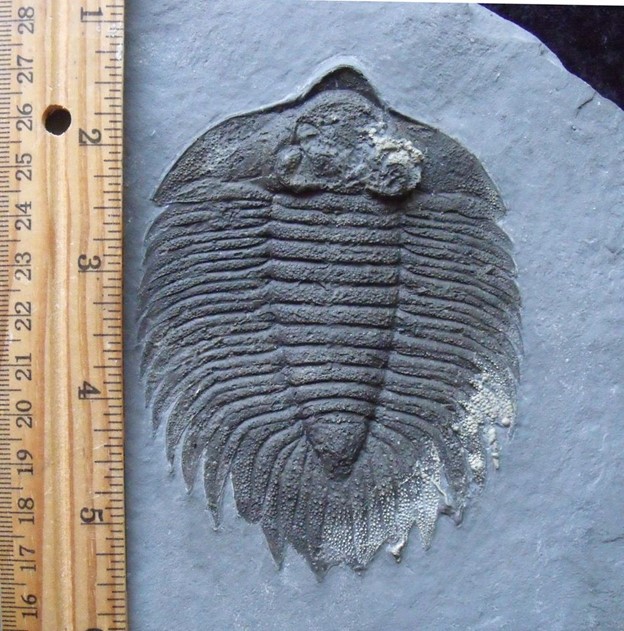
ARCTINURUS
boltoni. An ARCTINURUS from the Silurian
Rochester Shale. Nice exoskeleton and super detail. ARCTINURUS is in the Order
lichida often display grainy texture or have tubercles. Some species have spiny
thoracic segments. Often the pygidia are leaf-like in shape and also typically
end in spines. Highly sought after trilobites. Arctinurus boltoni (Bigsby,
1825) Silurian Period, Rochester Shale, Middleport Quarry. Middleport, New
York.
From
Wikipedia we get this description: Arctinurus
boltoni is a large (up
to 30 cm) lichid trilobite of
the mid-Silurian.
This trilobite reached about eight inches in length, though the normal adult carapace was
about four inches. It lived in moderately deep-water in semi-tropical regions. Arctinurus
fossils have been found in Europe and North America. Arctinurus was
first reported during the construction of the Erie Canal
through soft Silurian shales and mudstones in upstate New York.[1]
Before the late 1990s, complete Arctinurus fossils were very rare. The
vast majority of complete specimens were commercially mined near Middleport New
York, USA, in a shallow quarry in the Rochester
Formation, and the trilobite is now relatively common in
museum, university and private collections. Arctinurus tended to have epibionts
attached to the carapace. Ediacaran
Period—830mya to 541mya Cambrian
Period—541mya to 485mya Silurian
Period—444mya to 419mya Devonian
Period—419mya to 359mya Carboniferous
Period—359mya to 299mya Permian Period—299mya to 252mya
First
Appearance Of Plants On Land Rhynie
shales: We’re
still in Day 5 of our time-dilated calculation for the six days of Genesis 1
(750 million years ago to 250 million years ago). Going into the Devonian Period starting in
419 million years ago and on into the mid-Devonian Period--407 million years
ago--land plants show up in the shales of Rhynie, Scotland. It is paleobotany’s counterpart to the
Burgess Shale. What is amazing is that
plants have had to make a giant genetic and anatomical leap from primitive
algae (850 mya to 720mya), a single-celled plant that forms colonies in water,
and transform from that, from what can only be through a feat of genetic
bio-engineering to what we find in the shales of Rhynie chert. First let’s see what anatomical changes must
be made, and don’t forget, the genes and DNA within them have to be
re-programmed for these changes in anatomy found in the Rhynia plants
found within the Rhynie chert. 1) A
plant (unlike its water-bound cousins from algae to seaweeds) must have a way
of avoiding desiccation, water loss within its cellular structure. 2) Unlike
underwater plants, land plants must have a solid means of mechanical support to
hold them upright. 3) Unlike water-bound plants that can rapidly absorb
nutrients and oxygen from surrounding water, land plants must have a
specialized means of resource acquisition, namely a root system—that will, 1)
anchor the plant in the ground, 2) allow the plant to take up water and
nutrients into the rest of the plant. Rhynia
[https://en.wikipedia.org/wiki/Rhynia]
was an early plant found within the shale of Rhynie, Scotland in 407 million
year old rock. It consisted of naked
photosynthetic axes, pencil-sized structures that ran along the ground and
periodically produced vertical branches that reached upward about 8 inches. The
axes were coated with a thin coating of waxes and fatty acids called cuticle,
that prevented desiccation or loss of water from the plant cells. Like modern plants, it had opening and
closing stomata to allow carbon dioxide to enter and to prevent water
loss. Without cuticle and stomata land
plants wouldn’t be possible. From algae
to Rhynia it took a massive amount of intelligent genetic bio-engineering to
bring oceanic plants, even as advanced as sea-weeds, onto land. And Rhynia plants still lacked wood, leaves
and a modern root system. It had a nob
at the top to distribute spores for reproduction. It also had a primitive plant vascular system
to carry water and nutrients along its horizontal and vertical axes. It photosynthesized water and carbon dioxide
into basic sugars like all plants that would come from it. The formula is C0-2 + H-2-0 = CH-2 +
0-2. So, Rhynia made basic sugar, which
was transformed into cellulose, plus it released oxygen into the
atmosphere. So Rhynie chert preserves
photosynthetic pioneers of modern plants, in what I say is catching God in the
act of a complex bio-engineering project at the gene and DNA level, however he
did it. Fragments of other fossils older
than Rhynia show precursors of land plants made a foothold some 50 million
years before Rhynia, or about 450 million years ago in the late Ordovician
Period. Moving forward from Rhynie
another 50 million years takes us into the Carboniferous Period. But we’re not there yet.
“Continued
Evolution” (or bio-engineering) of Fish Devonian
Period, 419 million years ago to 359 million years ago: the age of fish continues: This is still
Day 5 on our time-dilation scale (750mya to 250mya). Not just known as the age when plants first
appeared on land, but also the age of fish.
Although real fish first appeared in the Ordovician Period, some of
these fish had somehow developed a bone cleithrum forming the posterior margin
of the gill chamber, and also the anchor for the pectoral fins, allowing a
movable joint at the base of these fins in early bony fishes, which would later
function as weight-bearing structures in tetrapods. Lungs before land: Some fish appear with air bladders, which
they used both for buoyancy and breathing, a dual role shared with the
gills. Kenichthys [https://en.wikipedia.org/wiki/Sarcopterygii]
established themselves in waterways and brackish estuaries, becoming the most
numerous of the bony fishes throughout the Devonian Period and most of the
Carboniferous Period. The bones of their
skull roof was broadly similar to those of early tetrapods. Their paired fins had a build quite similar
to the humerus, ulna, and radius of tetrapods in their fore fins and to the
femur, tibia and fibula of tetrapods in their pelvic fins. Primitive tetrapods appear to have been
bio-engineered from the tetrapodomorph
lobed-finned fish sarcopterygian-crossopterygian, Osteolepiformes, [https://en.wikipedia.org/wiki/Osteolepiformes], Fins
to feet: the
oldest tetrapodomorph is Kenichthys from China, dated to around
395 million years old (mid-Devonian) rocks.
The earliest tetrapodomorphs dating from 380 million years ago, were Gogonasus
[https://en.wikipedia.org/wiki/Gogonasus],
lobed-finned fish known from
three-dimensionally preserved fossils found from the Gogo formation in Western
Australia, and lived in the late Devonian Period, and also Panderichtthys
[https://en.wikipedia.org/wiki/Panderichthys]. Comparative biology and molecular sequence
analysis show that tetrapod vertebrates are close relatives of a specific group
called the lobed-finned fishes—the smoking gun pointing toward our Master
Geneticist’s next “Genetically Modified Organism” the Tiktaalik. So a major tetrapodomorph animal is
the Tiktaalik [https://en.wikipedia.org/wiki/Tiktaalik and
https://evolution.berkeley.edu/evo-news/what-has-the-head-of-a-crocodile-and-the-gills-of-a-fish/]. The
morphological gap between fish and tetrapods remains large. Again, what anatomical changes were required
to bridge this gap? Vertebrates
required these changes to go from an aquatic environment onto land: 1) They need lungs to breath air, and big rib
cages, extending from the backbone to support the functioning of the lung’s
muscles to enable breathing. 2) The
bones making up the shoulder girdle had to be separated from the skull. 3) Both structural support of their bodies
and enabling locomotion of land vertebrates required muscular limbs attached to
pronounced pelvic and shoulder girdles separate from the skull. A remarkable discovery was made in
375-million-year-old rocks in Arctic Canada, the Tiktaalik. Tiktaalik had a body resembling
a lobe-finned fish, breathing by gills and lungs, had a shoulder girdle
separate from the skull by a neck, supporting muscles required for limb-like
locomotion and body support. It could
breathe air and capture prey in its jaws, on land and in water. Also fossilized trackways on surfaces of
sedimentary beds provide independent evidence that by the late-Devonian
vertebrates began to colonize dry land (estimated 300 million years ago). The first record of plants on land as we’ve
seen was 407 million years ago, the Rhynia, in the early Devonian
Period. From the Silurian Period on into
the late-Devonian through plants had stabilized in freshwater habitats,
allowing wetland ecosystems to develop, God genetically diversifying plant
species on into the Carboniferous Period, the Age of Plants… Carboniferous
tetrapods—Devonian-Carboniferous transition (350mya)—Romer’s Gap: beginning to
mid-Carboniferous Period. The
earliest confirmed terrestrial forms of tetrapods are known from the
Carboniferous deposits, such as Ichthyostega [https://en.wikipedia.org/wiki/Ichthyostega]. Until the 1990s there was a 30 million year
gap in the fossil record between the late-Devonian tetrapods and the appearance
of tetrapod fossils in mid-Carboniferous amphibian lineages. During this “Gap” tetrapod backbones
developed, as did limbs with digits and other adaptions [genetically modified]
for terrestrial life. For an organism to
live in a gravity-neutral aqueous environment, and then to colonize one that
requires it to support its entire weight as well as all the anatomical changes
necessary required significant genetic modification. We find evidence of this in the
mid-Carboniferous Period when early tetrapods “radiated” (i.e. they were
genetically modified) into at least three to four main branches. Some of these branches of tetrapods were: anthracosaurs
[https://en.wikipedia.org/wiki/Anthracosauria],
which were relatives of modern frogs,
salamanders, etc., Anthracosauria, extinct reptile-like
amphibians, Reptiliomorpha [https://en.wikipedia.org/wiki/Reptiliomorpha],
crocodilian-like aquatic tetrapods also
known as embolomeres, [https://en.wikipedia.org/wiki/Embolomeri]
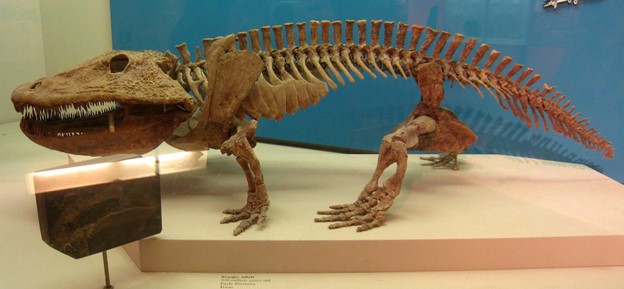
Eryops megacephalus [https://en.wikipedia.org/wiki/Eryops]
Eryops
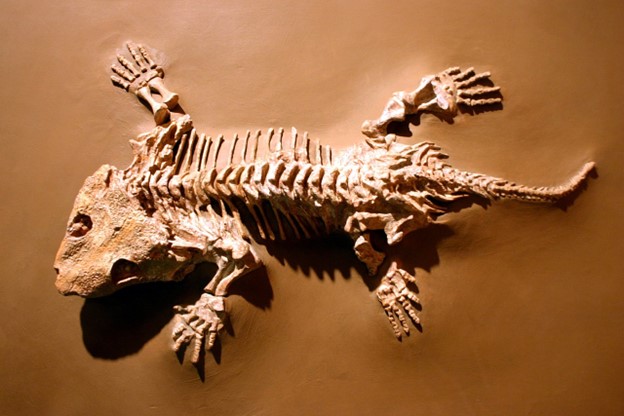
megacephalus Seymouria baylorensis. https://en.wikipedia.org/wiki/Seymouria#/media/File:Seymouria1.jpg Amniotes: late-Carboniferous. Today includes
reptiles, mammals and birds appeared in the late-Carboniferous Period. Going through the Permian Period (299-252mya)
and into the Triassic Period this group (the amniotes) had diversified (via
genetic modification) into the earliest mammals, turtles and crocodiles
(lizards and birds not appearing until the Jurassic Period, and snakes in the
Cretaceous). The
Carboniferous Period around 307 million years ago suffered from about three ice
ages, cooling and drying the planet, causing major plant extinctions, lowering
oceans, killing off many amphibians through loss of habitat. Permian
tetrapods (299mya to 252mya):
amphibia (labyrinthodonts), emnospondyl, anthracosaurs, sauropsida [https://en.wikipedia.org/wiki/Sauropsida]
and synapsida [https://en.wikipedia.org/wiki/Synapsid]. During
the Permian Period the distinction was less clear, amniote fauna being
typically described as either reptile or mammal-like reptile. Permian-Triassic Extinction Level
Event: Probably the most severe mass
extinction event of the Phanerozoic Era (541mya to present), was the largest
known mass extinction, which occurred 252 million years ago at the end of the
Permian Period. In the rocks exposed at Meishan,
China near its base, the limestone bristles with fossils of late-Permian brachiopods [https://www.bgs.ac.uk/discovering-geology/fossils-and-geological-time/brachiopods/],
bryozoans [https://en.wikipedia.org/wiki/Bryozoa],
echinoderms [https://en.wikipedia.org/wiki/Echinoderm],
large skeletalized protists [https://en.wikipedia.org/wiki/Protist],
distributed on the shallow
seafloor. Halfway up the rockface these
fossils disappear, all of them, all at the thickness of a knife-blade. On the upper side of this divide we see only
a few fossils, mainly clams and snails.
What happened? The Siberian
Traps (252 million years ago) [https://en.wikipedia.org/wiki/Siberian_Traps]
located east of the Ural Mountains we
find the geologic evidence of a HUGE, massive outpouring of basaltic rock—the
extent of these eruptions of magma measures about 3,000 square miles, with an
estimated volume of 1 million cubic miles, more than 8,000 feet thick. Radiometric dating shows these huge eruptions
coincide with the dates of the Meishan extinction layer. Volcanic eruptions emit massive amounts of
carbon dioxide into the atmosphere. The
amount released by the Siberian Traps eruptions increased overall
carbon dioxide content of the atmosphere and oceans 7-fold. 1) This would have warmed the atmospheric
temperatures considerably, 2) causing oceanic acidification, and 3) oxygen
depletion (especially in the oceans).
Land-based respiring animals and plants would have weathered this pretty
well, but in the oceans the effects, as evidenced in the Meishan rocks, was
pretty devastating. Clams, snails and
fish experienced few extinctions, doing fairly well, including decapod
crustaceans such as shrimp, crabs and lobsters.
Most of the other pre-Triassic ocean species died out, leaving us with
many of the modern species we’re familiar with.
Soils As
land-based plants took over the landmass of the continents the interaction of
roots, fungi, accumulating plant debris and microbes, bacteria and later
earthworms, releasing organic acids, created the soils needed for further plant
growth all the way through the Devonian, Carboniferous and Permian Periods, and
on into the Mesozoic Era of the dinosaurs.
Much of Earth’s coal formed from plant debris in wetlands from the
Carboniferous Period. Giant insects, as
well as giant tree-sized ferns and mosses over 100 feet tall grew in this
period. Day
6—250 million years ago to present “Day
six, Genesis 1:24-27: (From
Genesis) The land animals became dominant, and God created man in his own
image. Paleontology and science: 250,000,000 years ago until the appearance of
Adam. Well 250 million years ago there
was a mass extinction (the Siberian Traps eruption), 90 percent of life on
earth died, followed by a rapid repopulation, land animals now predominating. That was the Permian-Triassic event. Depending on how you defined them, there have
been between 5 and 20 E.L.E.s or Extinction Level Events (like in the movie Deep Impact but worse). Anyway, about 35 million years later, around
250,000,000 years ago, the dinosaurs appeared and dominated life on earth for
about 150,000,000 years. Then 65,000,000
years ago another E.L.E. occurred, this one known as the KT Extinction, which
killed off the dinosaurs. [Comment: Some think all life on the planet, down to
the plankton level in the world’s oceans was killed off during this KT
extinction level event. But according to
recent paleontological evidence, not all life died off during the KT-barrier
extinction level event. See http://www.unityinchrist.com/dinosaurs/dinosaurs.htm,
which describes this E.L.E. Some believe
the E.L.E.’s point to specific creations and recreations of life on earth,
plural, and not necessarily macro evolution of the various species, as we’ve
seen before, in the Gap Theory explanation.]
And this opened the way for mammals and birds to become dominant, and
then the first hominids, and finally human beings as we know them
appeared. Today the Cosmic clock continues
to tick to measure the passage of time at the Cosmos level. And as the universe continues to expand, the
rate at which it measures time continues to slow. But that doesn’t mean anything to us
now. From the moment God breathed life
into Adam and when God gave man his soul, we on earth have denoted the passage
of time by our earth-based clocks, where one second is part of one day, which
reflects the rotation of earth on it’s axis, and a year that marks the
completion of one earth circuit of the sun.
What if there isn’t any God? The
idea that Moses or anyone else at the time Genesis was written, when most
people believed the world was flat, that could have created a story that so
perfectly reflects what science has proven to be true, all on its secular own
(without God), to believe that, for me anyway, is harder then to believe in
God. What we are talking about here
today is a result of applying proven science to the issue. This is a scientifically derived answer to
the question with no spin or subjective interpretation. So you see, science and it’s 15.75 billion
years and the six days of Genesis are in complete accord. Science has proven what religious leaders
have been unable to prove for thousands of years. But in reality science has just caught up
with the truth of the Bible. Science has
simply deciphered the Genesis code. I
think what I find most amazing about this is the uncanny brilliance of Biblical
Genesis, which is presented to us in such a way that mankind had to evolve to
its current level before we were able to understand the story as it was
originally written. That’s it!” (quoted from the movie The Genesis Code,
Copyright © 2010 American Epic Entertainment, LLC, all rights reserved. © 2010
Genesis Productions LLC, 22 Harbor Park Drive Port Washington, NY 11050) transcript of the physics section of
the movie The Genesis Code, with
slight editing for clarity. All the
other information was taken from various Wikipedia sources and Andrew Knoll’s
incredible paleo-geologic history of Earth, titled “A Brief History of
Earth, (four billion years in eight chapters)”] Next, from the fossil
record found in the rocks for Day 6: The Mesozoic Era—The
Age of Dinosaurs The
Mesozoic Era encompassed the period of time from 252 million years ago to 66
million years ago, from the Triassic Period, Jurassic Period and through the
Cretaceous Period. Diapsids [https://en.wikipedia.org/wiki/Diapsid],
a large reptile group including lizards,
snakes, crocodiles, dinosaurs and pterosaurs began to, as the evolutionists
call it, “diversify” during the Triassic Period. i.e. the amphibian species we’ve looked at in
the Permian Period were “genetically modified” into the diapsid group
just mentioned. During the Triassic
Period, one group called Cynodontia [https://en.wikipedia.org/wiki/Cynodont]
gave rise to Mammalia (which survived the K-T Barrier extinction into our
present Cenozoic Era). Within the 50
million years of the Triassic Period tetrapod diversity (by way of genetic
modification) came to include both carnivores and herbivores, divided between
amphibians (crocodile-like reptiles) and amniotes (reptiles, birds, turtles and
mammals). Dominant trees were conifers,
Ginkos and other seed plants with ferns only playing a minor role. These “modern” plants radiating via genetic
modification out only in the late Jurassic Period and into the early Cretaceous
Period (150-140 million years ago), along with pterosaurs and
dinosauromorphs. The Triassic landscape
(252-201mya) was filled with agile large reptiles, both carnivores and
herbivores, but not true dinosaurs, which were not in abundance or
diverse. Dinosaurs rose to prominence
because they survived the late-Triassic extinction level event, another major
volcanic eruption like the Siberian Traps, but this one extended from Fingal’s
Cave in Scotland to the Palisades of New York to the Black Cliffs of Morocco’s
Atlas Mountains, and on into the Amazon rain forest. An estimated 40 percent of all genera and up
to 70 percent of species disappeared from the oceans. On land Triassic diversity of vertebrates was
cut way back by this volcanism including diverse crocodilians. But dinosaurs and mammalian ancestors
survived and expanded filling the gaps left by the extinction of other land
species. [Why Were Triassic Animals so Weird? https://www.youtube.com/watch?v=QGy4fh81INU] [https://www.youtube.com/watch?v=y7jSOp2mr2s] Dinosaur
sizes: Dinosaurs tended toward large
sizes, the large sauropods [https://en.wikipedia.org/wiki/Sauropoda], What Was the Earth Like When Dinosaurs Were Around? https://www.youtube.com/watch?v=n_teJd4-GGw
Triassic Period—252mya to 201mya
Jurassic Period—201mya to 145mya
Cretaceous Period—145mya to 66mya
Large
sauropods were genetically modified to have long necks enabling them to feed on
large amounts of treetop sources of food with ease. Their necks and skeletal structures were
designed with bird-like hollow spaces, keeping them light and strong, allowing
for long necks. The heads of these
herbivore sauropods with these long necks were designed to be small, keeping
weight down, again allowing for long necks with a proper weight to muscle
strength to allow for this length.
Again, their DNA and genes just didn’t up and decide to produce longer
necks with a strong but lightweight skeletal structure with small heads at the
end of them. That “blind evolution”
could have achieved this perfection of design is quite hard to believe. The Titanosaurs reached up to 120 feet (37m)
in length and weighed 70 to 90 tons.
Their remarkable necks enabled them to reach food not available to other
plant eaters. Unlike crocodiles, some of
which did survive the end-Triassic E.L.E., the large dinosaurs (carnivore and
herbivore) had a bird-like respiratory system, allowing for a far greater
transport of oxygen through their huge bodies.
Sauropods had high metabolic rates, enabling rapid growth from egg to
full-sized adult dinosaur. Due to the
size verses volume of their cellular mass, their metabolism gave them internal
temperatures ranging from 97 to 100 degrees F., much like modern living
mammals. As sauropods were modified into
these large sizes, the carnivores went through similar “genetic modification”
into larger sizes, thus maintaining a balance between herbivores and
carnivores. Early mammals lived in the
same communities with the dinosaurs, but they were small, enabling them to keep
out of their way, unnoticed as it were.
As Huxley said in 1868 “The road from reptiles to birds is by way of
Dinosauria…wings grew out of forelimbs” (I’d say by genetic modification, of
course). A small dinosaur found in
late-Triassic and early Jurassic rocks was the Archeopteryx [https://en.wikipedia.org/wiki/Archaeopteryx],
the skull modified to resemble the bills
of birds, but jaws lined with teeth, and it was covered in feathers. The dinosaur-bird connection has been
reenforced by dozens of new discoveries in Cretaceous beds in China, dinosaurs
closely related to birds sporting feathers and elongated limbs, again, later
genetically modified to be able to fly.
Pterosaurs were the first to fly, being flying reptiles, some of immense
size, but with lightweight hollow skeletons.
Soon these “birdomorphs” would follow. [How the Tyrannosaurs Ruled the
World – with David Hone, 201mya to 66mya, https://www.youtube.com/watch?v=f-jD7kQvyPs]
[Cretaceous
Era (Part one) : The pinnacle of the dinosaurs reign, https://www.youtube.com/watch?v=TGHD6AXixs8
and https://www.youtube.com/watch?v=V-8ZQuZcyMo]
K-T
Barrier Extinction In
the town of Gubbio, Italy the rocks on the canyon walls reveal layer upon
layer, as you go up the canyon walls, of calcium carbonate, limestone, filled
with microscopic fossils dating to the Cretaceous Period. Above hundreds of these limestone beds a thin
layer of clay appears. Above this layer
very few of those microfossils appear that are below this clay layer. This line of clay dates to 65-66 million
years ago. Naturally occurring iridium
is a radioactive element found mainly in meteorites and micrometeorites. It is not a naturally occurring element found
on earth’s surface outside of its meteorite source. This iridium is deposited all around the
world at a steady slow rate. Within
these layers of limestone above and below this layer of clay a steady low rate
of iridium deposit is found. But Walter
Alvarez and his father Luis Alvarez discovered that the amount of iridium
levels within this layer of clay were much higher and apparently deposited all
at once. From the levels of iridium, the
Alvarez’s were able to calculate the size of the meteorite that struck the
Earth 66 million years ago, and it calculated out to be about 7 square miles in
diameter. Travelling at the estimated
speed of comets, which travel at 40,000 miles per hour, this thing struct what
is now the Yucatan Peninsula on the Mexican Gulf of Mexico, carving out an
underwater crater 125 miles in diameter.
All the dinosaurs died out, some within the fiery blast range,
immediately, others died within weeks, as Earth’s lush vegetation died out
sufficiently due to the “nuclear winter” effects, starving to death on a
rapidly cooling planet. Fish fared
better, as evidenced by the living fossil, the Coelacanth, a lobed-finned fish
only seen in fossil rocks older than 66 million years ago, until one was caught
off South Africa by a fisherman in his nets in 1938. Crocodiles, dating back to the Triassic
Period, survived as well, as some of their primary food sources, fish,
survived. Mammals as well survived away
from the blast zone—with God again resuming his project of genetic
modification, giving us all the modern Cenozoic species of land plants and
animal species we’re familiar with.
Andrew Knoll, in his wonderful and excellent book “Brief History of
Earth” says this about Earth’s extinction level events, and I quote: “Common
causation is out of the window—different events relate to meteorites, ice ages,
and massive volcanism. Where we do
find common ground is that in each case, environmental disruption was rapid;
the rate of environmental change was as important as its magnitude. When environmental change is slow,
populations can adapt [through population genetics and natural selection] to
their shifting circumstances, but when it is fast, leaving migration or
extinction as the only available options.
Mass extinctions reflect transient but profound environmental
disruption, driven by mechanisms within the Earth or elsewhere in our
neighborhood. While the timescale of
mass extinction is short, however, rebuilding diversity is more protracted—fossils
tell us that recovery from major extinction takes a long time—hundreds of
thousands or even millions of years.
Mass extinctions have clearly played a major role in shaping
evolutionary history. The modern world
is full of animals in part because dinosaurs became extinct. Fish in open ocean radiated only after
end-Cretaceous mass extinction eliminated ammonites. Reefs today contain modern corals, mollusks,
and crabs not so much because they outcompeted the tabulate corals,
brachiopods, and trilobites, but because mass extinction decimated those
groups. When you trek through a rain
forest or snorkel above a coral reef, you might reflect that you’re surveying
the survivors of Earth’s repeated mass extinctions.” [Why did
Crocodiles Survive and Dinosaurs Die? https://www.youtube.com/watch?v=Gan8Vu4oM0w,
Last Days of the Dinosaurs, https://www.youtube.com/watch?v=UChQHrjefVU
and https://www.youtube.com/watch?v=Mt5wzzmprMo]
Still
Day 6--252 million years ago to present After
the K-T Barrier Extinctions: the Cenozoic Era Following
the catastrophe of this huge meteorite impact, as the initial fires died down,
the surviving species diversified into all the species we’re familiar with by
way of God’s genetic modification processes.
Over the next 15 million years the planet warmed due to the large rise
of carbon dioxide in the atmosphere, the result of 500,000 years of volcanic
eruptions on the Indian subcontinent, the Deccan Traps [https://en.wikipedia.org/wiki/Deccan_Traps],
perhaps set off by the Yucatan meteorite impact. As a result you had palm trees and alligators
in Alaska and the Canadian Arctic. With
the extinction of dinosaurs Earth became safely available for the spread and
growth of all the Mammalian species we see today. The continents spread out as the
super-continent Pangaea broke up, giving us the Atlantic Ocean, the Rockies,
Alps, and Himalaya Mountain ranges. As a
result of weathering rates as rocks reacted to rain, and these higher
atmospheric levels of carbon dioxide reacting in solution to water forming
carbolic acid, ate away with the rocks exposed on the continents. This carbolic acid then reacted with calcium
ions in the ocean to precipitate CaC0-3, calcium carbonate. This process scrubbed the excess carbon
dioxide out of the atmosphere, gradually lowering Earth’s temperature. Palms, alligators and all warmth-loving
species moved south. By 35 million years
ago, 30 million years after the K-T Barrier extinction, glaciers began to
spread across Antarctica. Hominins
to Man The
record of the rocks shows primates, genetically modified into diverse but
related species such as lemurs, tarsiers, monkeys and the primates Homo
sapiens descended from, the great apes. 6 to 7 million years ago in the African
continent a new lineage of great apes was “genetically modified” from what
later became chimps and bonobos. These
were called hominins [https://en.wikipedia.org/wiki/Hominini],
which were broadly chimp-like, but these hominins were distinct in
one critical way, they could walk upright. Genetic modification obviously took
place that resulted in these anatomical changes that would lead to the “Homo”
species being able to walk erect, giving a posture enabling upright locomotion. These were those anatomical changes: 1) a
curved spine to balance the upright trunk, 2) a reconfigured pelvis to
facilitate muscles needed for walking, 3) a vertical oriented neck that places
the head atop the body, 4) and an arched foot with a prominent heel. We all have these features, as do all
hominins, even the earliest ones.
Fragments of their skeletons appear in 6 to 7 million year old rocks. But the best complete skeleton shows up in
the 4.4 million year old rocks of Ethiopia, Ardipithecus ramidus, Ardi
for short [https://humanorigins.si.edu/evidence/human-fossils/species/ardipithecus-ramidus]. Ardi could climb but could also walk upright,
being capable of bipedal locomotion.
About a million years later than Ardi, 3.2 million years ago a group of hominins
appears in the record of the rocks, Australopithecines [https://en.wikipedia.org/wiki/Australopithecine]. Australopithecine
bones are fairly common, but again, an excellent full skeleton was discovered
and named “Lucy.” [https://en.wikipedia.org/wiki/Lucy_(Australopithecus)]
“Lucy” was discovered in 3.2 million year old rocks in Ethiopia, she had larger
hips, larger brain, arched feet, and a short big toe, and walked upright with
greater ease. Mary Leakey discovered an
amazing set of footprints of a man, woman and child in 3.7 million year old
rocks in Tanzania, walking across what was once wet volcanic ash in a 90-foot
trackway, later buried in another layer of ash.
These footprints were of Australopithecines. Other evidence shows Australopithecines were
fashioning primitive tools of stone.
[Here’s an interesting speculative article about what Australopithecines
may have been like: https://nautil.us/portrait-of-the-human-as-a-young-hominin-18441/?utm_source=pocket-newtab] See video “The History of Hominins,” at: https://www.youtube.com/watch?v=EcNeajTqzdI
Time
Chart For Appearance of Man Basic
hominins appear: 6-7 mya Ardipithecus
ramidus, “Ardi”: 4.4mya Australopithecines,
“Lucy”: 3.2 mya First
tools crafted: 3.3 mya Australopithecines,
4.4 mya—to Homo erectus, 1.9mya Homo
erectus, 1.9mya to 250,000 ya—to 250,000 ya—(living firmly on the ground,
hunting and food gathering, Earth sliding into an Ice Age)— To
Homo sapiens, 300,000 ya to now. Homo
sapiens shared Ice Age Earth with three other Homo species: Neanderthals (sophisticated
hunter-gatherers) Homo florensiensis (a diminutive
relative named “the Hobbit”) Denisovians—50,000 ya to 30,000 ya All
four species occasionally interbred Neo-Darwinism: Population Genetics “In
1944 George Gaylord Simpson wrote Tempo and Mode in Evolution. Simpson argued that evolution patterns
defined by fossils reflect population genetics [https://en.wikipedia.org/wiki/Population_genetics]
as the mechanism underlying natural selection and hence evolutionary change
through time” Andrew Knoll states in his wonderful book on the paleo-geologic
history of the Earth, “Brief History of the Earth, Four Billion Years In
Eight Chapters.” But taking into
consideration the incredible leap in anatomical change species have taken, from
say for plants, going from single-celled algae living in water to the
complexity of Rhynia on land over 2.5 billion years later, 407 million years
ago, and then multiplying in diversity of plant complexity in all the
plant-life in the Devonian through the Carboniferous Periods can never be
properly explained by population genetics combined with natural selection. And the same applies to the singled-celled
animal protozoans “evolving” by population genetics combined with natural
selection to become all the diverse animal species in the Cambrian oceans,
evolving then into fish, clams, shrimp, crabs and lobster-like crustaceans
through the Ordovician, Silurian, Devonian, Carboniferous and Permian seas—all
the way to fish becoming amphibian air-breathing tetrapods, and then becoming
fully land-dwelling tetrapods—four-legged animals roaming the terrestrial
Earth. Population genetics coupled to
natural selection can never properly account for these massive
genetic and anatomical changes that early single-celled ocean-dwelling life
went through to become what we see later in the geologic-fossil record or what
we see on Earth today. Population
genetics, combined with natural selection, can explain
why modern corals, which everyone predicted were going to die off in rapidly
warming oceans, why these corals in Hawaii and Australia’s Great Barrier Reef
can now tolerate temperature rises of more than 2 degrees C. Population genetics and natural
selection can explain why a volcanic caldera lake in the
Philippines, that used to be connected to the saltwater ocean—filled with
saltwater species of fish, including Jacks—and during an eruption about 100
years ago got cut off from the ocean, and slowly turned from brackish to
freshwater—that over that 100+ years the fish in this caldera lake became
totally adapted to freshwater.
Population genetics and natural selection can and does explain how that
was possible. But population genetics
cannot properly explain how algae “evolved” into land plants and then trees,
grass, shrubs and all the plants we have on Earth today. Another thing, all the biota of each Era and
Period of time in the paleo-geologic record was a totally balanced biota, a keen
and incredible balance between herbivore and carnivore species and between
plant and animal species, from the beginning of life on Earth right up to
now. Riley Black, in her
incredible book “The Last Days of the Dinosaurs” made this
statement, which proves my thesis that there are genetic “gene switches” which
can be turned on and off. She believes
these “gene switches” have only been turned on or off by mutations, but my
premise is that from the first creation of the proto-cellular life by an
all-wise God, bio-engineering by the turning on and off of genetic “gene
switches” has been creating via “theistic evolution” the various biota of life
down through the geologic ages. Although
Riley Black believes in blind evolution, I find that hard to believe in, given
the complexity of life throughout the geologic record and all these balanced
biota throughout the ages, to say nothing of the complexity of the DNA code of
life, which to me points to intelligent design of a Master geneticist. She made a statement which points to the
flipping of genetic “gene switches” which in my estimation points to a Master
geneticist bringing about the “theistic evolution” of all life on the planet,
past and present. She stated “Nor
can birds evolve to have teeth or claws.
The genes for these weapons and tools are still in their bodies, but
they have been shut off by mutations [she says mutations, I say by the Master
geneticist, God Almighty] and slowly degraded over time. There is no evolutionary switch that can just
turn them back on.” That last
sentence is no longer true for GMO geneticists in the lab, they can turn those
ancient gene switches back on, they just haven’t chosen to do so at
present. If a PhD level geneticist can
do that, God as a Master geneticist can certainly control the theistic
evolution of the species down through the ages, creating whatever balanced
biota he wishes. [quote, emphasis mine, “The Last Days of the Dinosaurs” by
Riley Black, p. 183] “What
Is A Genetic Engineer?” “Genetic
engineers are highly trained experts who use a variety of molecular tools and
technologies to rearrange fragments of DNA.
The overall goal in doing so is to add or remove an organism’s genetic
makeup for the better, or to transfer DNA code from one species into the
other. The overall goal of this is to
enhance organisms so that they are better able to thrive in certain
environments. An example is when a plant
is modified to thrive better in drought conditions… “Education
and Training” “To
become a genetic engineer, the bare minimum education requirement will be a
Bachelor’s degree in biochemistry, biophysics, molecular biology, or molecular
genetics. However, in most cases it will
be much more beneficial to have a Master’s or Doctorate level degree in
molecular genetics or molecular biology instead. Undergraduate degrees may provide an initial
entry point into the field, but holding a PhD is the primary path used to enter
the field and conduct your own work.” “How
Are GMO’s Made?” “GMO
(genetically modified organism) has become the common term consumers and
popular media use to describe foods that have been created through genetic
engineering. Genetic engineering is a
process that involves: 1) Identifying the genetic information—or “gene”—that
gives an organism a desired trait. 2) Copying that information from the
organism that has that trait. 3) Inserting that information into the DNA of
another organism. 4) Then growing the new organism.” [from www.fda.gov/food/...] Of
the animals geneticists have modified are pigs, chickens, cows, and salmon
(which grow to full size in half the time).
I recently heard that a geneticist discovered a “dormant” gene in
chickens, which if triggered, caused the chickens to grow teeth, a
bio-engineering feat which would walk the chicken back toward its raptor
ancestors from which it came. My point
is, genetic change over eons of time has not been through “blind evolution,”
but has been the work of a Master Geneticist, the Creator God of the Universe
and all terrestrial and aquatic life on planet Earth. Be sure to order your own copy of the
movie “The Genesis Code” at: “A
Brief History of Earth, Four Billion Years in Eight Chapters” by Andrew H.
Knoll, Custom House, © 2021” See:
A Brief History of Geologic Time: https://www.youtube.com/watch?v=rWp5ZpJAIAE Six
Days of Genesis 1 By Time-Dilation of Relativity Length of Day Day 1 = 15.75 bya to 7.75bya (8by) Day 2 = 7.75bya to 3.75bya (4by) Day 3 = 3.75bya to 1.75bya (2by) Day 4 = 1.75bya to 750mya (1by) Day 5 = 750mya to 250mya (500my) Day 6 = 250mya to present (250my) Six Days of Genesis 1
15.75 billion years HADEAN
EON: from 4.544 to 4.0 billion years ago [see
A Brief History of Geologic Time: https://www.youtube.com/watch?v=rWp5ZpJAIAE] ARCHEAN
EON: from 4.0 to 2.5 billion years ago PROTEROZOIC
EON: from 2.5 billion years ago to 541 million years ago. (2.4 billion
years ago, oxygen levels rise.) PHANEROZOIC
Eon: 541 million years ago to present Paleozoic
Era (541
million years ago to 252 million years ago) Cambrian
Period: 541 million years ago to 485 million years ago Ordovician
Period: 485 million years ago to 444 million years ago Silurian
Period: 444 million years ago to 419 million years ago Devonian
Period: 419 million years ago to 359 million years ago Carboniferous
Period: 359 million years ago to 299 million years ago Permian
Period: 299 million years ago to 252 million years ago Mesozoic
Era (252
million years ago to 66 million years ago) Triassic
Period: 252 million years ago to 201 million years ago Jurassic
Period: 201 million years ago to 145 million years ago Cretaceous
Period: 145 million years ago to 66 million years ago Cenozoic
Era (66
million years ago to present—earliest fossils of man appear 6-7 million years
ago) Was
It Six Days or 16 Billion Years?
As Pastor Chuck Smith said, “There are
many fine men of God who teach that the earth is young, having only been
created less than 10,000 years ago. One
of their strong arguments in favour of a young earth comes from Exodus 20:11,
which states, “For in six days the LORD
made the heavens and the earth, the sea, and all that is in them.”” But as we have seen, six days by whose “frame
of reference”? If it’s from God’s frame
of reference, outside of Space & Time, taking into account Einstein’s Laws
of Relativity and Time Dilation, we have clearly seen those six days amounted
to 15.75 billion years as observed from our frame of reference, but not
God’s. According to those who promote
‘the Gap Theory,’ a whole series of “re-creations” of life have taken place
after the huge E.L.E.’s had destroyed it from off the planet. So we see that according this Gap Theory, a
specific 6-day recreation of life can easily have taken place, using Genesis
1:1-31 as a template for the literal six-day creation account as well. One template, the smaller 6-literal-day
recreation, fits neatly within, inside the larger template for Genesis 1, that
of the 6 P.O.T.’s, or epochs, which add up to 15.75 billion years. Which
Interpretation For Genesis 1:1-31 Is Correct? “Creation of the universe and
all life, 6 days or 15.75 billion years, Gap Theory with separate creations for
each epoch, or Theistic evolution after the specific creation of cellular life
3.5 billion years ago until now, it doesn’t matter—the irreducible complexity
found within each living cell proves creation and intelligent design took place
at the cellular level, and all at once—whether that be in six days as we count
time, or 3.5 billion years ago, as geologists have found. The method and timing God used after that is
totally immaterial beyond the provable specific design and creation of the
irreducibly complex internal structure of the living cell. Different parts of the greater Body of
Christ waste precious money, time and effort in their attempts to prove the
methods and timing God used to create the universe and all life on earth—and
that their pet theory is correct above all the others. Many of them even refer to other
interpretations as blasphemous. Those
who go this far in their dogmatic interpretations only serve to disunite the
Body of Christ. The efforts to
add up and try to interpret the geologic evidence, coupled to physics in an
honest attempt to interpret Genesis 1:1-31 is perfectly fine, as long as those
doing it avoid being totally dogmatic in their interpretation, and instead say
“this is our best guess interpretation.” Personally, I can see via the
irreducible complexity of the internal structure of the living cell, that it
was designed and created all at once.
Whether Genesis 1:1-31 was a 15.75 billion year “time-dilated 6 days,”
or a literal “6 days,” by our human reckoning of time is immaterial. Trying to prove one’s own interpretation of
Genesis 1:1-31 is correct and everyone else’s is wrong is totally divisive to
the greater Body of Christ and a total waste of time and precious resources
which could be used for the promotion of the Gospel, which is Jesus’ central
command for the Church (cf. Matthew 24:14; 28:18-20). You’ve
just been given three distinct interpretations for Genesis 1:1-31, one literal
24-hour/day creation; the Gap Theory interpretation; and Time-Dilation coupled
to “theistic evolution” via God “genetically modifying” all lifeforms from 3.5
billion years ago to the present, through all the geologic Eons, Eras and
Periods of Earth’s fossil record. It
does not matter which interpretation you believe, “Young-Earth, Literal”,
“Gap-Theory,” or “Time-Dilation coupled to Theistic Evolution,” it will not
jeopardize your salvation in any way, if you are a firm believer in a Creator
God that created the heaven and the Earth and all lifeforms in it, past and
present, and that you’ve accepted Jesus Christ into your life as your Saviour,
and God’s Holy Spirit dwells inside of you.
Simply put, you believe that Jesus was born of a virgin, lived a perfect
life, died on the cross to pay for your sins, and was resurrected back to life
(immortal life) after three days and three nights in the grave, and that he’s
coming back to Earth—that is the Gospel in a nutshell. If you believe that and have accepted Jesus
into your life, that is what matters. It
does not matter one single bit which interpretation you believe about Genesis
1:1-31, which by the way, was written in Poetic Hebrew. Genesis 1 is written, again, in Poetic
Hebrew, and merely states that God did the creating—IT IS NOT A
PROOF-TEXT PROVING THAT GOD EXISTS OR THAT HIS WORD IS TRUE—FULFILLED PROPHECY,
VERIFIABLE IN SECULAR HISTORY BOOKS, IS THE ONLY SOUND PROOF THAT GOD EXISTS
AND THAT HIS WORD IS TRUE.
Genesis 1 is a skeletal outline detailing God’s creation of the heavens
and Earth and all life found on it at present, and that outline is written in
poetic Hebrew. It is not a proof-text
into the scientific creation of the heavens, Earth and all lifeforms, past, and
present. The literalists, God love-‘em,
that try to prove that dinosaurs walked with man, are idiots, and waste their
time, money and that of others focusing on a subject we’ll all have cleared up
at Jesus’ 2nd coming—instead of focusing on what Jesus told us all
to be doing, preaching the Gospel to the entire world while there is yet time
(cf. Matthew 24:14-15; 28:18-20). To see
solid proof that the Bible is true and that God exists, that his Word is true,
see https://unityinchrist.com/ProofOfTheBible-FulfilledProphecy.htm. And considering this past war between
Vladimir Putin’s Russian Federation and the Ukraine, there may not be much time
left before the great tribulation, World War III. Let’s not be spending that precious time we
have left arguing about whether man walked with dinosaurs or the literal age of
the Earth or Universe. Related links: “A Brief History Of Earth, Four Billion
Years in Eight Chapters” by Andrew H. Knoll A Brief History of Geologic Time: https://www.youtube.com/watch?v=rWp5ZpJAIAE Radiometric
dating: https://en.wikipedia.org/wiki/Radiometric_dating Formation
of earth’s solid iron core 550mya aided in protecting life from the Cambrian
Period onward, see: https://www.theguardian.com/science/2022/jul/03/explosion-of-life-on-earth-linked-to-heavy-metal-act-at-planets-centre?utm_source=pocket-newtab See, http://www.unityinchrist.com/dinosaurs/molecularmachines.htm Or order and read “Darwin’s Black Box”(from http://www.amazon.com)
To see solid proof that the Bible is
true and that God exists, that his Word is true, see https://unityinchrist.com/ProofOfTheBible-FulfilledProphecy.htm Was Genesis 1:1-31 Written in a type of Poetic Hebrew, Not
Literal? “One
Biblical scholar from way back in the 1890s and early 1900s who evangelicals
widely respect, named Milton S. Terry, literally wrote the book on Biblical
Hermeneutics, with a book by that title. Bible scholars look to him as the one who
originated the historical-grammatical method of hermeneutics (interpretation).
What many of them don't know is that he also wrote a book called Biblical
Apocalyptics, in which, while using those now-standard methods, he
identified the first 11 chapters of Genesis as "Hebrew
Apocalyptics," that is, a form of ancient literature that uses figures
and symbols more than historical realities to convey its message. So that’s one reason to consider those
chapters in a non-literal sense so that we can instead focus on what the writer
was really trying to say. In the case of
Genesis 1, you have a framework being used that shows three days of “forming”
followed by three days of “filling,” with day 1 corresponding to day 4, days 2
to day 5, and day 3 to day 6. All this contributes to a picture the writer is
giving us in figurative form, rather than historical or scientific, long before
anyone had our modern conceptions of history or science.” (Fred Heeren) Geology Of The Earth & Its
Lifeforms Before Adam In the sermon transcript that follows in the link below, what I think Dr.
Hoeh is stating is that Mr. Armstrong believed God had used angels, those that
were under Lucifer to “complete his creation,” meaning the creation of life on
earth, terraforming the planet with life, after God’s initial creation of the
primitive living cell. This would have
involved genetically modifying lifeforms starting with the cell and going all
the way up through complex plant and animal lifeforms, starting in the oceans
during the Ediacaran and Cambrian periods, right up to the Cretaceous dinosaur
age, and then right up through the bio-engineering of early man to homo
sapiens. Considering what we’ve heard
about how Lucifer sought alternatives to God’s way of Give, alternatives that
involved competition, lying and murder, when viewing the lifeforms presented to
us in the record of the rocks, the fossil record, lifeforms appear to have been
designed to compete with each other, violently, instead of peacefully
coexisting with each other, like the picture painted for us in Genesis 2, in the
Garden of Eden, whose lifeforms, including Adam and Eve, appear to have been created directly by God, and
probably within a literal 6-day span of time.
God would, and this is speculation, we’ll find out if it’s true and to
what degree it’s true, but God would present the angels and Lucifer with the
schematics for the modifications of lifeforms God wanted to see brought about,
as time went along, from one period to the next. It was those angels carrying out the
schematic plans, bio-engineering the changes into those lifeforms, who also
bio-engineered into them the way of competition, the way of get, rather than
cooperation. So Dr. Hoeh, by observation of the geologic record, coupled to the
Biblical teachings about angels and the devil, what he’s proposing, postulating
is that God used the angels who followed Lucifer, who were under his authority,
to “theistically evolve,” create, bio-engineering the lifeforms--from beginning
to end, right up to, but I’d say not including what God created in the Garden
of Eden. If so, this probably took place
after God created the first living cell, cellular life, the cell being a highly
complex organism, even the first primitive ones (DNA itself being highly
complex). Thus the cell had to have been
created all at once, and by God himself.
Then through genetic “gene-switch-throwing,” all lifeforms to follow
essentially were GMO’s, genetically modified organisms, from the pre-Cambrian
period, up through all the other periods of time, including the bio-engineering
of primitive man. It’s my guess,
that inside of the Garden of Eden, all lifeforms, including that of Adam and
Eve, were created directly by God, within six literal days, again, all living
within the confines of that Garden, wherever it was. Outside that Garden were all the lifeforms we
find in the Quaternary period, including early man, Denisovians, Neanderthals,
Australopithecines, some lines dying off in obvious competition beforehand,
others melding in with the last development, the homo sapiens. DNA from Denisovians and Neanderthals has
been found in the modern DNA of humans.
But the line from Adam came through the line of Noah, surviving the
Flood, and that line had included within it, through the wives of Noah’s three
sons, some of the interbreeding that took place between the sons of Adam and of
those homo sapiens who resided outside of the Garden of Eden, thus explaining
the trace elements of Neanderthal and Denisovian DNA found in that of modern
man. I am merely putting within Dr.
Hoeh’s sermon here updates, bringing what he is saying up to date with modern
discoveries, and making his ideas clear, showing their intent where his sermon
may not have been that clear. Dr. Hoeh
was a very honest historian, and as you can read here, whenever he found
himself to be in error, he corrected that, as he went on in life, teaching and
researching at the Worldwide Church of God’s Ambassador Colleges. To read Dr. Herman L. Hoeh’s 1977
sermon I’ve titled “The Geology Of The Earth & Its Lifeforms Before
Adam” log onto: https://unityinchrist.com/wwcofg/GeologyOfTheEarthBeforeAdam.html
|