




|
Joshua
14:1-15 “And
these are the countries which the children of Israel inherited in the
land of Canaan, which Eleazar the priest, and Joshua the son of Nun, and the
heads of the fathers of the tribes of the children of Israel, distributed for
inheritance to them. 2 By
lot was their inheritance, as the LORD
commanded by the hand of Moses, for the nine tribes, and for the half
tribe. 3 For
Moses had given the inheritance of two tribes and an half tribe on the other
side of Jordan: but unto the Levites he
gave none inheritance among them. 4
For the children of Joseph were two
tribes, Manasseh and Ephraim: therefore
they gave no part unto the Levites in the land, save cities to dwell in,
with their suburbs for their cattle and for their substance. 5
As the LORD
commanded Moses, so the children of Israel did, and they divided the land.
6 Then the children of Judah came unto
Joshua in Gilgal: and Caleb the son of
Jephunneh the Kenezite said unto him, Thou knowest the thing that the LORD
said unto Moses the man of God
concerning me and thee in Kadesh-barnea. 7
Forty years old was I when Moses
the servant of the LORD sent
me from Kadesh-barnea to espy out the land; and I brought him word again as it
was in my heart. 8 Nevertheless
my brethren that went up with me made the heart of the people melt: but I wholly followed the LORD
my God. 9 And
Moses sware on that day, saying, Surely the land whereon thy feet have trodden
shall be thine inheritance, and thy children’s for ever, because thou hast
wholly followed the LORD thy
God. 10
And now, behold, the LORD
hath kept me alive, as he said, these forty and five years, even since the LORD
spake this word unto Moses, while the
children of Israel wandered in the wilderness: and now, lo, I am this day fourscore
and five years old. 11 As
yet I am as strong this day as I was in the day that Moses sent
me: as my strength was then, even so is my
strength now, for war, both to go out, and to come in. 12
Now therefore give me this mountain,
whereof the LORD
spake in that day; for thou heardest in that day how the Anakims were there,
and that the cities were great and fenced: if so be the LORD
will be with me, then I shall be able to drive them out, as the LORD
said. 13 And
Joshua blessed him, and gave unto Caleb the son of Jephunneh Hebron for an
inheritance. 14 Hebron
therefore became the inheritance of Caleb the son of Jephunneh the Kenezite unto
this day, because that he wholly followed the LORD
God of Israel. 15
And the name of Hebron before was Kirjath-arba;
which Arba was a great man among the Anakims. And the land had rest from war.” Introduction [audio
version: https://resources.ccphilly.org/detail.asp?TopicID=&Teaching=WED624] “Joshua
chapter 14, we are going to encounter the closest look at a man called Caleb, one
of my favorite Bible characters in chapter 14, we have glimpses of him in other
places. But it really gives us a picture
of the man. And he is set in contrast to
Reuben, Gad and half the tribe of Manasseh.
We have been following along, the victories, the wars of Canaan, which
evidently lasted 7 years, we gather from these passages, and a list of the
cities that were taken and the kings.
And then God begins to move into, in Joshua 13, the distribution of the
land on the east side of the Jordan river, to Reuben and to Gad and to half the
tribe of Manasseh, where they had asked Moses to grant to them their portion on
that side of the Jordan river. And Moses
said ‘If you’ll go with your brethren into the land and you’ll go before
them into battle, when they have gained victory and when they are ready to move
into their inheritance, then you can go back and take your portion on this side
of the Jordan.’ Chapter 14 says “And
these are the countries which the children of Israel inherited in
the land of Canaan, which Eleazar the priest, and Joshua the son of Nun, and
the heads of the fathers of the tribes of the children of Israel, distributed
for inheritance to them.” (verse 1) Now
chapters 13 to 20 we’re going to hear, 21, we’re going to hear the word
“inheritance” over 50 times, so certainly that is central in the picture here
as we move onward. And we’re going to
see these lots, it’s distributed by the casting of lots, and again, no
semblance or concept of gambling in the mind of the Jew [Israelite, which is
all 12 tribes, not just Judah, the Jews], they believed the LORD
was the one who oversaw the casting of the lot, and that it fell out the way he
wanted it to fall out. So there was no
happenstance, and it removed from them, and it should have removed from them
the right to be envious or to be angry at what someone else had received, if
they perceived that they had themselves had received. And as we follow on, we see the tribe of Dan
unthankful for their inheritance, we see them move north, and the city of Dan
established there, and the worship of the golden calf becoming central up in
that area, we see idolatry becoming rooted there, and idolatry had begun
earlier because they had not been content with the portion that had been given
to them. But here it says that these
portions were divided and distributed for inheritance to them, and we’re going
to see very interestingly that they fall out according to the prophecy of Jacob
on his deathbed 400 years before this in Genesis chapter 49. It says in verse 2, “By lot was their
inheritance, as the LORD commanded
by the hand of Moses, for the nine tribes, and for the half tribe.” The idea is the
other two and a half tribes now receive their inheritance on the other side,
now there’s nine and a half tribes left, “For Moses had given the
inheritance of two tribes and an half tribe on the other side Jordan: but unto the Levites he gave none inheritance
among them.” (verse 3) because their inheritance was to be the LORD,
“For the children of Joseph were two tribes, Manasseh and Ephraim: therefore they gave no part unto the Levites
in the land, save cities to dwell in, with their suburbs for their
cattle and for their substance.” (verse 4)
What it’s saying is, if you remove the tribe of Levi, you have
Joseph in there, it looks like then there’s only 11 tribes, but Joseph isn’t
counted, his two sons Ephraim and Manasseh are counted, so Joseph’s name is
removed and Levi is removed because they don’t receive an inheritance in the
land, and when you count through you find Ephraim and Manasseh, they represent
Joseph and you still have 12 tribes in the distribution of the land
itself. [Comment: And here’s an interesting point, one the Jews
don’t like to admit, but in Genesis 49 Jacob prophecied that to Judah, the
Jews, would be given the scepter of kingship, leading to the Messiah, {including
king David being in that line of kings}, and to Joseph, being the two tribes of
Ephraim and Manasseh was to go the birthright blessings of land and great
wealth, as well as their possessing “the gates of their enemies.” These birthright blessings are repeatedly
promised by God “to the Fathers, Abraham, Isaac and Jacob” in Genesis 12
through 48, and ending up going to Joseph’s two sons which became the tribes of
Ephraim and Manasseh, whoever they are now, as they’ve become historically lost
after 721BC. This division of the
promise of Sceptre and Birthright, both given to Abraham, but later divided up
between Judah and the sons of Joseph, is clearly spelled out in 1st
Chronicles 5:2, where it says “For Judah prevailed above his brethren,
and of him came the chief ruler; but the birthright was Joseph’s” In Genesis 48 Jacob prophecied Joseph’s two
sons would become one great nation [Manasseh] and a “company of nations”
[Ephraim]. They both are currently historically lost,
but the prophetic riddle can be easily solved by looking for two kindred
nations, one a “company of nations” and one “great nation,” both speaking the
same language, and up till recently (the 20th century), both
possessing “the gates of their enemies.”
The Jews don’t like to hear stuff like this, nor do conventional
Christians, but when the LORD regathers the 12
tribes back to the Promised Land after the Tribulation (World War III), these
secondary truths will become evident.
For now, believe what you want to on this subject.] And
it says “As the LORD commanded
Moses, so the children of Israel did, and they divided the land.” (verse
5) Now
it had said in Numbers chapter 26, it says “The LORD
said unto Moses, unto these the land shall be divided for an inheritance
according to the number of names. To the
many thou shalt give the more inheritance,’ that
is, to the bigger tribes they were allotted more territory, ‘and to the
few thou shalt give the less inheritance, to every one shall his inheritance be
given according to those that were numbered of them, notwithstanding, the land
shall be divided by lot, according to the names of the tribes of their fathers
they shall inherit, according to the lot shall the possession thereof be
divided between many and between few.’ Now
the Talmud tells us, tradition says the way the priests did this is they had
two urns, one of them had the names of the tribes and the other one had the
territories described, and that they would put their hand in each urn, and pull
out one lot simultaneously, and whatever lots they pulled out matched. And of course remarkably God had said ‘To
the larger tribes the larger pieces of land would go,’ and if that’s
true, God was superintending the whole thing, because the description of the
land came out according to the tribe that was pulled out of the other urn. And we begin with the tribe of Judah, because
Judah is the largest tribe in Israel, and they will receive the major portion
of the southern part of the country, then we’ll move to Ephraim [&
Manasseh] who receives the major part of the northern part of the country. Caleb
“Wholly Followed The LORD” But
as this is ready to begin, and as we have this summery of Reuben and Gad and
half the tribe of Manasseh, all of a sudden in verse 6 we’re interrupted. It says “Then the children of Judah came
unto Joshua in Gilgal: and Caleb the son
of Jephunneh the Kenezite said unto him, Thou knowest the thing that the LORD
said unto Moses the man of God concerning me and thee in Kadesh-barnea.” (verse
6) Now,
Caleb comes to Joshua, because he don’t want anything to do with casting lots
or rolling dice. Because back in
Numbers, if you remember, we were told there that Moses chose 12 spies to go
in, it says “of the tribe of Judah, Caleb the son of Jephunneh was chosen
to go into the land,” and when they came back it was only Joshua and
Caleb that gave a good report. The ten
other spies said ‘Ya, the land’s fruitful, the land’s beautiful, but
there’s giants there, they’re going to eat us up, we were like grasshoppers in
their sight, and the cities are walled up to heaven,’ and the people,
they become terrified, and it says “And Caleb stilled the people before
Moses, and said ‘Let us go up at once and possess it, for we are well able to
overcome it,” but the men that went up with him said ‘Impossible.’ And then the children of Israel
started to whine and said ‘You should have left us in Egypt,’ and
then it says “And Joshua the son of Nun and Caleb the son of Jephunneh,
which were of them that searched the land tore their clothes,” they
understand the implication of what’s happening, and they talked to the people
of Israel, “Only rebel not against the LORD,
neither fear ye the people of the land, for they are bread for us,” ‘They’re
not going to eat us up, we’re going to eat them up,’ “Their defense is departed from them, the LORD
is with us, fear them not.” “But” it
says, “all the congregation bade stone them with stones,” they
all grabbed stones and said ‘Let’s stone them, Joshua and Caleb, for
trying to drag us into the land.’ It
says, as we go on, God told them they wouldn’t go in, “But my servant
Caleb, because he had another Spirit within him” and how important that
is, and how important it is for us to be that way around unbelief, “because
he had another Spirit within him, and hath followed me fully,” then God
said, “him will I bring into the land whereunto he went, and his seed
shall possess it.” Again, it
says “Doubtless you shall not come into the land concerning which I swear
to make you to dwell therein, except for Caleb the son of Jephunneh and Joshua
the son of Nun.” And then again
in Numbers, the LORD
says “For the LORD
had said of them, they shall surely die in the Wilderness, and there was not
left a man of them,” telling us how this
generation passed away, “save Caleb the son of Jephunneh and Joshua the
son of Nun.” Then in Deuteronomy
chapter 1 it mentions it one more time, it says “And the LORD
heard the voice of your words and he was wroth,” because
of their unbelief, and he said “surely there shall not one of these men
of this evil generation see the good land which I sware to give unto your
fathers, save Caleb the son of Jephunneh, he shall see it, and unto him will I
give the land that he hath trodden upon,” it’s very specific, “and
to his children, because he hath wholly followed the LORD.” So
Caleb, here he is, now he was 40 years old we’re told, when he went into the
land with the spies. And they didn’t
want to have anything to do with it, they saw the giants, the sons of Anak,
they were terrified, and Joshua and Caleb also said ‘Ya, the giants are
there, ya, the cities are walled up, but it is a land that floes with milk and
honey, the fruit of it is remarkable, and we can go in, and we can do this,
let’s go in,’ and he was 40 years old when that happened, but they
turned away, it’s going to tell us here he wandered for 38 more years, which
would make him 78 years old, and at this point he says he’s 85, which meant the
wars of Canaan must have lasted 7 years.
So here he is now, 85 years old.
They’re getting ready to cast lots for the land [starting with the tribe
of Judah]. He says ‘Whoa, whoa,
whoa, whoa,’ you know. ‘before
this lot stuff ever started, the LORD
made me a promise, and he promised to give me the land that my feet trod upon,
it has nothing to do with lots or dice, so I don’t want to be part of this,’ and
he said, ‘Joshua, you remember what the LORD
said and how he spoke it through Moses,
you remember the promise that was made.’ So we’re going to have this man, Caleb. We want to take note of this, because look,
he has no advantages, he’s a Kenezite, it tells us here. And in Genesis 15:16 it names the Kenezites
as one of the tribes of Canaan, he’s a Gentile, and somewhere along the line,
his father’s house, his family joined itself to the tribe of Judah, and had
been incorporated into the tribe of Judah, what a wonderful picture, because
that’s where Christ would come from. And
when Moses chooses a spy from the tribe of Judah, he chooses Caleb the son of
Jephunneh. He was born a slave in Egypt,
they came to Kadesh-barnea about two years after they came out Egypt, and he
was 40 years old then, which means that the first 38 years of his life was
spent in bondage in Egypt as a slave. His
name Caleb means “dog,” it can mean “forceful” but the primary sense of it is
to be a dog, and maybe those were the days when they were forcing the
Israelites to throw their male children into the river, to drawn them, maybe
his father thought his life no better than a dog, we don’t know that, he has no
natural advantage, he lived as a slave, he’s from a Gentile family, of lineage,
his name must have brought a mockery on him his whole life. And yet this is a man, it says, who wholly
followed the LORD. And we’re told that 6 times. We’re told it in Numbers, we’re told it in
Deuteronomy, we’re told it three times here in this passage, and it says the
same thing each time, “he wholly followed the LORD.” “Wholly” it’s “WH” it’s
not “holy”, but it means to fully be given over, to consecrate oneself, to
dedicate oneself, “he wholly followed,” “followed” means “to make
progress, to move forward slowly,” he “wholly,” he consecrated himself, he
dedicated himself to following the LORD,
step by step, making progress. Look, who
of us can say that? I might say to you ‘I
followed the Lord for a long time,’ can I sit here? makes me take inventory, I have my own life,
have I wholly followed the Lord? That’s
an incredible thing to say. You know I
think, it doesn’t mean he was perfect. I
look at Abraham and Lot, both of them believed in the same God, both of them
left the Ur of the Chaldees, both of them left family behind, both of them made
a difficult journey. But when push came
to shove, Abraham’s decision was always based on God’s will for his life, he
relinquished. And Lot believed, and Lot
was motivated by faith, but when push came to shove, Lot’s decision was always
motivated by the flesh, by what he wanted.
It doesn’t say he was an unbeliever.
And he was one of those that started well, like Solomon, and like
Samson, like Demas, like so many others that started well, Lot, and finished
poorly. Caleb here is a remarkable
example that’s placed in front of us, and 5 times in these verses he’s going to
say “the LORD
said”.
Look, he didn’t have an Old Testament, we have no record at this point
that he’s got his own copy of the Old Testament or anything. He’s saying ‘The LORD
said, the LORD
said,’ the idea is, this was the Word of the LORD
to him, this is God’s Word. ‘And
because it’s God’s Word, God said it, I’ve held onto it, it’s been the
sustenance of my life.’ ‘You
guys can cast lots when you’re done with me, but you ain’t casting lots for me,
because I have a receipt here, and I’m going to cash it in, nothing to do with
casting dice. It was written out over 40
years ago and I’m cashing it in now.’ And
he’s a remarkable guy as we look at him.
What
The Man Caleb Says To Us In Our Old Age It
says here, the children of Judah, they came to Joshua in Gilgal, they’re the
largest tribe, they’re gonna cast lots, the inheritance and so forth, and it
says “and Caleb the son of Jephunneh the Kenezite said unto him, Thou
knowest the thing that the LORD
said unto Moses the man of God concerning me and thee in Kadesh-barnea. Forty years old was I when Moses the
servant of the LORD sent
me from Kadesh-barnea to espy out the land; and I brought him word again as it
was in my heart. Nevertheless my
brethren that went up with me made the heart of the people melt: but I wholly followed the LORD
my God.”
(verses 6b-8) Numbers 14:24; 32:12; Deuteronomy
1:36, and verses 8, 9 and 14, six times that identifies this man, his life, he
wholly followed the LORD
his God.
And he says to Joshua, “And Moses sware on that day, saying, Surely
the land whereon thy feet have trodden shall be thine inheritance, and thy
children’s for ever, because thou hast wholly followed the LORD
thy God.” (verse 9) Moses
speaking at that point. “And now,
behold, the LORD
hath kept me alive, as he said, these forty and five years, even since the LORD
spake this word unto Moses, while the
children of Israel wandered in the wilderness: and now, lo, I am this day fourscore
and five years old.” (verse 10) In
other words, he’s saying ‘The LORD’s
kept me alive, he said that he was going to give me the land and give me the
portion my feet tread upon, so maybe the whole generation died, but I knew I
wasn’t gonna die, because I had a promise that I was going to inherit in the
land.’ So
he says “And now, behold, the LORD
hath kept me alive, as he said, these forty and five years, even since the LORD
spake this word unto Moses, while the children of Israel wandered in the
wilderness: and now, lo, I am this
day fourscore and five years old.” (verse 10) ‘I am 85 years young,’ this
guy. 85 years old, 60 to 70 in Jewish
tradition was entering into old age, 70 to 80 was the years of the hoary head,
and anything over 80 was considered well-stricken in years, that phrase was
used. And here’s a man whose 85 years
old. He has been waiting 45 years for
God’s promise. Those are two concepts I
do not like to put together, “wait” and “45 years.” I don’t like to wait 15 minutes, I’m antsy,
my wife challenges me about it all the time, “You’re so impatient,” at a
check-out stand, in traffic, I don’t know what it is [I’ve got a similar
affliction, Pastor Joe], but he waited, he waited 45 years, because God said
it, five times, it kept him alive, imagine that. He knew, because God said it, he was going to
enter the land. He knew however long it
took, he was going to receive his inheritance, for him, and for his
children. He knew he wanted to be
amongst God’s people and inherit the Promises of God’s people. Listen, you and I have a promise of our
inheritance, and I don’t think it’s 45 years away from us. Are we setting our affection on things above,
is it keeping you, are we able to wholly follow the Lord? Because, it might cost you. You might be around classmates or friends or
people you work with, or even other Christians, and they might say ‘Uhn-ah,
you’re fanatical, we’re not gonna do that,’ and you might be saying ‘What
do you mean, let’s go in, God has given us his Word, we’re gonna eat ‘em up,
they don’t have any defense,’ and they might want to stone you. People are afraid of that. This man was a man of a different spirit, we
need young men, young women, older men, older women, of a different spirit than
the world. We don’t need a different
music program, we don’t need a different projection system, we don’t need a
different this and different that, we need human beings with a different
spirit, that are on fire for the things of God.
And it may cost you. The rest of
your friends might want to stone you, he was willing to stand alone, and for 45
years, I’m astounded at this man. Look,
you’re never too old, I see some of you sitting around here thinking ‘I
don’t want to do anything at 85.’ Listen,
you’re never too old. George Mueller,
when he started his ministry in England, and had a burden for orphans, you read
through, and he had like 5 plates, 4 forks when he started his first orphanage,
he had nothing, he never asked for anything.
If anyone came to him and said ‘What can we give to?’ he wouldn’t
tell them. He ended up caring for over
10,000 orphans, he had 5 huge buildings, he never asked for anything except on
his knees in his prayer-closet. He had
wanted to be a missionary, but he had been turned down five times, so at 70
years old, and he was sickly his whole life, George Mueller decided ‘I don’t
need a mission board anymore, I’m going to do this on my own.’ So from 70 to 87, George Mueller
travelled over 200,000 miles, preaching, no airplanes, remember that, no
airplanes. He travelled over 200,000
miles, he preached the Word in 42 different countries, he preached over 6,000
times in those 17 years. And he ended
back up in England, and when he was 90 he was still preaching 6 times a week
and working every day. And he was sickly
his whole life. He outlived all his
doctors, you know, he was a man of a different spirit, he was a man of a
different spirit, and it’s never too late and we’re never too old. [to learn more about George Mueller, see https://unityinchrist.com/prayer/mueller.htm] He says ‘I am now 85 years old,’ “As
yet I am as strong this day as I was in the day that Moses sent
me: as my strength was then, even
so is my strength now, for war, both to go out, and to come in.” (verse
11) please notice “for war, both to go out, and to come in.” ‘Ya, there may be 85 candles on my
birthday cake, but there might as well be 40, because I’m as strong and as
ready now as I was when I was 40 years old, I am raring to go, to war.’ This is an amazing guy, I like this
guy. ‘I’m ready to go to war,’ at
85 years old. By the way, he’s the only
one, who drives all of the Canaanites out of his territory, Caleb, son of
Jephunneh, the Kenezite. I look at him,
and I think ‘He held on, that Wilderness wandering, 45 years, the Word of
God, and the promise of inheritance was so real to him that it outweighed the
things of this world.’ He in fact as
it were, set his affection on things above.
He knew there was an inheritance, incorruptible, undefiled, that fadeth
not away. God’s Word was as real to him
as the circumstances around him, and those 45 years did not wear him out,
because he was set on another world.
Hope deferred makes the heart sick, this guy never lost hope, we don’t
hear anywhere through here that he was bitter, ‘Oh ya, now I get my
inheritance, I’m 85, 45 years ago when those whippersnappers, that’s when I was
ready to go to war,’ there’s none of that, he’s saying ‘Let me at
‘em, I’m as strong now as I was then, don’t give me any of that “lot” stuff, I
know what I want, and I have God’s promise, and you guys know that, so don’t
cast no dice for my inheritance, because I know exactly what I want.’ Look at verse 12, “Now therefore give
me this mountain, whereof the LORD
spake in that day; for thou heardest in that day how the Anakims” the
giants “were there, and that the cities were great and
fenced: if so be the LORD
will be with me, then I shall be able to drive them out, as the LORD
said.”
He doesn’t say ‘I’ll take that green
pasture, with that nice lake full of trout and those streams, those palm trees
down there,’ he says ‘You ain’t casting dice for my lot, I want that
mountain, and I want those stinking giants, I’ve been waiting to get at them
for 45 years, they scared us away back then and they’re gonna pay. I want to get in there and I want to get at
those Anakim.’ Look, he’s asking
for Hebron, give me this mountain, so it says in verse 13, “And Joshua
blessed him, and gave unto Caleb the son of Jephunneh Hebron for an
inheritance.” Hebron, listen, God
told Abraham to walk through the land, the length of it and the breadth of it, “Arise,
walk through the land, the length of it and the breadth of it, and I will give
it unto thee, and Abraham removed his tent, and he came and he dwelt in the
plains of Mamre, which is in Hebron, and he built there an altar unto the LORD
God.”
It was in the plains of Mamre where God appeared to him, told him to
look at the stars of heaven, changed his name from Abram to Abraham and gave
him the covenant of circumcision. It was
in the plains of Mamre, Abraham was sitting in the door of his tent and three
strangers came, the LORD and
two angels and told him what he was going to do to Sodom and Gomorrah. It’s in Hebron, the cave of Machpelah, where
Abraham and Sarah and Isaac and Rebekah and Jacob and Leah are buried, and
Caleb says ‘You give me that, you give me that, this is my heritage too. Abraham was another Gentile that God
received, God has received me, and those giants have no place at all in our
heritage. You give me that, I am as
ready now to take it as I was then.’ Amazing, ‘You give me this mountain,’ not
Palm Springs with a golf course. “Now
therefore give me this mountain,” interesting, “for thou heardest in
that day how the Anakims were there, and that the cities were
great and fenced” walled up is the idea “if so be the LORD
will be with me, then I shall be able to drive them out, as the LORD
said.” (verse 12) He knows that the Captain of the LORD’s
host had been with them through all of their battles, “then I shall be able
to drive them out,” he’s not going to do it on his own, “as the LORD
said.”
that’s good enough for me. And Joshua
then publicly blesses him, “and gave unto Caleb the son of Jephunneh Hebron
for an inheritance.” How
interesting, Hebron means “bringing together,” it means “fellowship,” it means
“communion,” and if there’s any place where there’s giants, it’s there. If there’s any place Satan wants to subjugate
in our lives, it’s the place of communion, it’s the place of prayer in our
lives, it’s the place where we’d draw close in fellowship with God, because
that’s the place where the giants are, saying ‘You’re not worthy, after the
way you acted in traffic today, you think he wants to hang out with you, you’re
bad for his reputation, after the way you did this, with the thoughts you were
thinking, with your attitude, being the kind of husband, the kind of wife, all
of that…’ there are giants there. If
we’re to come into full communion with him and full fellowship with him--that
is not based on performance, it is based on relationship, it is not the
perfection of performance, it is the perfection of relationship, ‘Yes, Lord
I blew it today, but your Word says that if I confess, you’re faithful and just
to forgive me, to cleanse me from all unrighteousness, that the blood of Christ
is as effective in my life today as it was then. Lord, just remove the enemy Lord, remove this
warfare, let me come before you with clear conscience, praising you for the
grace that you extend.’ There’s
battles there, there’s war there. What
an interesting picture here, he comes, “And Joshua blessed him, and gave
unto Caleb the son of Jephunneh Hebron for an inheritance. Hebron therefore” it says “became the
inheritance of Caleb the son of Jephunneh the Kenezite unto this day,” here
it is “because that he wholly followed the LORD
God of Israel.” (verses 13-14) What will it say on our tombstone? ‘Whoops,’ or ‘Took a shot at it,’
or ‘He wholly followed the Lord’? I heard one statistician, and he broke down
your life, my life, human life into a single day, and this is what he said,
this is your life in a single day, “If you’re 15 years old here tonight, it’s
10:25 in the morning, if you’re 20 years old, it’s 11:34 in the morning, if
you’re 25 years old it’s 12:42, afternoon, if you’re 30 years old it’s 1:51pm
in the afternoon, if you’re 35 years old in your day, it’s 3 0’Clock in the
afternoon, if you’re 40 years old it’s 4:08 in the afternoon,” the day’s
slipping away, isn’t it? “if you’re 45, it’s 5:15pm,” dinnertime, breakfast and lunch are gone “if
you’re 50 years old, it’s 6:25pm, if you’re 55” I’m somewhere in there, “it’s
7:30pm, time for the [Wednesday night] services to start, if you’re 60 years
old, it’s 8:42 in the evening, if you’re 65 it’s 9:51, if you’re 70 years old
it’s 11 O’clock,” time for the evening news, “and if you’re over 70 it’s past
midnight.” [Thanks Joe] Where are you in the day, and how will you
finish? You know, Caleb had a great
history, it’s kind of sparse in everything, but it’s renowned enough that Moses
chose him to represent the tribe of Judah and be a spy. We know in his history he had faith back
then, he was a Kenezite, he was absorbed into the children of Israel, but he
was a man of great faith, even to the point his own peers turning against him,
he was of a different Spirit, he was willing to stand alone. In regards to the Wilderness journey, we’re
not told anything except he held onto the future. For 38 years in the Wilderness and 7 years in
the wars of Canaan, this guy never let go of the fact that God had promised him
something, and it was enough for him to live on. He never let go of the fact that God had
promised him something, and it was enough for him to live on, ‘Whereunto
are given us great and precious promises whereby we may be partakers of the
divine nature, having escaped the corruption in the world through lust,’ that’s
what we’re told by Peter, that we have great and precious promises, and it’s by
those we escape the corruption that’s in this world through lust, and through
those we’ve been partakers of the divine nature, and through a divine nature,
an inheritance incorruptible, undefiled, that fades not away. Our inheritance is closer to us than Caleb’s
was to him, he had less light than us, he didn’t have a copy of the Scripture,
and yet the promise of God was so real to him, it kept him. Just think where we are tonight. All the things we’re told about the days
we’re living in now, don’t look around and get discouraged, look around and
realize everything’s right on schedule, everything’s right where the Bible said
it would be, and the Lord said when you see these things, he didn’t say “freak
out, see an analyst, get a mood ring, get some anti-depressants [I need some of
those],” he said when you see these things, be sober, be vigilant, be
watchful, lift up your heads, because your redemption has drawn nigh, that’s
what he said to us. He said he told us, ‘So
when you see these things, you will know that I’m at the very doors.’ He didn’t say ‘I’m telling you all this
stuff so when it happens you can be depresso’s’ he said ‘I want you
to be ready, I want you to be watching, because I’m the Bridegroom and you’re
my bride, and I’m coming for you, and when it all starts going down and falling
apart, you lift up your heads and you look, because I’m gonna be there.’ Man, oh man, we have great and
precious promises, more than Caleb had. And
the Word of God was real enough for him to hold on for 45 years, that’s
remarkable, that’s remarkable. “And
the name of Hebron before was Kirjath-arba; which Arba was a
great man among the Anakims. And the
land had rest from war.” (verse 15)
Arba was the father of the Anakims, a great Anakim. related
link: George
Mueller was never too old. see https://unityinchrist.com/prayer/mueller.htm
Joshua
15:1-63 “This
then was the lot of the tribe of the children of Judah by their families; even
the border of Edom the wilderness of Zin southward was the uttermost
part of the south coast. 2 And
their south border was from the shore of the salt sea, from the bay that
looketh southward: 3 and
it went out to the south side to Maalehacrabbim, and passed along to Zin, and
ascended up on the south side unto Kadesh-barnea, and passed along to Hezron,
and went up to Adar, and fetched a compass to Karkaa: 4
from hence it
passed toward Azmon, and went out unto the river of Egypt; and the goings out
of that coast were at the sea: this
shall be your south coast. 5 And
the east border was the salt sea, even unto the end of
Jordan. And their border in the
north quarter was from the bay of the sea at the uttermost part of
Jordan: 6 and
the border went up to Beth-hogla, and passed along by the north of Beth-arabah;
and the border went up to the stone of Bohan the son of Reuben: 7
and the border went up toward Debir from
the valley Achor, and so northward, looking toward Gilgal, that is before
the going up to Adummim, which is on the south side of the river: and the border passed toward the waters of
Enshemesh, and the goings out thereof were at Enrogel: 8
and the border went up by the valley of
the son of Hinnom unto the south side of the Jebusite; the same is Jerusalem: and the border went up to the top of the
mountain that lieth before the valley of Hinnom westward, which is at
the end of the valley of the giants northward: 9
And the border was drawn from the top of
the hill unto the fountain of the water of Nephtoah, and went out to the cities
of mount Ephron; and the border was drawn to Baalah, which is Kirjath-jearim:
10 and
the border compassed from Baalah westward unto mount Seir, and passed along
unto the side of mount Jearim, which is Chesalon, on the north side, and
went down to Beth-shemesh, and passed on to Timnah: 11
and the border went out unto the side of
Ekron northward: and the border was
drawn to Shicron, and passed along to mount Baalah, and went out unto Jabneel;
and the goings out of the border were at the sea. 12
And the west border was to the
great sea, and the coast thereof.
This is the coast of the children of Judah round about according
to their families. 13 And
unto Caleb the son of Jephunneh he gave a part among the children of Judah,
according to the commandment of the LORD
to Joshua, even the city of Arba the father of Anak, which city is Hebron.
14 And
Caleb drove thence the three sons of Anak, Sheshai, and Ahiman, and Talmai, the
children of Anak. 15 And
he went up thence to the inhabitants of Debir:
and the name of Debir before was Kirjath-sepher. 16
And Caleb said, He that smiteth
Kirjath-sepher, and taketh it, to him will I give Achsah my daughter to wife. 17
And Othniel the son of Kenaz, the
brother of Caleb, took it: and he gave
him Achsah his daughter to wife. 18
And it came to pass, as she came unto
him, that she moved him to ask of her father a field: and she lighted off her ass; and Caleb
said unto her, What wouldest thou? 19
who answered, Give me a blessing; for
thou hast given me a south land; give me also springs of water. And he gave her the upper springs, and the
nether springs. 20 This
is the inheritance of the tribe of the children of Judah according to
their families. 21 And
the uttermost cities of the tribe of the children of Judah toward the coast of
Edom southward were Kabzeel, and Eder, and Jagur, 22
And Kinah, and Dimonah, and Adadah, 23
and Kedesh, and Hazor, and Ithnan, 24
Ziph, and Telem, and Bealoth, 25
and Hazor, Hadattah, and Kerioth, and
Hezron, which is Hazor, 26
Amam, and Shema, and Moladah, 27
and Hazar-gaddah, and Heshmon, and
Beth-palet, 28 and
Hazar-shual, and Beer-sheba, and Bizjothjah, 29
Baalah, and Iim, and Azem, 30
and Eltolad, and Chesil, and Hormah, 31
and Ziklag, and Madmannah, and
San-sannah, 32 and
Lebaoth, and Shilhim, and Ain, and Rimmon:
all the cities are twenty and nine, with their villages: And in the valley, Eshtaol, and
Zoreah, and Ashnah, 34 and
Zanoah, and Engannim¸Tappuah, and Enam, 35
Jarmuth, and Adullam, Socoh, and Azekah,
36 and
Sharaim, and Adithaim, and Gederah, and Gederothaim; fourteen cities with the
villages: 37 Zenan,
and Hadashah, and Migdalgad, 38 and
Dilean, and Mizpeh, and Joktheel, 39
Lachish, and Bozkath, and Eglon, 40
and Cabbon, and Lahmam, and Kithlish, 41
and Gederoth, Beth-dagon, and Naamah,
and Makkedah; sixteen cities with their villages: 42
Libnah, and Ether, and Ashan, 43
and Jiphtah, and Ashnah, and Nezib, 44
and Keilah, and Achzib, and Mareshah;
nine cities with their villages: 45
Ekron, with her towns and her villages: 46
from Ekron even unto the sea, all that lay
near Ashdod, with their villages: 47
Ashdod with her towns and her villages,
Gaza with her towns and her villages, unto the river of Egypt, and the great
sea, and the border thereof: 48
and in the mountains, Shamir, and
Jattir, and Socoh, 49 and
Dannah, and Kirjath-sannah, which is Debir, 50
and Anab, and Eshtemoh, and Anim, 51
and Goshen, and Holon, and Giloh; eleven
cities with their villages: 52 Arab,
and Dumah, and Eshean, 53 and
Janum, and Beth-tappuah, and Aphekah, 54
and Humtah, and Kirjath-arba, which is
Hebron, and Zior; nine cities with their villages: 55
Maon, Carmel, and Ziph, and Juttah, 56
and Jezreel, and Jokdeam, and Zanoah, 57
Cain, Gibeah, and Timnah; ten
cities with their villages: 58 Halhul,
Bethzur, and Gedor, 59 and
Maarath, and Beth-anoth, and Eltekon; six cities with their villages: 60
Kirjath-baal, which is Kirjath-jearim,
and Rabbah; two cities with their villages: 61
in the wilderness, Beth-arabah, Middin,
and Secacah, 62 and
Nibshan, and the city of Salt, and Engedi; six cities with their villages. 63
As for the Jebusites the inhabitants of
Jerusalem, the children of Judah could not drive them out: but the Jebusites dwell with the children of
Judah at Jerusalem unto this day.” Maps of land of Canaan during Joshua’s
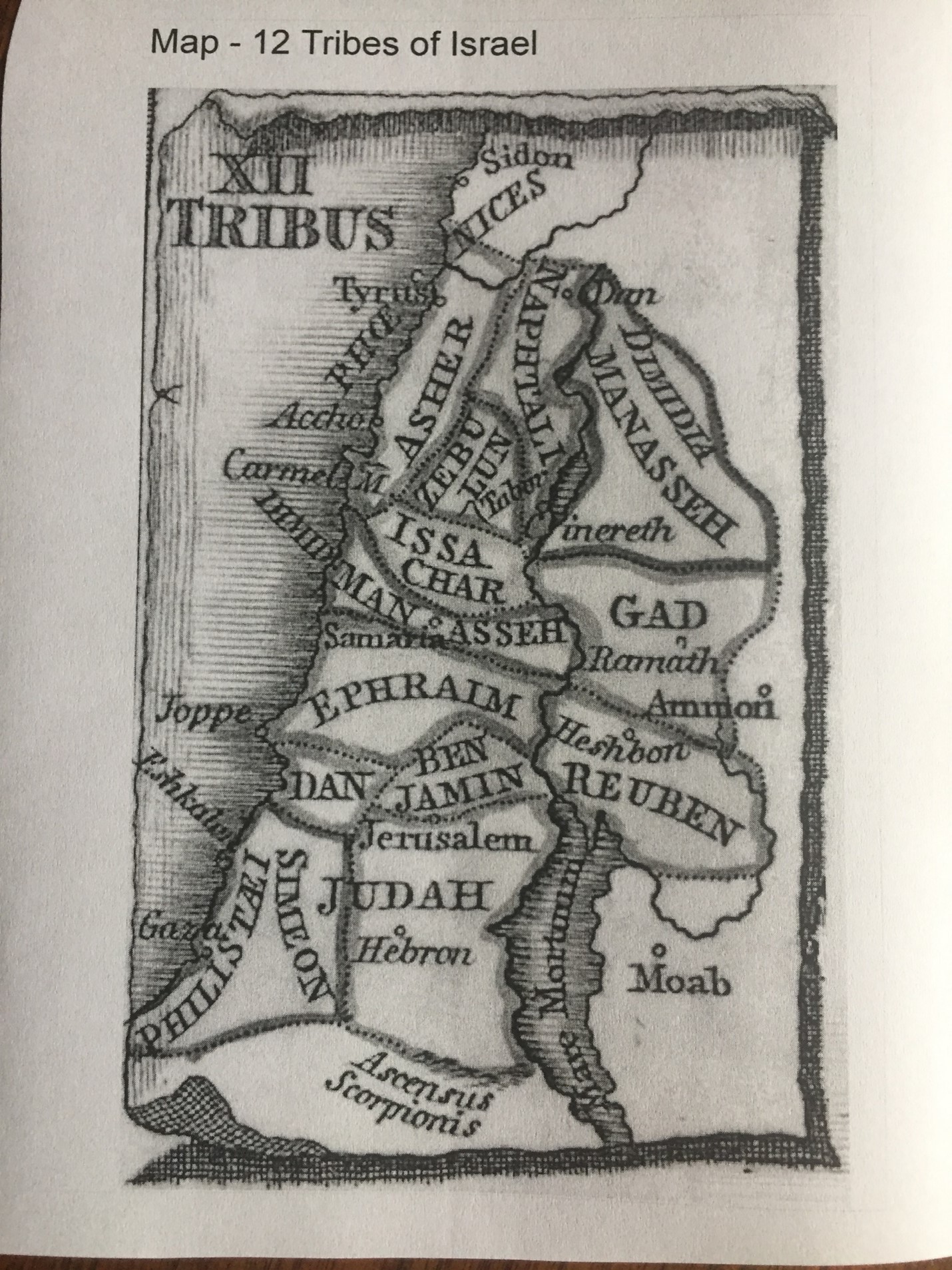
campaign, cities and territories given to the 12 tribes of Israel: The
Israelites Cross The River Jordan Map of the Twelve Tribes of Israel
“This
then was the lot of the tribe of the children of Judah” as
we come here now, the largest tribe, we begin with Judah, Caleb has got his
portion now, we’re going to look at the land divided in three stages, Judah in
the south, Ephraim in the north, and the other tribes, the other seven and a
half tribes around them. But we’ll look
at some things quickly here, we won’t hit everything. “This then was the lot of the tribe
of the children of Judah by their families; even to the border of Edom
the wilderness of Zin southward was the uttermost part of the south
coast.” (verse 1) It tells us now in
verse 2, it describes the south border, it tells us in verse 4 it passed toward
Azmon and down unto the river of Egypt, which is not the Nile, and goes to the
coast, we look, the east border was the Salt Sea, that’s the Dead Sea, we’re
going to find the other border is the Great Sea that borders of Judah, because
the east and the west borders are the Mediterranean Sea and the Dead Sea. They receive a huge inheritance because
they’re the largest tribe. You can read
through all of these names on your own.
Look, they may not mean a lot to us this evening as we’re reading
through them, but every name had incredible significance relative to the
Promises of God when he had promised these people that this would be the land
that would be given to them. Verse 8 says
“And the border went up by the valley of the son of Hinnom unto the south
side of the Jebusite; the same is Jerusalem” the city of Jebus,
Jerusalem, the same city, and it continues to describe the border there, and if
you’ll turn over, and it says in verse 12, “and the west border was to
the great sea, and the coast thereof.
This is the coast of the children of Judah round about according
to their families.” Now on your own
you want to read back in Genesis 49, read the prophecy that Jacob gave on his
deathbed relative to Judah, and then come back and read this, it is of course
supernatural in scope and in its coordination here if you look at this. Now
Back To Caleb And His Family Now
verse 13 brings us back to Caleb, because he’s received this inheritance, and
this is what it says “And unto Caleb the son of Jephunneh he gave a part
among the children of Judah, according to the commandment of the LORD
to Joshua, even the city of Arba the father of Anak, which city is
Hebron.” (verse 13) his inheritance was
inside the territory of Judah, “according to the commandment of the LORD”
not the lot, “according to the
commandment of the LORD
to Joshua, even the city of Arba the father of Anak, which city is
Hebron. And Caleb drove thence the three
sons of Anak,” that were still remaining, his
three sons that were giants, “Sheshai,” funny name for a giant, but you
don’t make fun of a guy whose over ten foot tall, “and Ahiman, and Talmai,
the children of Anak. And then he went
up from thence to the inhabitants of Debir:
and the name of Debir before was Kirjath-sepher.” (verses
13-15) Now when you see Kirjath it
speaks of a city that’s walled up or a fortress, so when there’s Kirjath in
front of something, it’s the fortress of Sepher here, that’s what it was called
ahead of time. “And Caleb said, He
that smiteth Kirjath-sepher, and taketh it, to him will I give Achsah my
daughter to wife.” (verse 16) and I wonder if Achsah is saying ‘No dad,
wait a minute, give me a little bit of, excuse me Dad, can you fill me in a
little bit before you make these decisions?’
Ah, this is a strange way to pick a son-in-law, isn’t it? It wouldn’t go far with me, but he says here ‘To
whomever takes this city, Kirjath-sepher, that man I will give him Achsah my
daughter to be his wife.’ “And
Othniel the son of Kenaz, the brother of Caleb, took it: and he gave him Achsah his daughter to wife.”
(verse 17) so one of Caleb’s brothers’ sons took it, “and he gave him
Achsah his daughter to wife.”
[Caleb’s nephew, Achsah’s first cousin--they knew each other.] Now, the beautiful picture of course is
this, Othniel is the first judge in the book of Judges, when we come there
we’ll see more of him. His name means
“Lion of God,” and he comes forward to defeat an enemy so that he can take a
bride. So we have this incredible
picture of the Lion of God coming forward to defeat the enemy of God’s people
so that he can take a bride for himself.
Of course, you understand the picture and how beautiful it is, it points
us to Jesus Christ. “And Othniel the
son of Kenaz, the brother of Caleb, took it:
and he gave him Achsah his daughter to wife.” (verse 17) Now I’m assuming that she was pretty or nobody
would have fought for her, maybe I’m wrong, just assuming. Ah, we don’t know what her age is, you know,
maybe it doesn’t matter, if Caleb’s 85 and he looks like a 40-year-old, you
know, his daughter could have been 50 or 60, but if she was as spry as he was,
ah, good catch for Othniel here, I guess.
And it says “And it came to pass, as she came unto him, that
she moved him to ask of her father a field:
and she lighted off her ass; and Caleb said unto her, What
wouldest thou?” (verse 18) that’s what wives do, isn’t it? She’s a new wife, she’s already moving her
husband. ‘and Caleb said, What do
you want, honey?’ he knows her,
been living with her for sixty years [she could have been much younger
too]. This is what she said, “Who
answered, Give me a blessing; for thou hast given me a south land; give me also
springs of water. And he gave her the
upper springs, and the nether springs.” (verse 19) Of course what a beautiful picture of the
Bride of the Lion of God, asking for springs of Living Water, you know, it
should be our request every day, ‘Lord, give me springs, upper springs,
the lower springs, Lord, fill me afresh with your Spirit.’ And Jesus, when he said ‘Whoever
comes and drinks, out of his innermost being shall flow rivers of living
waters,’ and John said ‘This spake he of the Spirit, which was
not yet given.’ So here’s the
bride, asking, Jesus said ‘How much more will the Father give the Spirit
to those who ask him.’ So just,
this is a beautiful, beautiful picture here, in type, and stays with
Caleb. Look, here’s a man of a different
Spirit, Caleb, you have this whole picture of him, him and Joshua are the only
one’s who don’t receive their inheritance by lot, they receive it by the Word
of God. He comes in to receive his
inheritance as the companion of Joshua, Jesus, Joshua, faithful, him and
Joshua, and he’s a joint-heir with him.
He gives to his daughter these upper springs and the nether springs, “And
this is the inheritance of the tribe of the children of Judah according to
their families.” (verse 20) Now
we’re through that. Judah
Inherits Over 100 Different Cities, But Can’t Drive The Jebusites Out Of
Jerusalem As
we come to verse 21, we come to now the cities of Judah that are named in the
southern part, in the plains of the lower part after this. Ah, don’t want to do this to you, “And the
uttermost cities of the tribe of the children of Judah toward the coast of Edom
southward were Kabzeel, and Eder, and Jagur,” (verse 21) and then you can
read through all of these cities, and I’m sure you’ll do that this week, ah,
from “From Ekron even unto the sea, all that lay near Ashdod, with
their villages” Gaza, so Gaza was even in the news back then, “with
her towns and villages, unto the river of Egypt, and the great sea,” the
Mediterranean, “and the border thereof:” and then it says “and
in the mountains, Shamir, and Jattir, and Socoh,” now it means these
cities, to verse 63 that were given to Judah, these cities particularly were in
the mountainous areas, not just down in the southern plains, and in the
mountains, and its lands, all of these cities, it puts them in front of us, ah,
you can read through those. And it comes
to an interesting note, the last verse, 63 here it says “As
for the Jebusites the inhabitants of Jerusalem, the children of Judah could not
drive them out: but the Jebusites dwell
with the children of Judah at Jerusalem unto this day.” (verse 63) We just have an interesting picture, it
seems that Judah inherits well over a hundred different cities and villages,
given to us here, and has little problem occupying them, there’s no difficulty,
except for Jerusalem. And we look at
that, and we think, you kind of think ‘What’s the difficulty here?’ Adoni-zedec, who was the king of Jerusalem,
had been killed by Joshua. It seems that
if there’s a failing, it must be between, for some reason, between the tribe of
Judah and its leaders and the Captain of the LORD’s
host who appeared to Joshua in chapter 5, verses 15 to 16, who said he’d go
before them and drive out the enemy--or, there is just a measure of God’s
providence or both and sovereignty here, because it will be David and Joab that
will finally take Jerusalem. And
Jerusalem represents the heart of the land, David will be in Hebron for seven
years, until the whole land, north and south, comes and owns him as king. Once he’s owned as king, he goes up and he
takes Jerusalem, and it’s almost as though the fact the heart is never taken
until the right king is finally placed upon the throne. So there’s certainly part of a longer story
that’s here. And it mentions in passing,
you know, these over hundred cities, it seems that there’s little trouble to
occupy them, little difficulty, except this city of Jerusalem, which is still
set before us, which will be taken in the future.” Joshua
16:1-10 “And
the lot of the children of Joseph fell from Jordan by Jericho, unto the water
of Jericho on the east, to the wilderness that goeth up from Jericho throughout
mount Bethel, 2 and
goeth out from Bethel to Luz, and passeth along unto the borders of Archi to
Ataroth, 3 and
goeth down westward to the coast of Japhleti, unto the coast of Beth-horon the
nether, and to Gezer: and the goings out
thereof are at the sea. 4 So
the children of Joseph, Manasseh and Ephraim, took their inheritance. 5
And the border of the children of Ephraim according to their families was thus: even the border of the inheritance on the
east side was Ataroth-addar, unto Beth-horon the upper; 6
and the border went out toward the sea
to Michmethah on the north side; and the border went about eastward unto
Taanath-shiloh, and passed by it on the east to Janohah; 7
and it went down from Janohah to
Ataroth, and to Naarath, and came to Jericho, and went out at Jordan. 8
The border went out from Tappuah
westward unto the river Kanah; and the goings out thereof were at the sea. This is the inheritance of Ephraim by
their families. 9 And
the separate cities for the children of Ephraim were among the
inheritance of the children of Manasseh, all the cities with their villages. 10
And they drave not out the Canaanites
that dwelt in Gezer: but the Canaanites
dwell among the Ephraimites unto this day and serve under tribute.” “And
the lot of the children of Joseph” verse 16,
and we only have a few verses here, so don’t say ‘Ah, now he’s starting
another one of these.’ “And the
lot of the children of Joseph fell from Jordan by Jericho, unto the water of
Jericho on the east, to the wilderness that goeth up from Jericho throughout
mount Bethel,” (verse 1) Now we’re
going to have Joseph represented in Ephraim and Manasseh, and they’re
territorial, so we’ll go into this northern section from the Jordan to the
Mediterranean, and Ephraim in many ways receives the most beautiful part of the
land itself. Even today, when you travel
through that part of Israel, it’s beautiful, it’s lush, it’s fertile [that is
in keeping with the birthright promises given by Jacob to Ephraim &
Manasseh on his deathbed, in Genesis 48].
It says that they received this, “and goeth out from Bethel to Luz,
and passeth along unto the borders of Archi to Ataroth,” (verse 2) look,
they receive the whole area where Shechem is, where Abraham was, the received
the area of Shiloh where the Tabernacle and the Ark of the Covenant was for 300
years, that falls in Ephraim here, goeth down westward and so forth, verse 5
says “And the border of the children of Ephraim according to their families
was thus: even the border of
their inheritance on the east side was Ataroth-addar, unto Beth-horon the
upper;” and then it goes on and it describes. Verse 9, “And the separate cities for the
children of Ephraim were among the inheritance of the children of
Manasseh, all the cities with their villages.” Because there was Ephraim and there was half
the tribe of Manasseh left, you remember that, a tribe and a half of Joseph’s
sons. [Comment:
And here’s an interesting point, one the Jews don’t like to admit, but
in Genesis 49 Jacob prophecied that to Judah, the Jews, would be given the
scepter of kingship, leading to the Messiah, {including king David being in
that line of kings}, and to Joseph, being the two tribes of Ephraim and
Manasseh were to go the birthright blessings of land and great wealth, as well
as their possessing “the gates of their enemies,” military “choke points.” These birthright blessings are repeatedly
promised by God “to the Fathers, Abraham, Isaac and Jacob” in Genesis 12
through 48, and ending up going to Joseph’s two sons which became the tribes of
Ephraim and Manasseh, whoever they are now, as they’ve become historically lost
after 721BC. This division of the
promise of Sceptre and Birthright, both given to Abraham, but later divided up
between Judah and the sons of Joseph, is clearly spelled out in 1st
Chronicles 5:2, where it says “For Judah prevailed above his brethren,
and of him came the chief ruler; but the birthright was Joseph’s” In Genesis 48 Jacob prophecied Joseph’s two
sons would become one great nation, Manasseh, and a “company of nations,”
Ephraim. They both are currently
historically lost, but the prophetic riddle can be easily solved by looking for
two kindred nations, one a “company of nations” and one “great nation,” both
speaking the same language, and up till recently (the 20th century)
both possessing “the gates of their enemies.”
The Jews don’t like to hear stuff like this, nor do conventional
Christians, but when the LORD regathers the 12 tribes back to the Promised Land
after the Tribulation (World War III), these secondary truths will become
evident. For now, believe what you want
to on this subject.] And here’s the note, “And they drave not
out the Canaanites that dwelt in Gezer:
but the Canaanites dwell among the Ephraimites unto this day, and serve
under tribute.” (verse 10) Now it’s
an interesting contrast to Caleb. Caleb
was facing giants, and he was 85 years old, “wholly followed the LORD,” and in
that he drove out, that territory was God’s territory, that territory was given
to Abraham by promise, that territory, no giant, no Anakim, no Rephaim had
right to any of that, and Caleb went in and routed out those giants and their
brood with a vengeance they never forgot.
And yet here’s Ephraim, in itself as a tribe, much bigger than Caleb and
his family, they have enough strength to subjugate those in Gezer and make them
pay tribute, which means they had enough power to destroy them, which is what
they were commanded to do. And sometimes
you know, there’s a picture here of disobedience. They’re without excuse, because they
subjugated them, but those chose money, they chose mammon over obedience, and
the interesting thing we’re going to see, is by the time we get to the Book of
Judges, we’re going to see Ephraim subjugated, in subjection to the
Canaanites. So sad, within a
generation. So, you know, it’s putting
some very interesting things in front of us here, ah, your life, my life--are
there things that we let live? Maybe
it’s just some Gezer, paying us tribute, it strokes us in some way. We know the Lord wants us to put it to death,
that’s what he commanded us, we have enough strength that we keep it at bay,
because we don’t want it out in the open in front of all the other Christians
and everybody else who might watch us, but we never really put it to death, we play
with it, because it pays us some tribute, it strokes us in some way, gives us
some small pleasure, it gives us some small thing, and we know in our hearts
that the Lord has told us to destroy it, to get rid of it. And the fact that we can keep it in check to
the degree that we can, gives us a false confidence that we can do that as long
as we want. We can’t live in successful
disobedience as long as we want. We are
sowing to the wind, and we’ll reap the whirlwind. We’re going to see Ephraim subjected to them
by the time we get to the Book of Judges.
On the other hand, Caleb, that guy, man of a different Spirit. That’s what we want to be in our generation,
even if it means our friends might stone us.
You have friends like that? Some
Christian friends sometimes too. Because
you want to take a stand, you want everything that God said he would give to
you, you want to go in and take it when they don’t want to go in and take
it. When they’re saying you’re fanatical
and crazy, this is too much, you’re too sold out, you never take a break, no,
the giants are going to be bread for us.
Their defense is gone because we’re serving the Living God, we’re wholly
following him. And Caleb, you know he’s
set there in front of us, put in our sight, not with the same amount of print
as Abraham or Joseph or David or Elijah certainly, but he’s put there in front
of us, a Kenizite, one whose joined himself to God’s people, a pagan, somebody
whose called a dog his whole life, somebody who was raised as a slave, don’t
tell us about your dysfunctional family, Caleb’s someone in all of that who
took hold of something of the LORD, somebody who took hold of Moses when they
were delivered from Egypt, somebody who took hold of freedom, somebody who took
hold of the Promises that God made and said ‘No way I’m going to let go
of these things.’ And
look, you know, I don’t know about you guys, but I look at the news and I look
at the world, to be an optimist is to believe Jesus is coming. We are very informed about the world that we
live in. And it’s a great time for you
and I to take hold of the things that will remain, when everything is shaken
that can be shaken, we want to be holding onto the things that can’t be shaken,
which are the Promises of God that’s offered to us so freely through the blood
of Jesus Christ, the completed work of his Son.
And that’s where we are, and look, Caleb, effects his son-in-law,
effects his daughter. We should be
infectious, we should be easy enough to read to those around us, living
Epistles, the generation behind us, the children and grandchildren don’t stand
a chance without 85-year-olds with a sword in their hand. We are never too old to be vibrant. I want to be able to say at 80, even if I’m
in denial, ‘Hey I feel like I did when I was 40! Got as much hair, it’s all home in a cabinet,
but I’ve got it.’ You know, you want
to be vibrant spiritually, you don’t want to kind of burn out. The Bible says he doesn’t quench a smoking
flax, he doesn’t break a bruised reed, he fans it back to flame, and he’s
willing to do that for us. Are we willing
to wholly follow, in our decisions, when push comes to shove, does God weigh
more than the other part of the equation?
Or do we say ‘I’ll do that next year, if I do that I’ll never get a
spouse,’ or ‘this is just tonight, the hangover will be gone tomorrow,’ or
do we say ‘Lord, I know this is what you want. My friends are going to stone me when I tell
them why I’m not doing what they’re doing, but I’m going to take a stand,
you’re made me a promise. And everything
in this world is falling apart, and like Paul, Lord, I want to be renewed day
by day, while I look, not at the things that are seen, but at the things that
are not seen, because the things that are seen are temporal, the things that
are not seen are eternal, they’re eternal.’
And Caleb would step off the page and challenge you and I, who have more
light, more truth, greater promises than he ever realized, and say to us ‘If
this promise was able to keep me 45 years while a whole generation passed away,
what will you do with the treasures of God’s Word’ you know, he’s
challenging me, ‘that have been handed to you?’ Great challenge, let’s stand, let’s
pray…[transcript of a connective expository sermon on Joshua 14:1-15; Joshua
15:1-63 and Joshua 16:1-10, given by Pastor Joe Focht, Calvary Chapel of
Philadelphia, 13500 Philmont Avenue, Philadelphia, PA 19116] related
links: Audio
version: https://resources.ccphilly.org/detail.asp?TopicID=&Teaching=WED624 Map
of Promised Land by Tribes: Map
of the Twelve Tribes of Israel George
Mueller, another believer who wouldn’t quit in his old age, see https://unityinchrist.com/prayer/mueller.htm
|