





|
Jesus Christ’s letter to the Church at Sardis
Revelation 3:1-6, “And unto the angel of the church in Sardis write; These things saith he that hath the seven Spirits of God, and the seven stars; I know thy works, that thou hast a name that thou livest, and art dead. Be watchful, and strengthen the things which remain, that are ready to die: for I have not found thy works perfect before God. Remember therefore how thou hast received and heard, and hold fast, and repent. If therefore thou shalt not watch, I will come on thee as a thief, and thou shalt not know what hour I will come upon thee. Thou hast a few names even in Sardis which have not defiled their garments; and they shall walk with me in white: for they are worthy. He that overcometh, the same shall be clothed in white raiment; and I will not blot out his name out of the book of life, but I will confess his name before my Father, and before the angels. He that hath an ear, let him hear what the Spirit saith unto the churches.” J. Vernon McGee gives us a very good description of Sardis which contains some pretty clear clues as to her identity. First clue, she was located in a very defensible area, militarily secure, guaranteeing her peace and prosperity. Ever hear of the saying “too much of a good thing?” Well that’s Sardis’ problem. Too much peace and prosperity can bring the downfall of a nation, kill it, over time. And so it can with a church as well. Here’s what J. Vernon McGee says about the city of Sardis (and he personally visited these cities, several times). “Sardis was the capital of the great kingdom of Lydia and one of the oldest and most important cities of Asia Minor. It was located inland and built on a small elevated plateau which rises sharply above the Hermus Valley. On all sides but one the rock walls are smooth, nearly perpendicular and absolutely unassailable. The only access is on the southern side by a very steep and difficult path.” [THRU THE BIBLE, Vol. V, p.912, par. 4] J. Vernon McGee said he and another pastor tried climbing the trail that was the southern entrance to the city and gave up. This city’s peace and security was just about guaranteed. J. Vernon McGee gives us the next important clue to the Sardis era’s identity. “As the civilization and the commerce grew more complex, the high plateau became too small, and a lower city was built chiefly on the west side of the original city…this made it a double-city, and it was called Sardeis or Sardis. The plain was well watered by the Pactolus River. It became the center of the carpet industry, and is noted for its wealth. Coins were first minted there. Its last prince was the wealthy Croesus…he was considered the wealthiest man in the world, and everything he touched seemed to turn to gold.” [ibed. p. 912, col. 1, par. 5, col. 2, par. 3] So we should be looking for a church era whose members would live in a very wealthy nation, which divided into two wealthy nations, nations that would spawn some of the wealthiest men on earth. And these two nations or groups of nations, would be extremely militarily secure, equating to freedom of religion, free from persecution. One interpretation
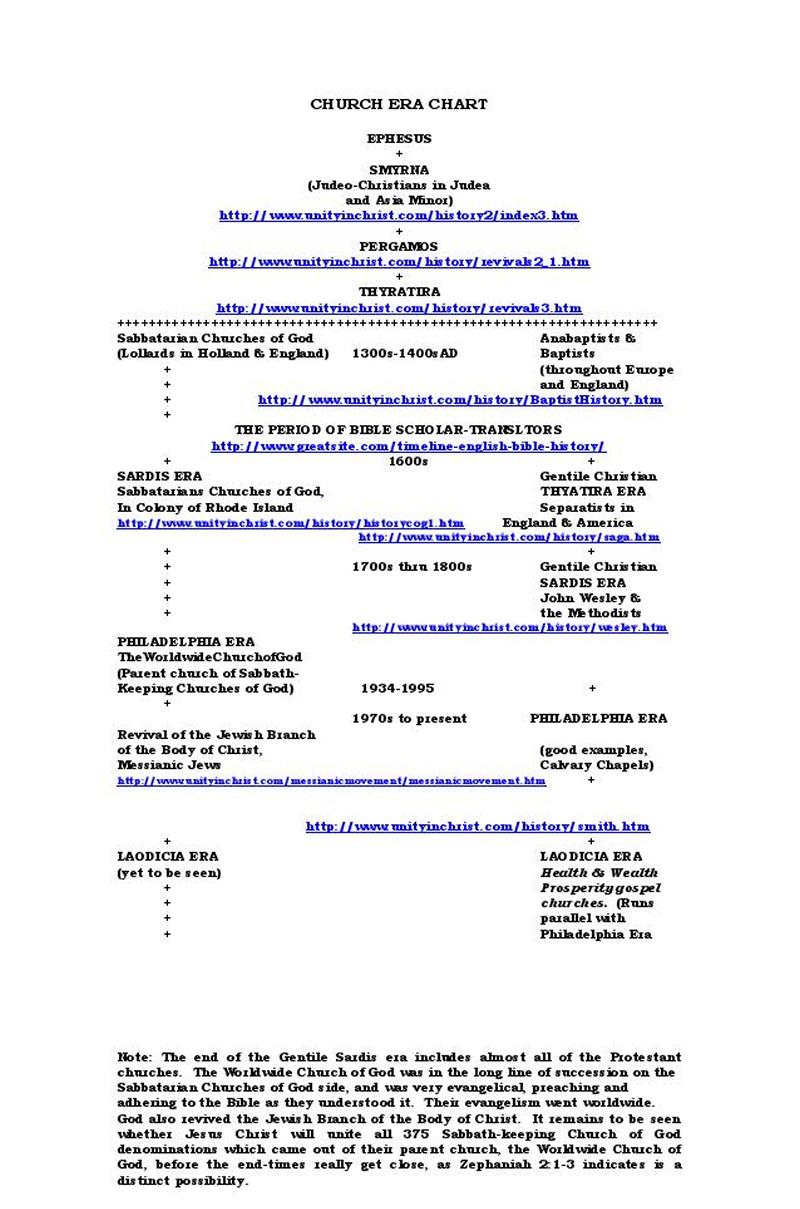
Now J. Vernon McGee believed the Sardis era represented the (entire) Protestant Church(es) during the period between 1517 and through the 1800s AD. But I think that’s too general. Also the period of time, both in Europe and England, from 1517 through the 1600s was also a period of extreme religious persecution and martyrdom of true Christians by governments and the Romish Church. It was very common. Even the Separatists of England came under this persecution, fleeing first to a textile region of Holland, and then finally to America. But right after the English Civil War and going on into the 1700s Parliament became strong and the autocratic rule of king over the Church of England was severely weakened, and a period of peace and security overtook England. This period of peace and security was also extended to all who would truly seek to worship God. Thus we see that God started up another Gentile Christian revival, using a man named John Wesley. During the late 1700s and on into the late 1800s both the British Empire and the United States of America would become very wealthy superpowers, peaceful lands filled with great wealth and industry, as well as being lands that now guaranteed religious freedom to all. As one of my early pastors always taught us, great peace and prosperity can and often does put Christians to sleep, and can at times cause spiritual death, in the sense of a church. Wesley’s Methodist revival started out very healthy and was very missionary minded while he was alive. But slowly over time, living in the lap of luxury and peace, this revival-era started to go to sleep. See what Jesus said about it. Revelation 3:1, “And unto the angel of the church in Sardis write; These things saith he that hath the seven Spirits of God, and the seven stars; I know thy works, that thou hast a name that thou livest, and art dead.” “I know thy works,” Jesus is commending Sardis here, they had works, and as we see historically, they were good works. Wesley and his Methodist revival is credited with not only breathing saving spiritual life into the England of the 1800s, but “God used John Wesley in such a way that he is given credit by historians for saving England from the revolution which destroyed France…” They were also strongly missionary at this time. “Thou hast a name that thou livest, and art dead.” J. Vernon McGee says this, and I agree with him. “Protestantism today, as a whole, has a name that it lives, but is dead. Many Protestant churches today are just going through the form”, going through the motions, so to speak. Second condemnation of Sardis: Revelation 3:2, “Be watchful and strengthen the things that remain, that are ready to die: for I have not found thy works perfect before God.” Amidst all the peace, security (freedom from religious persecution) and wealth, this is a direct warning from Jesus Christ to Sardis that they’re going to sleep at the switch. Denominations, especially those living under such conditions, have a life-death cycle. The world with all its gadgets and toys and entertainment creeps in, and missionary zeal, once alive and vibrant, fades away. Also a love for God’s Word, and living by it fades away. Attendance at midweek Bible studies, prayer-meetings, dwindles until it’s no longer worth the effort of having them. This process slowly progresses until as Charles Stanley terms it “there are more ‘born-into’ the church than there are ‘born-again’ in the church.”
Jesus gives Sardis a real working solution to their
problem
Revelation 3:3, “Remember therefore how thou hast received and heard, and hold fast, and repent. If therefore thou shalt not watch, I will come on thee as a thief, and thou shalt not know what hour I will come upon thee.” Will Sardis follow this advice from Jesus? In Matthew 25:1-13 it is apparent they do not. What is Jesus Christ’s advice for Sardis’ malady? “Remember therefore how thou has received and heard, and hold fast, and repent.” OK, let’s get specific here, even though this can and does apply to all the older Protestant revival denominations in England and America. You Methodists, do you “remember how thou hast received and heard”? As a solid Christian revival/denomination you first “received and heard” through John Wesley. Do you know what John Wesley taught? He wrote many books about theology, books I might add, your present-day pastors might be embarrassed to pick up and read, let alone preach from. John Wesley stood for the inerrancy, infallibility of God’s Word, as written in its original Hebrew and Greek texts. John Wesley held a Classic Pre-Millennial interpretation for end-time prophecies, 2nd coming of Christ prophecies (not Amillennial, as you do now). The Methodist churches were full of mid-week Bible studies and prayer-meetings. There are many books and biographies written about John Wesley. So, first step in Jesus Christ’s advice to this Church era, ‘Look up and study the past, the vivid written histories about the start of this revival, Church era, denomination. Study John Wesley and his written works. Second part of Jesus Christ’s
advice for this era: “And hold fast,” Put in simple terms, ‘Stop right where
you are, don’t slide any further in the direction you’re going in.’ “and
repent.” Once you’ve stopped,
carefully examine the illustrious histories of the founder and founding of your
church-denomination, “repent.” ‘Repent’ in both the Greek and Hebrew
means to turn around and go in the opposite direction, retrace your steps back
into a real relationship with God, as a church, as individuals. Do something, put the knowledge of how your
denomination started out, and emulate the man God used to start it. [see http://www.unityinchrist.com/history/wesley.htm.]
If you ignore Jesus Christ’s advice for you, a dire
warning
If you ignore Jesus Christ’s recommendation, he has a dire warning for you and the whole denomination. “If therefore thou shalt not watch, I will come as a thief, and thou shalt not know what hour I will come upon thee.” Jesus is warning them that his very own second coming would come upon them suddenly and unexpectedly, without warning. This means the Sardis era of the Church would be around at the time of Christ’s 2nd coming, but even worse, they’d be around in the times preceding the 2nd coming, a time of world war which will be unmatched by any previous world war the world has ever witnessed or been through. Read Matthew 24:1-36; Mark 13:1-27; Luke 21:7-36, three separate written accounts of Jesus Christ’s own description of his 2nd coming, and the times leading up to it. Read them as is, without any previously held beliefs you may have toward prophecy. These are Jesus’ words as faithfully recorded by three of his faithful disciples. If you’ve seen any comprehensive war movies about World War II, Korea and Vietnam, realize this, Jesus said it’s going to be worse than all of them combined. It’s gonna be bad, real bad. If things don’t start to spiritually shape up where you are attending, then I offer to you what would be the advice of my ancestor, Elder Brewster. Log onto http://www.unityinchrist.com/history/saga.htm and just read that Introduction section to The Saga of the Pilgrims (it’s a short 1 or 2 pages max), for what he would advise you to do.
Revelation 3:4, “Thou hast a few names even in Sardis which have not
defiled their garments; and they shall walk with me in white; for they are
worthy.” Are you one of those
names? Is there something you need to do
in order to become one of those names? I
am sure that there are many, multiple tens of thousands, maybe more, who became
saved in the early stages of the Sardis era. But near the period of time when Jesus Christ’s return is immanent, a
time in the world’s history when man could erase all life from off this planet,
I believe Jesus is saying “thou hast a
few names even in Sardis which have not defiled their garments…”
Jesus gives a word of
encouragement with a serious overtone
Jesus then gives a word of encouragement for anyone who would heed his advice, but with a serious overtone to it. “He that overcometh, the same shall be clothed in white raiment; and I will not blot out his name out of the book of life, but I will confess his name before my Father, and before his angels.” Talk about an encouragement with a real dark side included in it. If ever there was one, this would take the prize.
Closing statement which appears
in all seven letters
Revelation 3:6, “He that hath an ear, let him hear what the Spirit saith unto the churches.” Trouble is, most in the era, at this point in time do not possess a Holy Spirit inspired, enabled hearing. But if you are slightly awake, cognizant of what’s being said in this letter, listen, hear what the Holy Spirit is saying to this Sardis era, which from the 20th century onward, would include all or most all of the Protestant denominations in America and England, Australia, New Zealand, and Canada. Those in third world countries, due to circumstances that more fit Smyrna, are plenty awake spiritually (the Anglican Church in Africa is a good example of that). So what is said about Sardis can be found inside any real Christian church denomination, but particularly the older Protestant denominations. The Holy Spirit is He who grants you the spiritual understanding, hearing, so that this message hits home, so that you can really understand it. If you don’t fully understand the messages and intent behind these seven letters of Jesus, pray earnestly for the Holy Spirit to open your eyes (read John chapters 14 & 16).
Related links:
John Wesley, the man: http://www.unityinchrist.com/history/wesley.htm
A Spiritual Giant of Prayer & Faith during the 1800s: http://www.unityinchrist.com/prayer/mueller.htm
Francis Asbury, Wesley’s Man in America: http://www.christianitytoday.com/ct/article_print.html?id=86207
http://www.victorshepherd.on.ca/Heritage/francis.htm
http://en.wikipedia.org/wiki/Francis_Asbury
What Should You Do If Your Church Remains Dead? Log onto: http://www.unityinchrist.com/history/saga.htm (and read the Introduction, about 2 pages).
Jesus Christ’s letter to the Church at Philadelphia
Right off the bat this Church era is an interesting one. It’s vibrant and full of life. It is a Church era that is distinguished by two major traits: 1) Getting back to the Word of God, and 2) Evangelism, local, national and international---this is an active missionary Church that adheres to the whole Word of God. Let’s look at the actual church at Philadelphia when Jesus spoke the letter, and John wrote it and sent it there. Philadelphia is located in a beautiful valley, about 125 to 150 miles from the coast. It was built on four or five hills. It is now a Turkish town. But it is still inhabited, having had continuous habitation from its beginning. It was also a fortress city used to intercept foreign enemy armies on the march toward Ephesus and Smyrna. Erosion is at work but it still has very fertile soil. Even today it is a prosperous Turkish town. Also the Philadelphia church was placed in a strategic location which enabled it to be a missionary church. So you have a church that has turned back to the Word of God (actually reading it daily and living by it), which is also strongly missionary. This is the other church which Jesus has no condemnation for. And as we’ll come to see, that is primarily why.
Revelation 3:7-8, “And to the angel of the church in Philadelphia write; These things saith he that is holy, he that is true, he that hath the key of David, he that openeth, and no man shutteth; and shutteth and no man openeth; I know thy works: behold, I have set before thee an open door, and no man can shut it: for thou hast a little strength, and hast kept my word, and hast not denied my name.” Some of Jesus’ attributes are given here. “He that is holy”, cf. Hebrews 7:26, “For such a High Priest was fitting for us, who is holy, harmless, undefiled, separate from sinners, and has become higher than the heavens…” “he that hath the key of David, he that openeth, and no man shutteth;
and shutteth, and no man openeth…behold, I have set before thee an open door,
and no man can shut it:…” To me,
this speaks of something special Jesus has done and is doing for this era of
the Church. Jesus has opened huge,
massive doors for evangelism: motion pictures (movies, i.e. the JESUS Film),
radio, television, and the mass printing and publication of Bibles and Biblical
resources, and also let’s not forget the latest door, the Internet, which is
called the Worldwide Web. Verse 8
specifically talks about this open door. So we have a Church era noted for massive evangelism, worldwide in
scope, although it has “a little
strength”.
And this era is also noted for: “and hast kept my word, and hast not denied my name.” Here Jesus identifies this era and Church as “and hast kept my word.” i.e., they would be living by the entire Word of God, the Bible. And they’d be fully involved in evangelism. With this era I get the sense that we shouldn’t be looking toward any one denomination, but instead we should be looking for either individual independent evangelical churches, which are heavily involved in evangelism and living by the whole Word of God, or a few denominations that exhibit these two traits. Some Baptist churches, individual congregations fit this model, template that we find in Revelation 3:7-8. Also some whole denominations fit the template, like the one that Bill Bright was a part of, which started Campus Crusade for Christ and the highly successful JESUS Film Project, which has brought hundreds of thousands to Christ in the third world (I think they’re Calvanist, but don’t quote me). Another one, (and they absolutely hate to be called a denomination, but if the shoe fits, where it) is the Calvary Chapel churches, affiliated with Calvary Chapel, Costa Mesa, California (Chuck Smith, senior pastor). Also Franklin Graham and the Baptist congregations associated with him, running Samaritan’s Purse. You also see that these Churches/denominations have created non-denominational International evangelistic organizations whose sole purpose is to allow as many Bible believing Christians as possible, across denominational lines, to contribute to International evangelism. Mission Aviation Fellowship provides an evangelistic organization that provides a huge amount of transportation and logistical support for all missionaries worldwide, not matter how remote a place in the world they may be (Borneo has some of the most challenging runways I’ve ever seen). Then you have K.P. Yohannan who started Gospel for Asia, linked to no one denomination that I know of, which trains, equips, pays for and sends out thousands of local church-planting missionaries all over the Indian sub-continent. “I know thy works.” Ephesians 2:8-10, “For by grace you have been saved through faith, and that not of yourselves; it is the gift of God, not of works, lest anyone should boast. For we are his workmanship, created in Christ Jesus for good works, which God prepared beforehand that we should walk in them.” This per se is not talking about good works of obedience, which we accomplish only by the grace of God and the power of the Holy Spirit who indwells us. This is talking about “the good works” of serving, aiding your fellow man in the name of Jesus Christ (which can be an integral part of evangelism), as well as the good works of evangelism. James 2:18, “But someone will say, ‘You have faith, and I have works.’ Show me your faith without your works, and I will show you my faith by my works…” “For thou hast a little strength,” The word “strength” is the Greek word dunamin, from which we get our word dynamite. Each denomination, sub group, independent local congregation, all on their own have “a little strength”, power, just a little dynamite. A motley and apparently disunited group of churches and denominations, a humble group of believers from all over the place, who live by the Word of God and are strong on evangelism, that’s what this era is made up of. But together, as Jesus has inspired the creation of non-denominational international evangelistic organizations which kind of coordinate a lot of their efforts, the effect is already being felt worldwide. Hindu’s in India are expressing serious concerns that India is turning into a “Christian nation.” This era of the Church, as I brought out earlier, has been given the technological open doors of radio, television, the motion picture, high speed printing presses and publication abilities, modern transportation aiding [the JESUS Film Project] missionaries to span the globe [Mission Aviation Fellowship is one example], trains, planes, automobiles, all suddenly available starting in the 20th century and now being used to their utmost.
Two other major traits of
Philadelphia
“And hast kept my word.” We live in a day where from liberal scholars to theologians to scientists, and just about everyone inbetween is actively trying to deny or disprove the inspiration and authority of God’s holy Word, the Bible. But in this day and age, what I would call the Age of Skepticism toward the Word of God, you find a group of people who not only believe in the inerrancy and authority of God’s Word---they’re living by it. They are not only living by the external Big Ten, but they are living examples of the spirit of God’s Law found in Matthew 5:17-48. “And hast not denied my name.” Again, and it is becoming more and more pronounced as time goes on, we live in an age where it is no longer acceptable to mention even the name of Jesus Christ in public, anywhere, schools, the office, foot ball games, public ceremonies, court rooms. (Why, these heathen court rooms don’t even provide a Bible for people to swear to tell the truth on!) Children in school get in serious trouble for drawing pictures of Jesus, to say nothing about talking about Jesus Christ, from kindergarten to their senior year in high school. But these same children can openly talk about, write about and promote any large range of religions that years ago we would have called pagan and out-and-out anti-Christian. And right smack in the middle of all this “political correctness” crap we find the Philadelphia era Church proclaiming the name of Jesus Christ from the housetops, from motion pictures, radio, television, printed Bibles and Biblical publications, from the Internet---as well as in all our personal interactions with our neighbors and co-workers---we are not denying His name, Jesus Christ, (Hebrew) Yeshua haMeshiach. As J. Vernon McGee said, and he hit the nail on the head, “This church in Philadelphia has been labeled many things. Some have called it the Missionary Church; some have called it the Serving Church; some have called it the Alive Church---all of these from are accurate. I personally like to call it The Bible-believing Church; it is the Bible Church.” [emphasis mine throughout] [THRU THE BIBLE, Vol. V, p. 918, col. 1, par. 5]
Revelation 3:9, “Behold, I will make them of the synagogue of Satan, which say they are Jews, and are not, but do lie; behold, I will make them to come and worship before thy feet, and to know that I have loved thee.” Jesus is basically saying that he will make those that have made themselves the enemies of the Philadelphia era Church to know how much he loves them. How will he do this? Those who are the enemies of Philadelphia that are fortunate (or unfortunate) enough to survive World War III and the 2nd coming of Jesus Christ, Jesus says “I will make them to come and worship before thy feet, and to know that I have loved thee.” That would be Orthodox Jews who are so busy persecuting Messianic Jewish believers in Yeshua, both here and over in Israel, Muslims, Hindus and anyone part of a governmental or political group that has set itself up to censure and/or persecute this Philadelphia era of the Church of Jesus Christ. So Jesus again commends Philadelphia for enduring all this opposition from pagan, Christ-less society.
Jesus gives a major promise of protection from the
Tribulation for Philadelphia
Revelation 3:10, “Because thou hast kept the word of my patience, I also will keep thee from the hour of temptation, which shall come upon all the world, to try them that dwell upon the earth.” Again Jesus is commending them for keeping his word of patience. Jesus is the Living Word of God, the very one who inspired the writing of the Old Testament as Yahweh (the pre-Incarnate Christ), and the New Testament as Jesus, God the Son. He commends them this final time for ‘keeping his Word in patience.’ With the world all around them rejecting both Jesus and God’s Word, this group is patiently keeping it, living by it, and proclaiming it. “I will also keep thee from the hour of temptation, which shall come upon all the world, to try them that dwell upon the earth.” Jesus Christ’s final word of encouragement to the Philadelphian era of his Church is that they will not pass through the Great Tribulation (World War III)! Now that promise is ironclad. You can take it to the bank. These are the words of Jesus Christ directly spoken to John his apostle, who was instructed to write them down for us to read. These are not John’s words, but the words of the God-man Jesus Christ.
Rapture vs. Place of Safety
Did you happen to notice that Jesus did not tell them how he would “keep them from the hour of temptation, which shall come upon all the world, to try them that dwell upon the earth”? There are two differing and secondary doctrines extant within the Philadelphia part of the Body of Christ today as to how Jesus will protect those in this Philadelphia era. One, held by the Dispensational Pre-Millennial believing part of the Body of Christ is the doctrine of the Rapture. They interpret certain prophetic passages in the Bible to attempt to show that Philadelphian believers will be Raptured up to heaven to sit out the Great Tribulation and the Day of the Lord in peace and safety. And then at Jesus Christ’s 2nd coming they will return with him to rule over the earth during the Millennium. There are certain passages in 1st Corinthians, 1st Thessalonians and the book of Revelation, which if interpreted a certain way, would indicate the Rapture is going to happen. But interpreted another way, it won’t. The other fairly large group of believers make up what is termed as the Classic or Historic Pre-Millennial side of the Body of Christ. Although not as widely taught amongst them, many of them hold to a “We’re going to be taken to a Place of Safety somewhere on the earth (or places of safety)” doctrine. Both doctrines are extremely secondary, for one, because they don’t involve spiritual salvation, or real spiritual nourishment of the believer. But instead these two doctrines involve what I term as a “Save Your Butt Salvation.” But they’re both secondary for a second and doctrinally speaking more important reason. Both doctrines, ‘The Rapture’ doctrine and ‘The Place of Safety somewhere on earth’ doctrine are based on very few Scriptures which have to be interpreted a certain way, and these passages can and often have been interpreted in several different ways. And if in fact, for either doctrine, Rapture or Place of Safety, if they are in reality interpreted a different way, the whole doctrine (either one) falls apart. I will point out the Rapture passages in the Book of Revelation as we come to them, and show the two possible ways they can be interpreted. I am going to give you a link to a short article which would appear to prove we’re going to some ‘place of safety on earth’, awaiting Jesus’ 2nd coming. [see http://www.unityinchrist.com/romans/print/Petra-ThePlaceofSafetyprt.htm.] Apparently, and most Bible scholars would have to agree, Jesus left the passages involving either a Rapture or being taken to a place of safety very obscure, so that neither doctrine is easily proved or disproved. What would that tell you? I know what it tells me, it tells us that Jesus does not want us to be spending lots of time, precious Bible study time, trying to prove or disprove one or the other doctrine. But what do we do? We get on our High Soap Boxes and proceed to make doctrinal mountains out of doctrinal mole-hills! And this only proves divisive to the whole Body of Christ in the Philadelphia era. What is the main two traits of the Philadelphia era? 1) They’d be living by the Word of God, the whole Word of God, and 2), They’d be a missionary Church era, a highly evangelistic Church era. As a matter of fact, they’d be so busy, so pre-occupied with those two things that they wouldn’t have the time or the money to pursue efforts into trying to prove or disprove certain doctrines about how Jesus is going to save our butts. Some believers, not liking the Rapture/Place of Safety fiasco, and forgetting Jesus Christ’s huge promise of protection in Revelation 3:10, have started spending money, time and effort delving into survivalist strategies and equipment. This is an error for those in Philadelphia too. But Jesus doesn’t mention it in his letter to Philadelphia, so I assume it was repented of and these doctrines were sidelined by all those involved in them. Let’s hope so, as they prove divisive and time consuming, and we still have a job to do. Jesus said very clearly that he will protect us. He didn’t clearly say how. So get busy living by the whole Word of God and get involved in evangelism, doing it (some are good at it on a personal level, some are not, don’t feel bad) or supporting it. Those who are fully involved in those two areas are not that worried about how God will protect them from the Tribulation, WWIII, that will come upon the whole world. Rapture, Place of Safety, either way it doesn’t matter to them. Jesus said he’d protect them, and that’s good enough for them, and it’s good enough for me.
Revelation 3:11, “Behold I come quickly: hold fast which thou hast, that no man take thy crown.” “Quickly” did not mean that as John was writing this down, that Jesus would be returning quickly back then. As we’ve seen through this series, it’s been almost 2,000 years since 31AD and that first Pentecost. Five whole era’s of the Church have gone by, elapsed, and we are living in the time period of the sixth and seventh eras, Philadelphia and Laodicea (these last two era’s, as we’ll see, run parallel to each other, not consecutively). No, the word “quickly” denotes that when he comes, the event will happen quickly, it will be a sudden event. Also this era of the Church, Philadelphia, would be alive and active right up until Jesus takes them to a safe place, whether that be a Rapture to heaven or he leads (or perhaps raptures) them to a place of safety on earth. Wouldn’t that be hilarious if the Lord Rapture’s us to a Place of Safety on earth? That would be exercising the divine sense of humor, I’d say, if that happens.
Reward of Philadelphia
Revelation 3:12, “Him that overcometh will I make a pillar in the temple of my God, and he will no more go out: and I will write upon him the name of my God, and the name of the city of my God, which is new Jerusalem, which cometh down out of heaven from my God: and I will write upon him my new name.” To be made a pillar ‘in the temple of God’ denotes a reward of high governmental, kingly and/or priestly positions, right at the headquarters first of Jesus Christ during the Millennium (cf. Zechariah 14:9) and thereafter in the “New Jerusalem, which cometh down out of heaven from my God”, which occurs after the Millennium when God the Father comes to earth with this New Jerusalem. This event is depicted in Revelation 21:1-23. It says we’ll be “pillars in the temple of God”. In Revelation 21:22-23 it says there is no temple in the New Jerusalem. And yet here in Revelation 3:12 it says that we will be “pillars in the temple of my God…” And then verse 12 mentions the New Jerusalem coming down. Also Revelation 21:22-23 says “for the Lord God Almighty and the Lamb are the temple of it”, i.e. the New Jerusalem. If we are pillars, and God the Father and Jesus Christ are the temple, it means that all the physical temples that have been built in Jerusalem by man for God are only symbols, types of a holy temple God is making, which is actually going to be composed of God the Father, Jesus Christ and Christ’s Bride, the Church, the holy saints. Paul does mention in 1st Corinthians that we, our bodies, are the temple of the Holy Spirit. The New Jerusalem is a structure, with streets, walls and gates made of precious stones. But God the Father, Jesus Christ, and apparently we will be a living temple, moving about, living, in the New Jerusalem. That’s Philadelphia’s reward, to be pillars within that Living Temple.
Closing
Revelation 3:13, “He that hath an ear, let him hear what the Spirit saith unto the churches.” Who is the Philadelphia era? I like the way J. Vernon McGee put it. We’ve already seen how to identify it---a Church era that would be living by the Word of God, and also one that would be heavily involved in evangelism, a missionary Church. J. Vernon McGee put it this way, “His true Church [Philadelphia era], and I do not think you can put them in any denomination or any local church. They are scattered throughout the world today, and you will find some of them belonging to some very funny organizations…” [THUR THE BIBLE, Vol. V, p.920, col.1, par. 2]
Related links:
For a good example of Philadelphia era churches check out the Calvary Chapel denomination: http://www.unityinchrist.com/history/smith.htm
Evangelistic Organizations of Philadelphia:
http://www.unityinchrist.com/evangelism/Short-TermMissions.htm
The JESUS Film Project: http://www.unityinchrist.com/evangelism/excerpts_isawjesus.htm
Samaritan’s Purse: http://www.unityinchrist.com/evangelism/samaritan_purse.htm
http://www.samaritanspurse.org
Gospel for Asia: http://www.unityinchrist.com/evangelism/worldmission.htm
Mission Aviation Fellowship: http://www.unityinchrist.com/evangelism/aviation.htm
“Jews for Jesus”: http://www.unityinchrist.com/messianicmovement/messianicmovement.htm
Jesus Christ’s letter to the Church at Laodicea
Quoting J. Vernon McGee for a few of the physical details about the city, “Laodicea was about forty miles east and inland from Ephesus on the Lycus River, which flows into the Maeander River. It is located at what is known as the “Gate of Phrygia.” Out of the Oriental East, the great camel caravans came down through the Gate of Phrygia and through Laodicea. This road came out of the east and went to Ephesus, to Miletus, and also up to what is called Izmir today but was Smyrna in that day. Laodicea was in a spectacular place, a great valley. Today its ruins are largely covered with the growth of what looks like wild oats.” It’s name means “justice of the people.” What about the city itself? He goes on, “Laodicea was a place of great wealth, of commerce, and of Greek culture. It was a place of science and of literature. It boasted an excellent medical school…Here is where they developed what was known in the Roman world as Phrygian Powder, a salve for the ears and the eyes. Laodicea was also the center of industry with extensive banking operations. Cicero held court here. It is said that he brought bank notes here to be cashed in this city. Jupiter, or Zeus, was the object of worship here.” [THRU THE BIBLE, Vol. V, p.920, col.2, par. 4 & 6, p. 921, col.1, par. 1] He also says that Laodicea was a place of great commerce where they made clothing.” What I notice about this church is that it lives in a city of great wealth, commerce, science, medicine, education and Greek culture. It almost sounds like the conditions of great wealth, peace and security that the city of Sardis had, if not a bit greater than Sardis. Remember Jesus said of Sardis “thou has a name that thou livest, and art dead.” Sounds like the Laodicea era may be living in the same wealthy nations that we found the Sardis era was and is located in (i.e., the U.S. and British nations, particularly the U.S.).
Revelation 3:14, “And unto the angel of the church of the Laodiceans write; These things saith the Amen, the faithful and true witness, the beginning of the creation of God.” Jesus Christ is calling himself “the Amen” here, used as a proper name, only place in the Bible he does that. Jesus Christ is the Amen, has the last word you might say. He is the Alpha and the Omega. Why would Jesus be letting them know this? There is a type of Christianity extant today that has rejected the deity of Christ. That is one trait of Laodicea Jesus is giving here, between the lines, you might say. “the faithful and true witness.” Jesus stands alone, and his Word as the true witness. He through his Word reveals real truth. The Sardis churches who have gone “liberal” don’t have this truth anymore. Nor does society or our political leaders with their “spin-masters” inventing so-called truth that is nothing but a pack of lies. Jesus through his Word has the only real truth, and he is telling the church at Laodicea that. Unlike Philadelphia, they’re not living by the Word of God, is what that means. “the beginning of the creation of God.” Jesus Christ (and this is brought out elsewhere in the New Testament) is revealing himself as the Creator of the heavens and the earth, and all life on the earth. We live in a day that is filled with evolutionary theory that teaches the Creation came about all on its own through evolutionary processes. It is taught as a science along with biology, biochemistry, archaeology, and geology.
Revelation 3:15-16, “I know thy works, that thou art neither cold nor hot: I would thou wert cold or hot. So then because thou art lukewarm, and neither cold nor hot, I will spue thee out of my mouth.” Everywhere else, to all the other churches, when Jesus said “I know thy works” he was commending them for their works, even in Sardis. But not here. This is directly connected to a severe condemnation. Laodicea’s water supply came from two sources, one a long aqueduct coming from distant snow-capped mountains. By the time the water reached the city it was lukewarm. The other source was from hot springs located at the junction of the Lycus and Maeander Rivers. But again, by the time one carried this water into the city, it too was lukewarm, no longer hot. People like to drink cold water, even sometimes hot water, but never lukewarm water. Iced tea or hot tea, iced coffee or hot coffee is what people want to drink A cold church is one that has come to the point of denying the faith, it is no longer living by the Word of God. It is full of liturgical practices but no substance, it’s dead, spiritually dead, there are no real believers in it. A hot church is hot for God’s Word, constantly studying it, living by it, proclaiming, evangelizing it---like the Philadelphia era. But a lukewarm church is at neither of those two extremes. A cold church really doesn’t have true Christians in it (C.I.N.O., Christian in name only). A hot church is full of real born-again, Holy Spirit indwelt believers, real Christians. A lukewarm church doesn’t want to be seen as being “liberal” nor do they want to be seen as a church that is “making waves” within society by its pro-active evangelism. It teaches some truth, but not all the truth. It just wants to exist comfortably outside of the limelight as far as proclaiming the true Gospel is concerned. What they preach, evangelize may make some people wonder and scratch their heads, but it doesn’t offend the way the Gospel of Christ does.
A real strong clue to Laodicea’s identity
Revelation 3:17, “Because thou sayest, I am rich, and increased with goods, and have need of nothing; and knowest not that thou art wretched, and miserable, and poor, and blind, and naked.” Now here’s a real clue as to Laodicea’s identity today. The Laodicea era Church, like the Philadelphia era Church, is living in the end-times, just prior to Jesus Christ’s 2nd coming. Philadelphia has been promised to be spared from the hour of temptation that will come upon all those who dwell upon the earth. Jesus has promised to spare the Philadelphia era from the Great Tribulation leading up to his 2nd coming. There is no such promise made to the Laodicean era churches. These two era’s, the last two, are actually living, existing side by side, probably in America, a land of great wealth (although Philadelphia, due to its powerful evangelism is now to be found all over the world!). But the big clue as to Laodicea’s identity is that they are materialistic, they’re into wealth, making money and spending it---not on the proclamation of the Gospel---but on themselves. They preach a Health, Wealth & Prosperity gospel. Some them are mega-churches which have their own television ‘Gospel Shows.’ And it’s real showmanship, that would put Barnum and Bailey to shame. They’re known by the nickname “Name-it, Claim-it churches.” Rather than using their financial wealth to promote the real Gospel of Jesus Christ around the world, as Philadelphia does, they use it on themselves. As J. Vernon McGee says about the Laodicea era “Worldly wealth is the measuring rod for the [this] modern church. Spiritual values have been lost sight of or are entirely ignored.” And I might add, their form of televangelism has given true Christianity a bad name and reputation, which it does not deserve. They’re full of promotional schemes to make themselves rich. But in reality, Jesus said “thou art wretched, and miserable, and poor, and blind, and naked.” I could name these televangelists by name, and you probably can too, but they’d probably sue me, and make some more money for themselves, and I don’t want to give them that pleasure, not one red cent of it. Don’t be fooled by their showy televised evangelistic and prophecy shows. We are living in the Laodicean Age as well as the Philadelphian Age, they’re side by side. Choose wisely whom you fellowship with. A proverb of Solomon says basically ‘Keep company with a wise man and become wise, keep company with fools and become a fool.’
Jesus gives Laodicea a remedy,
and it’s a scary one
Revelation 3:18-19, “I counsel thee to buy of me gold tried in the fire, that thou mayest be rich; and white raiment, that thou mayest be clothed, and that the shame of thy nakedness do not appear; and anoint thine eyes with eye-salve, that thou mayest see. As many as I love, I rebuke and chasten: be zealous therefore, and repent.” Verse 19 puts verse 18 in context. “As many as I love, I rebuke and chasten…” Verse 18 starts out “I counsel thee to buy of me gold tried in the fire…” Gold here represents their spiritual worth which becomes pure by fire. Since it is not likely that Laodicea will repent before the Great Tribulation, it appears Jesus will “rebuke and chasten” Laodicea in the fire of the coming tribulation. This is a very serious warning which I don’t think Laodicea will heed until they are being chastened and purified as gold in the fires of the tribulation. It is they who will become what has been termed as ‘tribulation saints.’ These Christians are spiritually wretched and poor, naked and blind. The eye-salve Jesus recommends is the Holy Spirit, who would give them spiritual eye-sight, if they would but stir Him up. And Jesus is standing at the door, knocking, waiting for anyone in this group, era, to open up to him, whether now or in the tribulation. Revelation 3:20, “Behold, I stand at the door, and knock: if any man hear my voice, and open the door, I will come in to him, and will sup with him, and he with me.” Jesus essentially says this to all potential believers, those he’s calling to himself. And this verse is used widely to depict that beautiful event. But in context with this letter, it is showing those in Laodicea he wants them to repent now, come to him, open up to him and let him into their lives, through heartfelt prayer & Bible study, supping, dining on the Word of God with him.
Reward for those who overcome in
Laodicea
Revelation 3:21, “To him that overcometh will I grant to sit with me in my throne, even as I also overcame, and am set down with my Father in his throne.” This is an awesome reward, but at a high price. Those of Philadelphia will be made “pillars in the temple of my God”, Jesus says. But to the Laodicean who overcomes, he will be at Jesus Christ’s side in the very throne room of God, in his very throne room. But here’s the price, “to him that overcometh will I grant to sit with me in my throne, even as I also overcame, and am set down with my Father in his throne.” How did Jesus overcome, so he could sit down with his Father in his throne? He died on the cross, he died a painful martyrs death. So the Laodicean’s reward has a high price-tag attached to it. Their reward will come at the very cost of their lives (unless they repent now while there’s yet time, and cross over out of Laodicea and into Philadelphia).
Revelation 3:22, “He that hath an ear, let him hear what the Spirit saith unto the churches.” If you think you may be a part of the Laodicean era Church, pray that the Holy Spirit gives you the eyesight to understand this letter from Jesus to the church in Laodicea. Your very future depends on it. The identifying traits of Philadelphia have been made clear, seek them out and become one. It is possible while the two Church era’s are peacefully co-existing parallel to each other, side by side. The tribulation hasn’t come yet, but it’s getting closer all the time, day by day. [copyright 2010 © UNITYINCHRIST.COM]
|