|
Part II. Rome’s
(and our) Decadent Morals
J.D.
Unwin in his out of print 1934 book “Sex
and Culture” wrote about what had significantly contributed to the rise and fall
of 80 empires in world history. As he examined these empires he was
looking for a common denominator. He found that common denominator,
it was the sexual energy, the sex-drive which is a powerful force
within both men and women. He found that when an empire was young,
just starting out, that sexual energy was aimed, channeled into
monogamous relationships, aimed towards marriage between one man and
one woman in order to build a strong loving family. This provided
the foundation for the forming and establishment of strong towns and
cities within that empire, strong communities, accompanied by strong
agricultural growth, which is the foundation for a strong economy
found within every strong empire. A strong desire was also created
to protect those strong, loving families, the fruits of all their
labours, which fostered the patriotic spirit from which a strong
military force would be formed to protect, again, the collective
fruits of all their labours contained in ‘hearth & home.’
As the society within each of those empires studied by Unwin allowed
their “sexual energy” to be directed away
from that family-oriented monogamous relationship into all kinds of other
directions, he found that empire didn’t last long, in historic
terms of time. Unwin’s work was not a religiously biased
treatise against what Christians call immorality, but was a purely
secular study of cause & affect in the realm of human sexuality.
(Unwin was good friends with Sigmund Freud.) In the Roman Empire the
bonds of strong, loving families were starting to be broken by the
time of Christ and the apostle Paul in the mid-first century AD.
Paul writing his Epistle to the Romans in the mid-first century AD
clearly described the decadent morals of which that empire had
acquired, and was falling headlong into. It got much worse, if that
can be imagined, as time went on. The time of the early Church of
God in Jerusalem was the time period of the Emperor Caligula in 37-41
AD, and was what the apostle Paul was trying to describe in Romans 1
(if you order the movie named “Caligula”, an older film,
you can see this for yourself. It is either an “R” or
“X” rated film, but it backs this up). What the apostle
Paul described is a direct reflection of the moral depravity which
was extant within the Roman Empire at the time he wrote his Epistle
to the Romans. Let’s take a look at it, strictly from the
historic point of view, placing it in context with the bottom line of
J.D. Unwin’s book. Romans
1:21-32, “Because that, when they knew God, they glorified him not as God, neither were thankful; but became vain in their
imaginations, and their foolish heart was darkened. Professing
themselves to be wise, they became fools, and changed the glory of
the uncorruptible God into an image made like to corruptible man, and
to birds, and fourfooted beasts, and creeping things.” i.e. going into pagan religions as opposed to the worship of the true
God. “Wherefore
God also gave them up to uncleanness through the lusts of their own
hearts, to dishonour their own bodies between themselves: who
changed the truth of God into a lie, and worshipped and served the
creature more than the Creator, who is blessed for ever. Amen. For
this cause God gave them up to vile affections: for even their women
did change the natural use into that which is against nature: and
likewise also the men, leaving the natural use of the woman, burned
in their lust one toward another; men with men, working that which is
unseemly, and receiving in themselves that recompense of their error
which was meet. And even as they did not like to retain God in their knowledge,
God gave them over to a reprobate mind, to do those things which are
not convenient; being filled with all unrighteousness, fornication,
wickedness, covetousness, maliciousness; full of envy, murder,
debate, deceit, malignity; whisperers, backbiters, haters of God,
despiteful, proud, boasters, inventors of evil things, disobedient to
parents, without understanding, covenantbreakers, without natural
affection, implacable, unmerciful: who knowing the judgment of God,
that they which commit such things are worthy of death, not only do
the same, but have pleasure in them that do them.” Now
reading that, you can see why Nero beheaded the apostle Paul. He
didn’t mince words. But Paul just described what destroys an
empire, or nation, or any society of man. I’m not pointing the
finger at anyone, just pointing out strong social laws, which when
broken by any empire, nation or society for a long enough period of
time, brings destruction onto the empire, nation or society. It’s
simple cause & affect. And remember, Paul wasn’t preaching
those verses just quoted to the Roman population in general outside
of the church walls, he was preaching that to the believers within
that local church. Believers within the walls of the churches of God
Paul raised up were supposed to sanctify themselves by applying and
obeying the moral laws of God in their personal lives. Outside the
walls of the Church, the Gospel of Jesus Christ was supposed to be
preached.
Rodney Stark, Sociologist, On Abortion In The Roman Empire The early Roman Empire and the Roman Republic from which it came was a very moral society which highly esteemed marriage and family. But as time went on and the centuries passed, attitudes toward sexuality changed. Rodney Stark, a sociologist, writes this in his “The Rise of Christianity.” Keep in mind Stark was writing about the later Roman Empire, not when it started out. “Abortion”
“In addition to infanticide, fertility was greatly reduced in the Greco-Roman world by the very frequent recourse to abortion. The literature details an amazingly large number of abortion techniques---the more effective of which were exceedingly dangerous. Thus abortion not only prevented many births, it killed may women before they could make their contribution to fertility [and a strong Roman Empire, I might add], and it resulted in a substantial incidence of infertility in women who survived the abortions…” [Stark, “The Rise of Christianity”, p. 119, par. 1] “However, the very high rates of abortion in the Greco-Roman world can only be fully understood if we recognize that in perhaps the majority of instances it was men, rather than women, who made the decision to abort. Roman law accorded the male head of family the literal power of life and death over his household, including the right to order a female in the household to abort…” [ibid. p. 120, par. 3] This quote says it all, showing the direction marriage was heading in around the time of the apostle Paul, and thereafter, the period of time Stark was writing about. “If a major factor in lower fertility among pagans was a male oriented culture that held marriage in low esteem…” That’s right where the United States of America, what I call America---The Modern Romans is headed in. We’re just about in the era of Emperor Caligula is my guess, but we probably don’t have as much time left as Rome had. We abort about a million unborn babies a year, over 65,000,000 babies in America alone since Roe verses Wade. This book-length article is written as a sincere heartfelt warning to the peoples within the United States of America. It is not a homophobic attack on any individuals. God tells his people that they are to love the sinner and hate the sin. It is in love these things have been pointed out, because the national destruction that is coming our way is not coming from Christianity, we’re merely the messenger (so please don’t shoot the messenger), it is coming from over the horizon, from the direction of Europe and a soon-coming United States of Europe (see https://unityinchrist.com/prophecies/2ndcoming_4.htm). Proper Interpretation of the Epistles I find my views getting tweaked in for accuracy, when I try to add historic content of when an Epistle was written, in context with the Roman times and places it was written in. Sometimes this may modify the content and meaning of the Epistle, but most of the true meanings come from understanding that most of what’s being said in an Epistle is not going to contradict what is said in the rest of the Bible. I see a lot of what Paul wrote being misapplied or misinterpreted, and the actions of today’s churches not matching up with how he was running or administering and instructing the early churches God used him to start. i.e. Paul was preaching the simple Gospel of Christ (see https://unityinchrist.com/misc/WhatIsTheGospel%20.htm). Paul when writing to the Romans was writing to the congregation meeting in Rome. Romans 1 was not being addressed to Roman citizens outside of the local church, he was not trying to influence Roman legislation, say, against homosexuality or abortion, both of which were rampant within the Roman Empire. He taught Biblical ethics and morality “within” the church, and taught the simple Gospel of Christ outside the Church. I think we’ve been misapplying the content of these Epistles to the outside world. That’s just one example of proper interpretation. The Gospel was going everywhere in the Roman Empire, simply because Paul’s #1 emphasis and priority (through Jesus’ direct guidance, cf. Acts 23:10-11) was to preach the simple Gospel of Jesus Christ to the outside world. Law & Grace, morality, was taught within the walls of the churches. During this last election cycle within the United States, I sincerely believe the evangelical Christian churches within the US have become seriously sidetracked into promoting political agendas instead of the Gospel, and using political Parties of questionable morality in an attempt to promote those Christian agendas. I believe the evangelical churches in America are about to be corrected by God on this error. Jesus did say the Gospel would be preached to the entire world, and then the end would come (Matthew 24:14-15). He said nothing about trying to influence the governments of man (Satan's governments, in reality) before his coming, in a vain attempt to promote their Christian agendas. By doing so, these Evangelicals have stained their hands with dirty politics, and shot in the foot their ability to reach the left or liberal side of America, whom God also loves and gave his Son for. How Should The Church Deal With The LGBTQ Community? John Pavlovitz in his book “IF GOD IS LOVE, DON’T BE A JERK” and Pastor Jim Cymbala of the Brooklyn Tabernacle had this to say about how the Church should deal with the LGBTQ community, and it is decidedly not how the evangelical Church deals with it, but it is the Biblical way to deal with those human beings. “Subjecting someone to that kind of exclusion and expulsion for who they love or their gender identity isn’t just nonsensical at a base level—practically speaking, it’s really lousy evangelism, terrible PR, and bad sin-fixin’. You’d really think that if you in fact believe that being gay was a sin, or that same-gender couples were perverting God’s plan for marriage, or that transgender teens were in danger of eternal damnation—your greatest and most pressing burden would be to keep LGBTQ human beings tethered to genuine, loving, abiding community. If they were indeed on a narrow road to certain death, I imagine you’d probably want them to connect to a church where they could experience the limitless love of your God in close proximity—instead of sharp rejection, swift removal, and finger-pointing from a distance…Nonreligious people accurately see that pushing someone away is a fairly terrible method of pointing them toward something supposedly life-giving; that wounding them while inviting them into a painful place and then condemning them because they rightly reject it seems like a form of abuse.” [“IF GOD IS LOVE—DON’T BE A JERK” by John Pavlovitz, p. 89, par.2, p.90, par.1] I have a perfect example of how Pastor Jim Cymbala, pastor of the famous Brooklyn Tabernacle, applied this incredible observation and advice, while not dropping his church’s Biblical standards in belief that homosexuality is against God’s Law within the walls of the church as applied to baptized/born-again members. Pastor Cymbala’s Brooklyn Tabernacle exhibited and still exhibits unconditional love toward the LGBTQ community and those suffering within it. In his book Fresh Wind, Fresh Fire he relates how one of his members came to him with an idea about how to help out and minister to the hurting homosexual prostitutes down in an area of NYC and Brooklyn called “The Salt Mines.” It was freezing winter, and many of these teenage prostitutes were out on the streets suffering from the cold with no shelter and inadequate clothing. He proposed to Pastor Cymbala going down there with hot soup in thermoses and warm blankets for them, and then inviting them back to the church building for a hot meal while Pastor Cymbala preached a sermon. Many of them accepted and were bussed to the church for the hot meal and sermon. A few came to accept Christ into their lives and dropped their lifestyle, as the church helped them get on their feet. To me, this was and still is a perfect example of how we should evangelize to the LGBTQ community, many of whom are suffering, whether they admit to it or not. It’s hard to give someone the precious Gospel of Jesus Christ whilst beating them up. The apostle Paul never did that. Romans 1 was expressly preached by letter inside the walls of the early Church, it was never addressed to the Romans outside the walls of the early churches of God. Evangelicals have the whole process backwards. Pastor Cymbala was following the spiritual tactics found at this link: http://www.unityinchrist.com/LegacyOfLove.htm
Part III. Now
For You Evangelical Christians: The
Church, Body of Christ, What Should We Be Like?
Some of evangelical Christianity is very loud and “in your face.” They tend to act more like hate-mongers toward the “unsaved world” around them, mirroring what we have just read about “America---The Modern Romans” in Part I, particularly like that Baptist church from Westboro. As the Bride of Christ, we who are genuine Christians need to be as Jesus was, who when reviled, reviled not again, and described his coming ministry in his first sermon in Luke 4:16-18, reaching out to the lost, hurting, maimed and bruised, the down-trodden in society, as a gentle, merciful Saviour. As the very Bride of Christ, the Body of Christ is supposed to mirror her future Husband, Jesus Christ, and not be a reflection of the belligerent Modern Romans we just read about. Jesus Christ, and yes, to a far lesser degree, even Henry Wallace showed us what we are to be like, servants of humanity, we are to be reaching out in compassion to assist, aid and nurture the lost, downtrodden and hurting of this world. Yes, we are to hate sin (when it’s found in our own lives), but love the sinner, as Jesus did. Any Christian group and/or denomination which is not mirroring our Saviour in this manner, in my eyes, is not really genuinely Christian, no matter what they may think or say. And if you should attend one of “those” churches, you should re-evaluate where you attend and even perhaps your Christianity (cf. II Corinthians 13:5). Oliver Stone said a young lady approached him in the early 1970s and said America needs to be more like a woman (i.e. gentle and nurturing). What she was saying without realizing it was that in essence America needs to be like the Bride of Christ or the way the Bride of Christ should be, reflected in the ministry Jesus led and started up, described in Luke 4:16-19, “And he came to Nazareth, where he had been brought up: and, as his custom was, he went into the synagogue on the sabbath day, and stood up for to read. And there was delivered unto him the book of the prophet Esaias [Isaiah]. And when he had opened the book, he found the place where it was written, “The Spirit of the Lord is upon me, because he hath anointed me to preach the gospel to the poor; he hath sent me to heal the brokenhearted, to preach deliverance to the captives, and recovering of sight to the blind, and to set at liberty them that are bruised, to preach the acceptable year of the Lord.” The Witness Of The Early Church Interestingly, as opposed to what we sometimes observe in the belligerent in-your-face witnessing found within certain elements of evangelical Christianity, what was the witness of real Christianity within the Roman Empire, what example were they setting, which ended up bringing millions of pagans into the early Church? What example were they setting us, as early as 155AD and 255AD? See, http://www.unityinchrist.com/LegacyOfLove.htm. That link will take you to a fascinating article/book-report that shows the quiet light of Christian service these Christians shed throughout the Roman Empire, and it was not in-your-face preaching and witnessing, which was something that would have gotten them killed, it was something far more powerful, something that ended up drawing millions of pagan Roman Gentiles into genuine faith in Jesus Christ. The Calvary Chapels (affiliated with Calvary Chapel, Costa Mesa, California) also exhibit this quiet light of Jesus Christ through service to the needy in a hurting world. Our preaching and witnessing to the world has to be of the quieter variety, loving the sinners, while hating the sin that clings to them, with large doses of shedding the light of Christ’s love to the world. How is that done? Is it wrong for the various parts of the Body of Christ to witness to the world from the printed word, magazines and such, and through television and radio broadcasts? No, certainly not, Jesus told his disciples to witness to the world, in Matthew 28:18-20, just before he ascended back to heaven. But we must be careful how we do that. The Gospel proclamation really walks forward on two legs, one being our good works service to the world, and then when folks ask us of the hope that lies within us, we gently tell them, answering their questions about our faith. The other leg can also be through a church denomination’s printed and broadcast efforts. But love for the hurting world we live in is the key, love, and not judgmental hatred for those in the world. Jesus died so that all men might be saved, not condemned (cf. John 3:16). So we must watch and be careful of the “condemnation” part of our witness, being careful to condemn the sin in our own lives, but not the sinner. It’s ok to point out where sin will take an individual, or a nation, but it’s not ok to single out any individual and condemn them for their sins. That’s not our job as the collective Bride of Christ. We must be careful that our spoken and written witness reflect the same witness as our good works of love to this lost and hurting world. If they don’t, something’s wrong with our witness. The two halves of our witness to the world have to be in sync with this love motive. Two Areas Where Evangelicals Need To Shift Their Focus Evangelicals in general, according to Bruce Ashford and D.A. Horton, have been deficient in two major areas, giving them the appearance of being harsh and condemning. Those two areas are racism and poverty. (for proof see again https://unityinchrist.com/topical%20studies/America-ModernRomans3.htm) They point out that Evangelicals as a whole need to become “radically generous to the economically disadvantaged.” As I have pointed out, they also said that Evangelicals have to cease to be part of any “special interest arm of any one political party.” I personally believe we as Christians or Messianic Jewish believers, ought to be totally apolitical, we have to be seen as apolitical and not as being a part of any special interest arm of any political party. In the beginning of Part III I mentioned that Evangelicals tend to be viewed in the same light as the Westboro Baptist church. What should our approach be toward that group of people who are so unmercifully attacked by that Westboro group of hate-mongers? I love the example of one Christian church, and how they reached out and witnessed in love toward a similar group of people. A member of the Brooklyn Tabernacle approached Pastor Jim Cymbala. He wanted to take thermoses of hot soup and warm blankets down to an area of the city known as The Salt Mines, where the male and female prostitutes (many of them teenagers) hung out. It was very cold out, winter, and these people were freezing. Pastor Cymbala gave him the resources and people to go do this, and then provided transportation and an invitation for anyone who wanted to come back to the church for a hot meal, while Pastor Cymbala presented the Gospel to them in a sermon. Many came, some few came to Christ and cleaned up their lives. Pastor Cymbala followed in the spirit of John 3:16, where Jesus said he didn’t come to condemn sinners, the world, but to save them. If we give the Gospel in love, and some of them slap us, we’re to turn the other cheek and move on. Jesus showed us there is no room for hatred in our Gospel presentation. We’re to reach out to the poor and disadvantaged in love and service, while presenting the Gospel in love. [Bruce Ashford is Provost & Dean of Faculty at Southwestern Baptist Theological Seminary and Professor of Theology & Culture. D.A. Horton is Pastor at Reach Fellowship, North Long Beach, CA] [I wrote this section before the politically divisive times that occurred during and just after the election year of 2020 and the defeat of Donald Trump at the polls. The recent history of those events and the politically charged and hate-filled attitudes being espoused by evangelicals only highlights what D.A. Horton observed in his article, which I quoted in this one.] What follows is excerpts from a NY Times interview with a Christian evangelical climate scientist. Excerpts
from the New York Times article “An Evangelical Climate
Scientist Wonders What Went Wrong”
New York Times: “Where, if any, are there areas where you see a conflict between scientific consensus and your religious beliefs?” “The biggest struggle I have is that in the Bible, Jesus says to his disciples, “You should be recognized as my disciples by your love for others,” and today when you look at people who self-identify as Christians in the United States, love for others is not one of the top characteristics you see. Christianity is much more closely linked with political ideology and identity, with judgmentalism, partisanship, science denial, rejection of responsibility for the poorest and most vulnerable who we, as Christians, are to care for. You know, there was a really interesting recent article about the landscape of evangelicalism in the United States, and it said that about 10 years ago if you asked people, “Do you consider yourself to be evangelical?” and they said yes, and then you asked, “Do you go to church?” about 30 percent would say no. But nowadays something like 40 percent of people who self-identify as evangelicals don’t go to church. They go to the church of Facebook or Fox News or whatever media outlet they get their information from. So their statement of faith is written primarily by political ideology and only a distant second by theology…Mark Noll is a historian at Notre Dame. He wrote a book in 1994 called “The Scandal of the Evangelical Mind.” In it he tracked how the political evolution of the United States related to how people view religion from an increasingly nationalistic and individualistic perspective, [and] an increasing rejection of authority.” New York Times: “Doesn’t the argument that the evangelical church has been so totally co-opted by political ideology imply a sort of dim view of its followers’ ability to think critically for themselves?” “Oh totally. There was an article in The Atlantic by Peter Wehner that had a good comment from Alan Jacobs, a Baylor professor. He said churches are not catechizing [instruct (someone) in the principles of Christian religion by means of question and answer]. People might show up for one hour on a Sunday morning, and half of that is singing, and there’s some entertaining talking because they want to keep people coming in the door because that’s how you fill the coffers. Churches are not teaching and people are spending hours and hours on cultural and political content and that is what is informing our beliefs…” New York Times: “How do you see rational thinking and emotionally driven behavior as working together—or not—in this context?” “…I think it’s Jonathan Haidt who says that we think that people use information to make up their minds but they don’t. People use what Haidt calls our moral [or emotion-based] judgment. We use moral judgment to make up our minds and then we use our brains to find reasons that explain why we’re right. There’s no way to separate the emotional from the logical [due to the make-up of the human brain]. We think it’s possible to convince people to act rationally in their best interests: Well, look at people who, as they are dying, are rejecting the fact that they have Covid [my sister died of Covid-induced heart failure, all the while denying she had Covid]. Look at people who are still rejecting simple things like taking a vaccine and wearing masks…” New York Times: “Does our current situation ever make you doubt?” “It does not make me doubt the existence or the goodness of God. It makes me doubt God’s ability to act in people who call themselves his followers…[Katherine Hayhoe, the Christian climatologist in a conversation with a university dean who wanted to talk to her] the dean came and sat down and said, “I used to be an evangelical.” So I asked the obvious question: “Why are you no longer?” He said: “It wasn’t because I doubted the existence of God. It’s because I couldn’t see any evidence of God working in people. I saw person after person who claimed that they took the Bible seriously, they were Christian”—I’m paraphrasing—“and all I saw was the opposite of love. It got to the point where I couldn’t see any evidence of God working in people.” That’s what I struggle with, too. What breaks my heart is the attacks I get from people who identify as Christians. When someone on Twitter has just called me a whore and I go to their profile and it says something about “loving others” and “so blessed” it makes me feel so discouraged. I’m thinking, God, what are you doing.”…[excerpts taken from a New York Times interview with the Evangelical climate scientist Katherine Hayhoe, Dec. 29, 2021]
Should The Church Be Apolitical? When Paul first presented and preached the Gospel in Gentile nations God wasn’t trying to influence the world’s political governments or improve them through Paul. Recently, my transcripts of the Calvary Chapel sermons going through the Epistles and Book of Acts for this website prove that in the days of the Gospel’s first presentation, trying to change the Roman government was never the apostle Paul’s intent. But I have seen through my study of history, and I’m a real history nut (you should see my library/study), the argument of the political left verses right, socialism and communism verses capitalism goes deep into the human need and the denial of those human needs that has been forced on certain groups of human beings over the timespan covering the 18th, 19th and 20th centuries. And due to this dynamic created by human needs the world’s current governments have been formed and created based on those needs, due to the political pressure created when they go unmet for a large portion of a population. The political debate over these three modern forms of government has crept into and in a harmful way coloured our presentation of the Gospel. A good portion of my real and adoptive family is dirt poor, work hard, have kids, and just can’t seem to get by, and understandably they are liberal, left-wing. When I look back at the presentation of the Gospel during the revival that took place during the late 1960s, especially amongst the JESUS MOVEMENT where Pastor Chuck Smith was used by God in the calling of tens of thousands of Hippies, many strung out on drugs and alcohol, those being called by God were most definitely liberal, left-wing, against Johnson and Nixon and the Vietnam War, and were pro-Civil Rights. God cut right through all of that and called hundreds of thousands of people into the Body of Christ, and the Gospel message they received had no political connotations attached to it, I know, I’ve studied Calvary Chapel’s history carefully. If the Gospel had been provided to those Hippies with rightwing political overtones which I see in the rightwing evangelicals today across the nation, they would not have received it. I know, because I know the type of evangelicals that are stumbling some of my adoptive family, again who are liberals. Now realize, over half of our nation is left-wing, Democratic right now, and I understand why, lean and mean capitalism within the United States has created an economic-political pressure which is unmercifully squeezing the poor (whose numbers are increasing exponentially) toward wanting socialism to sort of right the wrongs of social injustice. In the middle of all this social unrest going on in 2020, what I have honestly seen is a large group of evangelicals who have tied their hopes to a political party instead of Jesus Christ (see https://www.youtube.com/watch?v=zx8tsompfiM). So do you seriously think the left, a good 50 percent of our nation, want to hear the Gospel coming from people who are rabidly espousing a right-wing, politically charged agenda, and mixing it with the precious Gospel of Christ? It’s not gonna happen. We’re shooting ourselves and our Gospel presentation in the foot if you think so.
Evangelicals Accuse The Left Of Trying To Destroy The Police And Revise Our History--Is That An Honest Portrayal?
First, what about the police verses Civil Rights? Understand, all police are not bad, a good percentage of them are good people, but many of the big city and a lot of the local police departments and our justice system as a whole have been and are structured to be racist, and functioning on a double standard which the Blacks have had to endure since 1878. One retired court judge who spoke during Jonathan Cahn’s revival meeting on the Washington Mall commented on this strongly when he discussed the judicial system in America, flatly stating that it was racist and operating on a double standard. Now what about our history? It’s been stated that the liberals want to rewrite and revise our history. Let’s understand, in some areas the liberals are totally correct. Our history, I discovered after the death of George Floyd, does need revising, just as I discovered when I first started writing “America-ModernRomans,” written about the Presidencies going back to FDR, Henry A. Wallace, World War II, Truman, Eisenhower, Kennedy, Johnson and Nixon, and the Civil Rights movement. Much of the history I researched seriously revises our White Anglo-Saxon Protestant view of American history. Does history need revising? Yes, in some cases it does. It all depends on who you are, if you are Native American, your view of accurate history is different than ours (and should be added to ours, modifying it where necessary), if you are Mexican (I've studied Mexican history [see https://unityinchrist.com/Poverty/mexico.html]), it is different than our “Davy Crocket at the Alamo war” against Mexico, then and later. The actual history of the US fighting what it perceived as “a communist threat” in Latin America from the 1950s to the 1990s (using the CIA/Black Ops) is disgusting, and Truman set us on a course fighting Soviet Communism at a time when all the poor Russians under Khrushchev wanted to do was end the Cold War and feed their starving population (see https://unityinchrist.com/topical%20studies/America-ModernRomans1.htm). And finally, our standard American History books need to be revised to include Black history within the general history of the United States (see https://unityinchrist.com/topical%20studies/America-ModernRomans3.htm and continue reading all the way through https://unityinchrist.com/topical%20studies/America-ModernRomans4.htm). The BLM movement in the eyes of most Blacks and Civil Rights advocates, when looking back into history, especially black history, is merely a continuation of the Civil Rights movement of the mid 1950s through 1960s, and is far from being an agenda to push communism or any other ism. Right-wing politicians and evangelicals alike are saying that in order to avoid a very inconvenient truth (read that article at America-ModernRomans3.htm to see it for yourself). The civil unrest we have seen during the year of 2020 is merely a resurgence of unfinished business and reform which was interrupted by the dual assassinations of Bobby Kennedy and Dr. Martin Luther King Jr. back in 1968, recently brought on by a string of police murders of innocent Black people. My entire research into all that history (and my library is filled with good history books on that) has gone into this “America-ModernRomans” paper. You should read it from one end to the other.
Politics of Evangelical Christianity
Evangelical Christianity’s human efforts to try to bring about a Revival into America by political actions is not the way God brings about Revival. In the 1800s Charles Finney, through the moving of the Holy Spirit of God, brought about such a powerful Revival in Rochester, New York, where for years to come the jails emptied out and stayed empty, whilst their churches filled up and stayed filled for years. And it was not done through local Christians in the area getting involved in local dirty politics or trying to legislate morality into the city. Instead, a powerful move of the Holy Spirit of God brought morality into the hearts of a majority of Rochester’s citizens. It is an insult to God and his Holy Spirit for puny man, albeit sincere Evangelical Christians, to attempt to usurp the job of the Holy Spirit through dirty political means. There will be no Revival amongst evangelical Christianity as long as they try to usurp the job of the Holy Spirit of God by way of dirty political means. These evangelicals are touching something sacred, a job that is sacred to God alone, through the work of the Holy Spirit. That is a dangerous thing, to sin against Light. And this is an example of that here: https://www.youtube.com/watch?v=zx8tsompfiM
What’s Wrong With The Evangelical Church, part 1 (And How Did It Become So Political?) Evangelical Christianity has been turned into an evil, hate-filled, racist and militaristic beast, as Tares sown amongst the Lord’s precious Wheat (Matthew 13:24-30; 36-43). How was this “beast” formed, and by whom? That is what Kirstin Kobes Du Mez shows us in her book. What follows is a short sampling of that book, showing us where and by whom the beginnings of this beast first took form in the United States. JESUS AND JOHN WAYNE, QUOTES The Politicizing of Evangelical Christianity, When It Began Presidents from Eisenhower Onward (except for JFK) Wooed Billy Graham and Evangelicals For Their Endorsement and Votes “Contemporary evangelical partisanship can only be understood in terms of a broader realignment that transformed partisan politics from the 1950s to the 1980s, a realignment that evangelicals themselves helped to bring about. At the heart of this realignment were attitudes toward civil rights, the war in Vietnam, and “family values.” For conservatives, a defense of white patriarchy emerged as a unifying thread across this range of issues; for conservative evangelicals, a defense of white patriarchy would move to the center of their coalescing cultural and political identity.” [JESUS AND JOHN WAYNE, by Kristin Kobes Du Mez p. 33, par, 1] “After the young Billy Graham’s first visit to a U.S. president “Graham criticized the Truman administration’s “cowardly refusal to heed General Douglas MacArthur’s advice in Korea and lamented that the country had settled for a “half-hearted war” when America’s full military strength was needed. With Truman’s term coming to an end, Graham began signaling to Republicans that they could woo the evangelical votes by aligning with the evangelical views on morality and foreign policy. Eager to bring a new occupant to the White House, Graham took it upon himself to write a letter urging Dwight D. Eisenhower to enter the race. Eisenhower wasn’t a particularly religious figure, but Graham was convinced that the war hero possessed the “honesty, integrity, and spiritual power” necessary to lead the nation. When Eisenhower decided to throw his hat in the ring, he called on Graham to help mobilize religious support. Graham delivered. Despite the Democratic loyalties of Southern evangelicals, sixty percent of evangelicals nationally voted for Eisenhower, helping him achieve a decisive victory over Adlai Stevenson in 1952.” [ibid. p. 34, par. 2, emphasis mine] Evangelicals Under Graham & “The Fellowship” Started Wielding Tremendous Religious, Political & Business Power “And he [Eisenhower] kept an annotated red letter Bible that Graham had given him on his bedside table. He began opening cabinet meetings with prayer, and he appeared at the first National Prayer Breakfast in 1953, an annual event organized with Graham’s assistance by members of “The Fellowship,” a secretive group that wielded tremendous power by connecting religious, political, and business leaders to advance their mutual interests. [ibid. p.35, par.1, emphasis mine] “Eisenhower and Graham were united in their conviction that Christianity could help America wage the Cold War. Early on, Eisenhower recognized the religious nature of the conflict, and at a time when American religiosity was higher than ever, he knew the religious angle would be key to mobilizing support. By framing the Cold War as a moral crisis, Graham made himself useful to Eisenhower—and to subsequent Cold War presidents. Evangelicals weren’t the only ones with an interest in propping up Cold War politics; government officials, business leaders, educators, and the national media all played a part. But evangelicals raised the stakes. Communism was “the greatest enemy we have ever known,” and only evangelical Christianity could provide the spiritual resources to combat it.”” [ibid. p.35, par.2, emphasis mine] “The defense of Christian America required more than spiritual resources alone [in the eyes of evangelicals, who obviously didn’t believe in an All Powerful God to protect them]. Eisenhower presided over the vast expansion of America’s military-industrial-complex, and in his farewell address, he made the connection explicit; a strong military would keep Americans free to worship their God. At the same time, Eisenhower looked back on his presidency with some trepidation, warning of the dangers of mobilization. Few conservative evangelicals seemed to share his concern.” [ibid. p.35, par.3] 1950s “In the 1950s…Cold War politics also united Americans across party lines. To their delight, evangelicals found themselves securely within the political and cultural main stream. The formation of the Religious Right was still two decades away, but the pieces were already falling into place. By the end of the decade, evangelicals had become active participants in national politics and had secured access to the highest levels of power. And they had come to see a Republican president as an ally in their cause. Confident that God was on their side, evangelicals were at home in a world defined by Cold War certainties.” [ibid. p.36, par.3, sel. parts] Billy Graham and Civil Rights “By backing away from their support of civil rights, evangelicals like Graham ended up giving cover to more extremist sentiments within the insurgent Religious Right. Today some historians place race at the very heart of evangelical opposition to government-mandated integration, [which] predated anti-abortion activism by several years…evangelicals themselves—prefer to point instead to the significance of moral and “family values.” But in many ways, this is a false dichotomy. For evangelicals, family values politics were deeply intertwined with racial politics…” [ibid. p.38, par.3] “The evangelicalism that gained respectability and prominence in Cold War America cannot be separated from its Southern roots…Some proponents of Christian masculinity praised Confederate generals and defended the institution of slavery, but for many, the racial subtext was more subtle. Invariably, however, the heroic Christian man was a white man, and not infrequently a white man who defended against the threat of nonwhite men and foreigners.” [ibid. p. 39, par.2] While JFK & Khrushchev Were Trying To End The Cold War, Evangelicals Were “Stoking the Fire.” “Fundamentalist pastors were among those who rebuffed President Kennedy when he challenged the Soviet Union “not to an arms race, but to a peace race.” [ibid. p.41, par.2, ln 1] [to read about the history of this and civil rights, see: https://unityinchrist.com/topical%20studies/America-ModernRomans3.httm] President Johnson & Billy Graham “Most northern evangelicals ended up voting for Johnson, even though they did so without much enthusiasm. Johnson knew that the evangelical vote was in play, and he worked to keep Billy Graham on his side. The two struck up a friendship, and Graham supported Johnson’s Vietnam policy and his approach to civil rights legislation, even though he had declined to endorse the 1964 Civil Rights Act.” [ibid. p.43, par.3] President Nixon & Billy Graham “White evangelicals were a significant part of his majority; 69 percent cast their vote for Nixon. With Graham’s assistance, Nixon had worked to identify himself with born-again Christianity…Already in the 1950s, Graham had coached Nixon on how to appeal to evangelicals, drafting a speech for Nixon to give to Christian audiences referring to the “new birth” teachings of Quakerism and recounting a childhood marked by Bible reading and prayer. In a 1962 article in Graham’s Decision magazine, written at Graham’s prompting, Nixon described making a personal commitment “to Christ and Christian service” at a revival led by Chicago evangelist Paul Rader. Once in the White House, Nixon continued to solidify this strategic alliance…Nixon knew how to speak the language of evangelicals and how to appeal to their values through symbol and spectacle. This “ceremonial politics” was on full display at “Honor America Day” on July 4, 1970, an event organized with Graham’s help and staged on the steps of the Lincoln Memorial, with the aim of bolstering Nixon’s agenda. [What “Agenda” might that have been? See https://unityinchrist.com/topical%20studies/America-ModernRomans4.htm] Pat Boone was master of ceremonies. Clad in red, white, and blue, Boone lamented that patriotism had become a bad word. The country wasn’t bad, he insisted: “We’ve had some problems, but we’re beginning to come together under God.” Graham concurred. It was a time to wave the flag with pride.” [ibid. p.45, par.1-3, sel. parts] “Connections between the Nixon White House and conservative Christians went beyond ceremony and spectacle. When Nixon came under fire for his secret bombing of Cambodia, Colson tapped the Southern Baptist Convention to pass a resolution endorsing the president’s foreign policy. Graham too, worked to promote the presidents’ foreign policy agenda—including escalation of the war in Vietnam—with talk of patriotism and unity. Nixon’s reelection campaign prompted Graham to step up his support.” [ibid. p.46, par.1] “Evangelical support for Nixon was manifest at Campus Crusade’s Explo ’72. With an eye toward reelection, Nixon had been looking for ways to reach evangelical youth. At Graham’s urging, Nixon aide (and ordained Southern Baptist minister) Wallace Henley reached out to Bill Bright, head of Campus Crusade, to convince him to join a media strategy to advance the conservative cause.” [ibid. p.47, par.1] “Nixon won reelection handily, capturing 84 percent of the evangelical vote. The alliance between the Republican Party and evangelical Christians seemed secure. But things didn’t turn out exactly as planned. It would later be revealed that Explo ’72 took place during the week of the Watergate break-in. When news of the scandal broke and the extent of Nixon’s corruption (and Colson’s role in the cover-up) was revealed, Graham came to regret his unabashed foray into partisan politics. [let’s hope it was real repentance, but who knows, guess we’ll find out at Jesus’ 2nd coming.] It was a lesson that most other evangelicals refused to abide.” [ibid. p.48, par.2] Graham & evangelicals On War & The U.S. Military “For instance, Graham, who had visited troops in Korea and in Vietnam, spoke admiringly of the “rough, rugged men” he encountered, men who shed manly tears when they came forward to receive Christ. Fundamentalists were among the most enthusiastic supporters of the war—a war to prevent “godless communism with its murder and torture and persecution from taking over other lands which ask our help.” According to fundamentalist leader Carl McIntire, “the infallible Bible…gives men the right to participate in such conflicts” and the knowledge that God was on their side; believers felled in battle would be “received into the highest Heaven.”… “When word of American atrocities began to filter back to the home front, conservative evangelicals minimalized the violence and advanced moral equivalencies…To Baptist pastor Jerry Falwell, the US soldier in Vietnam remained “a living testimony” to Christianity, and to “old fashioned patriotism.” A defender of “Americanism,” the American soldier was “a champion for Christ.” “When the young army lieutenant William Calley faced trial for his role in the murder of some five hundred men, women, and children in what came to be known as the MyLai massacre, Billy Graham remarked that he had “never heard of a war where innocent people are not killed.”… “His moral reflection in the pages of the New York Times was remarkably banal: “We have all had our MyLai’s in one way or another, perhaps not with guns, but we have hurt others with thoughtless word, an arrogant act or selfish deed.” [ibid. p.49, par. 1-3, sel. parts.] “After the Tet Offensive in the summer of 1968, a poll revealed support for continued bombing and an increase in military intervention “among 97 percent of Southern Baptists, 91 percent of independent fundamentalists, and 70 percent of Missouri Synod Lutherans; only 2 percent of Southern Baptists and 3 percent of fundamentalists favored a negotiated withdrawal.” [ibid. p.50, par.2, sel. parts] “As the established power of the Protestant mainline eroded in step with their [obviously negative] critique of government policy, evangelicals enhanced their own influence by backing the policies of Johnson and Nixon…This partnership [between evangelicals and the military] was acknowledged ceremonially in 1972, when West Point conferred its Sylvanus Thayer Award—an award for a citizen who exhibits the ideals of “Duty, Honor, Country”—upon Billy Graham.” [ibid. p.52, par.1] The Tiny Few Honorable Evangelicals Out of all the evangelicals, only a small number have been genuinely Progressive the way Jesus was in Scripture, they were and are non-militaristic, “denouncing racism and calling for Christians to defend the rights of the poor and oppressed.” This book JESUS AND JOHN WAYNE continues on through all the presidencies right up through president Trump, and the picture doesn’t change except to get more ugly. I have merely given the starting point and the pattern evangelical Christianity has followed, in their unholy alliance with dirty politics and dirty politicians. This whole series of chapters in America ModernRomans gives some of the history of those presidents, American history, the unvarnished Untold Version. This short abbreviated history of evangelicals I have presented in these brief quotes from Du Mez’s book is only to show you why Christians should not vote, period, and those that do, like these evangelicals, will end up with the blood of millions on their hands.
What’s Wrong With The Evangelicals, part 2
Significant quotes from John Pavlovitz’s book “IF GOD IS LOVE, DON’T BE A JERK” “I Can’t Christian Today” John Pavlovitz said this in his book, “I’ve been a Christian most of my fifty-one years, a pastor in the local church for more than half of them. And on far too many mornings recently, I’ve woken up, checked Twitter or watched the news or walked away from family conversations or departed church gatherings, and thought to myself: “I can’t Christian today.” I can no longer be tethered to this thing that is so toxic and so painful to so many. I can’t wade through any more bad theology and predatory behavior from pulpit-pounding pastors who seem solely burdened to exclude and to wound and to harm. I can’t sift through all this malice and bitterness masquerading as Christianity to try to find what is left worth keeping. I can’t do any more face-palming while reading another celebrity evangelist’s tweets about walls at the border or seeing viral videos of joyless people spewing racist rants at fast-food restaurants—all while saying they follow the same Jesus I do. I can’t apologize anymore for people who are willfully hurting other human beings in the name of a God they preach is love. I can’t align myself with the human rights violations and overt racism and rabid nationalism that is defining Christianity in America [more specifically evangelical Christianity]. If being a Christian now means such things—count me out. You can keep it.” [ibid. pp. 132-133, par.’s 2&1] Pastor Pavlovitz Asks A Pertinent Question “As we [“we” being genuine Holy Spirit indwelt Christians] seek to be agents of compassion in the world, and as we interact with more people who know the Jesus story only through Franklin Graham and the alt-right Proud Boys and discriminatory bathroom bills and Muslim bans—is claiming this faith now a liability to authentic relationships because of the unscalable barrier it represents? Is the name Christian now so inextricably entwined with misogyny, bigotry, and homophobia that it cannot be untangled? Now that it has been so politicized and weaponized by a political party for its own gain, can we ever hope to reclaim it? Have we lost the battle for the name of Jesus to the wall builders and transphobes and the white supremacists? The answer doesn’t seem encouraging.” [ibid. p.135, par.1] John Says We Can’t Blame Humanity Outside of The Church For Rejecting Christianity “I can see when people are stealing his [Jesus’] identity and bastardizing his legacy. I know when they’re twisting the Scriptures to subjugate people, when they’re fashioning God in their own terrified image, when they’re slapping a veneer of religiosity on something with no redemptive value. Because I’ve experienced the authentic treasure of diverse, loving community, I know a counterfeit Christ is being sold by people brokering in bigotry. I’m able to see the frauds and false prophets because I’ve experienced the real and beautiful faith—but not everyone has, and so I don’t blame them for rejecting it all. It is often completely rejectable. Jesus spent a good deal of his life acknowledging this same injurious religious movement, and so their objections make sense to me [read Matthew 23, the whole chapter, for Jesus’ scathing condemnation of people like this]. If all I had to go on was this malicious , power-hungry, bullying, bitter thing I see running amok every day in America, I’d run from it too. If following Jesus meant signing up for all of this, I’d have no interest either. Sadly, the American [evangelical] Church has in many ways become the greatest argument for someone not becoming a Christian, for rejecting organized religion and never looking back. If that was all there was to this faith, I’d opt out of it too—but I know better.” [ibid. p.137, par.1] “…many of us who claim faith in Jesus have no interest in this kind of Christianity because we know Jesus wouldn’t either. When people in the Gospels were pushed to the periphery by unloving religious people, they usually ended up closer to Jesus.” [ibid. p.138, par.1, sel. parts] Do We Need To Leave Our evangelical churches? “More than ever, [evangelical] Christianity is synonymous with discrimination and exclusion, which means openhearted, equity-loving, diversity-welcoming followers of Jesus may need to make a difficult choice. We may need to in some ways, secede from this thing in order to fully live it out. We may need to lose our status as [evangelical] Christians in good standing in order to hold on to our souls and to reveal a Jesus who has been concealed in the system itself.” [ibid. p.139, par.1, sel. parts] John Pavlovitz Sums It Up, Everything I’ve Been Trying To Say “People who are assailed by the storms of life don’t need any more heartless, loveless, joyless self-identified saints claiming they’re Christian while beating the hell out of them. They need people who see how hard it is to be human and feel burdened to make it a little softer.” [ibid. p.142, par.1, sel. parts] “…if we’re to resurrect the heart of Jesus in this place and time, this toxic religion needs to die. Christianity as modeled by Jesus was never meant to hold power. It was never supposed to be dominant. It was never about control or brute force or dictating the laws of the land or imposing itself on people’s lives. It was certainly never about cozying up to national leaders with no regard for humanity. Someone needs to remind the [evangelical] Church and the Republican Party of that. Someone needs to preach it to the Bible Belt, and to the celebrity pastors, and to Christians who don’t realize just how much they’ve lost the plot and just how they’ve become the opposition to the author and perfecter of their declared faith. Someone needs to inconvenience these comfortable Christians with the actual words of Jesus. World domination wasn’t the plan. World renovation was.” [ibid. p. 183, par. 1]
So What Is Our Job As Christians Supposed To Be?
We as ordinary believers and pastors are to be “gentle as doves and wise as serpents” as Jesus told us to be. We all can present the Gospel of Jesus Christ to anyone we want to, often called “witnessing” to someone. The Bible encourages anyone and everyone to participate in that activity, but minus the political right-wing or left wing agenda, please. All those precious souls out there, whether on the political left or right need our witness, and it must be a loving witness that Jesus came, died to pay the penalty for our and their sins, was buried, spent three days and nights in the grave, was resurrected back to life so that he could set us free from sin and grant us eternal life, and that he is coming back again to establish his Kingdom on earth--that’s the simple Gospel of Christ. That message is political enough, and will get you killed for preaching it in certain countries. Isn’t that enough? If ever there was a time the people of the world and this nation needed to hear the simple Gospel of Jesus Christ without political overtones or rhetoric it is now. Why politicize the precious Gospel of Jesus Christ? It only pollutes it, because it makes it odorous and onerous for over half our nation in a way that God never intended it to be. Proving Jesus’ existence, that God exists, and that the Bible is his inspired Word and true should be an important part of our Gospel presentation. This website does that, without the politics (see https://unityinchrist.com/prophecies/1stcoming.htm and https://unityinchrist.com/ProofOfTheBible-FulfilledProphecy.htm and https://unityinchrist.com/Does/Does%20God%20Exist.html). What is that precious Gospel Jesus has given us to present? See https://unityinchrist.com/misc/WhatIsTheGospel%20.htm
The Church Must Be Apolitical
Again, the Gospel as the apostle Paul presented it, and as we should present it, must be apolitical, it must reach out to all peoples in all lands and nations. Does Gospel for Asia, or the JESUS Film Project or Samaritan’s Purse go out into other nations and as they present the Gospel, do they try to politically change the governments of those nations they go into? No, they wouldn’t dare. And they don’t encourage those God calls through them to do so either. Romans 13 is taught. Our job is to get the Gospel of Jesus Christ, the Gospel of the Kingdom of God out to the world as a witness, and a warning, and to herald Jesus Christ’s imminent return to earth and then the end will come (cf. Matthew 24:14-15 and Matthew 28:18-20). I agree with everything that’s being said about abortion, and that Christians should be opposed to it in their own lives. But the Gospel presentation must be apolitical, having no political overtones or agenda attached to it. The question of abortion is an individual national, political and law-of-the-land legal issue, and varies according to what nation you live in around the world. Abortion during the time the apostle Paul preached the Gospel in, during the time of the Roman Empire, was rampant and legal in that empire. While within the Christian churches at that time it was wrong and against God’s laws, Paul never preached against it to Roman citizens outside of the Church (the Book of Romans was addressed to the saints dwelling in Rome, i.e. church members, not to pagan Roman citizens). The apostle Paul didn’t try to legally or politically campaign against abortion. While Paul preached against homosexuality and all moral sins inside the Church, he never tried to get Rome to legislate against it, and he never gay-bashed homosexual Romans outside the Church. He knew that God’s coming Kingdom which Jesus would establish at his 2nd coming would take care of all that. Paul preached the Gospel of Jesus Christ to the outside world, while he preached about law & grace and Christian obedience within the Church. We have failed to make that critical distinction, and we are wasting our precious time, money and resources fighting battles the apostle Paul never fought while he presented the Gospel.
Jesus’ parable about true believers verses false believers in his Wheat verses Tares parable fits evangelical Christianity perfectly, but with the evangelicals there seem to be a far greater number of tares than wheat plants. For the parable look up Matthew 13:24-30, 36-43 and read it. Kristin Kobes Du Mez’s book really delves deeply into the history about the unholy alliance evangelicals have made with politicians and U.S. presidents. Reading between the lines you can see some true believers in the mix in her book. The best way to draw them out is through education, which is why I am so strongly recommending her book. Hopefully some will come to see what they have become a part of and find an exit out of where they are. There are a few evangelical churches (and one denomination) that are spiritually healthy and apolitical (see https://unityinchrist.com/history2/choosingachurch.htm).
Book recommendations
Spencer Ackerman’s “Reign of Terror” really exposes the dark side of political evangelical Christianity. He’s not a believer, but his book is an honest historic account of the two decades from 2001 to 2020, really “connecting the dots” in a totally factual way, letting the chips fall where they may. It’s a heavy read, but totally honest, and I highly recommend it as an accurate explanation of the past two decades we’ve lived through, and exposes what’s wrong with the political side of evangelical Christianity, all within the first 85 pages. We need to understand just why the Church, the greater Body of Christ has to put aside all politics, and display a Godly neutrality to all politics and political parties. Evangelicals have blood on their hands, the blood of perhaps millions of innocents around the world.
Quotes: “During Trump’s first year in office there were 237 reports of sexual abuse in immigration detention, among 1,448 such allegations filed against ICE between 2012 and March 2018…A woman named Victoria [whose young daughter died in detention due to these conditions] told Human Rights Watch that as CBP piled people into a small room with her in February 2017, “They turned up the air conditioning…We slept on the floor with the kids in the middle, trying to keep them covered up as much as possible.”…“For years CBP had been detaining children who crossed the border without their parents—many fleeing violence in Central America—in what an Arizona Republic reporter called… “a juvenile prison camp.” John Kelly, retired from the marines and now Trump’s secretary of homeland security, went far further…It would be another year before Attorney General Jeff Sessions and Kelly’s successor, Kirstjen Nielsen, unveiled Zero Tolerance, the official name for their policy `of kidnapping. But the practice began under Kelly, whose functionaries thought seizing children and threatening their parents with prosecution “would have a substantial deterrent effect.”...“An inspector general’s report found instead that the system was unprepared to address the overwhelming trauma exhibited by ever-younger children who had no way of knowing if they would ever see their parents again. Children unfamiliar with the concept of anxiety attacks reported suffering chest pains that they described as feeling as if their hearts were hurting. They were penned into places like a converted Texas Walmart that housed fourteen hundred. A care worker who visited in July 2018 called it “very clearly a prison for children.” Fox News’s Laura Ingraham called it “essentially a summer camp.”…“The administration made a show of ending Zero Tolerance in June 2018, barely three months after its launch. DHS still took more than a thousand children from their parents after that…By the end of Trump’s presidency, at least 545 children did not know where their parents were.” [Reign Of Terror, pp. 259-262, sel. parts] If you voted for Bush-II, Obama or Trump, you are responsible for practices like this, and all the other actions of the presidents from Bush-II, Obama through Trump listed in this book. I especially recommend the next book for an in-depth look at what has happened to evangelical Christianity from the period of President Eisenhower onward through Trump. As I said before, evangelical Christianity has been turned into an evil, hate-filled, racist and militaristic beast, as Tares sown amongst the Lord’s precious Wheat (Matthew 13:24-30; 36-43). How was this “beast” formed, and by whom? That is what Kirstin Kobes Du Mez shows us in her book: “Jesus and John Wayne HOW
WHITE EVANGELICALS CORRUPTED A FAITH AND FRACTURED A NATION”
By Kristin Kobes Du Mez
Yes, Christian nationalism has infected the Body of Christ severely, especially evangelical so-called Christianity. Christian nationalism has sidetracked many Christians from their central job Jesus gave them, which is to preach the Gospel before his coming (Matthew 24:14-16 anyone?), which the Worldwide Church of God and the Calvary Chapels under Pastor Chuck Smith were going full blast doing in the late 1960s through the early 1970s, the way we ought to be doing right now. Also the Worldwide Church of God was apolitical, teaching, as the early Sabbath-keeping Churches of God were from England, Rhode Island, and then across 19th century United States, that we should not vote or have anything to do with politics. A good book to read, written by a writer and former evangelical and writer for Christianity Today is “Jesus and John Wayne, How White Evangelicals Corrupted A Faith And Fractured A Nation” by Kristin Kobes Du Mez (300pp) giving basically a detailed history of evangelical Christianity and its politicizing, starting with Billy Graham’s forming political-religious alliances with all the presidents from Eisenhower through Nixon, just for openers. It’s a disgusting tale detailing the unholy marriage between politicians and evangelical so-called Christianity, which reached it’s peak just recently under president Trump. But it didn’t start with Trump, he was only the cherry on top of this putrid political-religious pie. We used to teach how bad it was that the Catholic Church and its popes made unholy alliances with major leaders in Europe, crowning all the “Holy Roman Emperors” (Justinian, Charlemagne, Otto the Great, Charles the Great, Napoleon, Mussolini [in a secret Vatican Concordat in 1935], and then the coming Beast person, whoever he is). So is the politicizing of evangelical Christianity any less evil? Our early Sabbath-keeping Church of God brethren would definitely be telling us so. Jesus called it “eating the bread of Herod.” Revelation 17 shows the unholy alliance of the Catholic Church and the future head of a European superpower in the near future. True Christians should not be voting, attempting to sway politicians to make our land a theocracy, that was never the job of the early Churches of God under Paul, neither should it be our job.
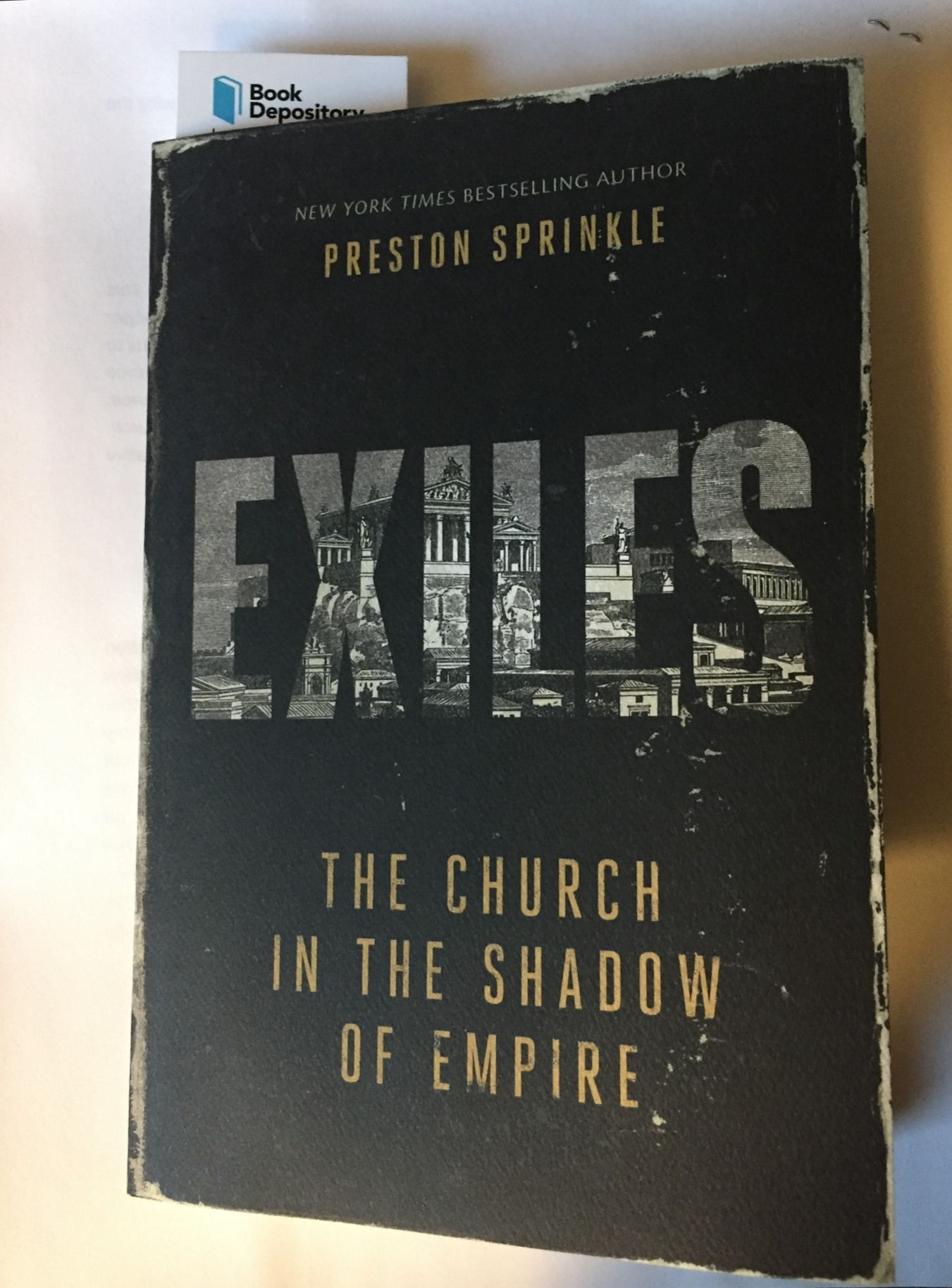
“EXILES,
The Church In The Shadow Of Empire” The
Book’s Significant Quotes: “Paul proclaimed that Jesus is
Lord, and this was a politically disruptive thing to say [in the Roman
Empire].” p. 11, par. 1. “Like the
Hebrew exiles before them (Jer. 29:7), the Ephesian Christians were called to
seek the good of their city. But they
weren’t called to prop Jesus up next to Artemis (or Caesar) to form a dual
allegiance.”… “The political task of Christians is to be the church.” p. 12,
par.1. “Preaching sermons about how to
pray or read the Bible typically doesn’t cause cities to riot. But preaching the good news that Rome had
enthroned a new King by crucifying him threatened the legitimacy of the
existing empire.” p.13, par 1. “The
first-century church wasn’t an apolitical spiritual gathering where individual
Christians left their Roman politics at the door and picked them back up on
their way out. It certainly wasn’t a
place where Christians mounted a Roman flag next to a Christian one. Rather, the church was the foretaste of
God’s Kingdom, a colony of heaven on earth.
It was a place, a family, a gathering where God’s plan for governing the
world was being revealed and practiced, where participants submitted themselves
to God’s rule in realms like economics, immigration, bodily autonomy, war,
violence, power, justice, and sexuality.
Christians believed they were called upon to submit to governing
authorities (Rom. 13:1-5). They also
believed that governing authorities were empowered by Satan (Rev. 13:1-18) and
would one day be destroyed by God.” p.13, par.2 MAIN GOAL OF THE
BOOK—What It’s About “My main goal is to lay a thick
biblical foundation for constructing a Christian political identity. [i.e.] How
should we, as exiles, interact with and respond to the politics of empire?”
p.13, par.3 “Part of the reason for
this book, then, is to soak ourselves in the narrative of Scripture, with all
its politically relevant themes, and let Scripture become the primary lens
through which we interact with the politics of earthly empires.”… “I
want us to take (more) seriously the political implications of our allegiance
to King Jesus. To put it plainly, I
think “God and country” ideology cuts against the grain of Scripture and, in
its more extreme forms is idolatry.” By
“God and country,” I mean the view that Christians should give their allegiance
both to God and to their country—whatever country that may be.”
p.15, par’s 2-3. “I’m talking about
being more passionate about American values than Christian ones, or not knowing
the difference.” p.16, par.1. Partisan
Politics Has Divided The Church “Partisan
politics have divided churches and friends and families who are Christians. This division suggests to me that our
allegiance to the state is sometimes, in practice, stronger than our allegiance
to Christ.” p.16, par.2. “Instead of a
“God and Country” lens, I want us to cultivate an exilic lens--one where we see
ourselves as exiles taking up temporary residence in a modern-day Babylon.”
p.17, par.3. “I’ve come to believe that, for Christians in America, allegiance
to either the Republican right or the Democratic left is toxic. It divides the church, destroys our witness,
and brings profound joy to the Devil, who’s always looking for creative ways to
derail the Kingdom of God…” p.19, par.3 We
Should View Ourselves As Exiles In The Shadow of Empire “I’ve been using the phrase “exile in
Babylon” to describe a different kind of Christian political identity, a
theological alternative to the toxic left/right options so many Christians have
accepted.” p.19, par.3. “Exiles is an attempt to put
biblical flesh on the idea that Christians should view ourselves as exiles
living in the shadow of empire.”… “One of my ultimate goals--one that’s pretty
vanilla, if you think about it--is to shift our political conversations as
Christians toward what the Bible actually says rather than what our favorite
political pundits say. [i.e.] When faced with a question like “What’s your view
on immigration?” I want to see Christians intuitively start that
conversation by considering what the Bible says about immigration.” p.21,
par.1. “Viewing ourselves as exiles
living under a foreign empire should strengthen the church’s unity and group
identity.” p.21, par.1. “I’m arguing for
a different grid altogether--a political identity that doesn’t derive from the
secular left/center/right options.” p.21, par.2. Excerpts
taken from “Exiles, The Church In The Shadow Of Empire” © 2024 Preston Sprinkle, available on amazon.
What In The World Is The World Coming To? “Jesus was asked ‘Lord, Are There Few That Be Saved?’ in verse 22 of Luke 13, “And he [Jesus] went through the cities and villages, teaching, and journeying toward Jerusalem.” Your Bible may say ‘making his way toward Jerusalem’, making his way toward his crucifixion, making his way toward his death, making his way toward carrying our sins, and paying the full price of what we deserve. “Then said one unto him, Lord, are there few that be saved? And he said unto them,” You know, this is the last six months of his public ministry, and he’s become stern with the religious leaders. His words are cutting a little deeper, they have a little bit more edge to them, as he pronounces the woes against the Pharisees and the Sadducees and the doctors of the Law. It is the most heated things that he has to say, more heated than what he says to drunkards or to prostitutes or to tax collectors. The ones he’s really turned on, and he’s skinned them alive, has been the religious leaders and the hypocrisy of their system. And now someone listening is saying, ‘Well then Lord, are there few then that will be saved? This sounds impossible, this is all we know, this is what we thought it was all about, and you’re telling us something that’s so far different, and you’re denouncing what we thought was our own religious experience. Lord, are there few then that will be saved?’ Now, I asked that question, when I was younger, only I didn’t put the word “Lord” in front of it. In my own heart I looked around, and I thought ‘What in the world is the world coming to?’ I remember being in elementary school, and I don’t know how many of you remember that, 1950s [I do, he’s only three years younger than I am], they used to have air-raid drills. [I used to attempt to build bomb-shelters with the kid who lived down the street, we’d dig deep holes in the ground, one in my yard, and another out in the woods. They’ve since filled in, thankfully.] I remember, kindergarten, first grade in the middle of the day, all of a sudden in the school the air-raid drill would go off, and they would take us, hundreds of us into the basement, air-raid drills in case the city was bombed. I remember when I was younger the air-raid sirens constantly in the streets would go off, they would test them. But I just remember as a little kid thinking ‘Wow! They’re taking us down into the basement so we don’t blow up!?’ And those seeds being there, of how, ‘This is strange.’ It was the end of World War II, and other nations were starting to get nuclear bombs [mainly Soviet-Russia, that’s who we were worried about, the big Soviet-Russian blockbuster nukes, as we would call them, 50-kilotonners, with a kill radius from the center of Boston all the way out to Route 128. Yeah, I remember. I was a little older, so I collected more facts on it, my friend Bobby Patkin and me. We’d go down to the Belmont Town Hall and get free bomb-shelter plan booklets, which are collectors items now.] You must have remembered even later than that, the phase when everybody was building bomb-shelters in their back yards. [A good movie to get and watch is “Blast From the Past”, it shows how nuts everybody was getting over this, it’s about this scientist type guy who builds this super bomb-shelter in his back yard, it’s really funny. He went a bit further than us boys were able to go, but we were all dreaming about doing that.] And by the time I got to high school, and friends that were graduating in front of me were going to Vietnam and not coming back. [They tried to draft me out of high school before I graduated, so I joined the Naval Reserve, Submarine Division 1-8, they let me finish high school, and then I went active duty, had a blast on an old WWII submarine, fond memories. But a sister-ship we were operating with in the Med, the Scorpion, was sunk by the Russians, and I didn’t learn the facts about what happened until recently when two books were written about it. See http://www.unityinchrist.com/author.htm] I mean, I remember being a teenager thinking ‘What in the world is this all about?’ You know I’m not going to work for 30 years and retire and get a pension and join a golf club in Florida. Because they’re going to blow this all up. They’re going to blow this whole stinking ball of dirt up. I remember thinking that when I was in high school, and listening to The Eve of Destruction [sung by Barry McGuire, now a born-again Christian] on the radio and thinking ‘Wow! Where are we going?’ And it was enough to push a whole generation I think into LSD, dropping out and turning on, and looking for something else, reaching to some spiritual plane or some thing, or you know, meditating on our navels, dropping acid and lighting incense and listening to Ravi Shankar. What we were saying is, “Who can be saved, are there few that will be saved? What takes us out of this? What is there if this all blows up? What is beyond this? It’s just I didn’t know then to put the first word on, ‘Lord, Lord, are there few that will be saved?’ [And this question could apply to both the spiritual, eternal life, and to the physical, those who will be saved alive in the ensuing World War III. The number that will die in WWIII will be huge, about 90 percent of the world’s population, according to Bible prophecy.]” That is a quote taken from a Pastor Joe Focht sermon given in 1996, with my comments in brackets [ ]. Pastor Joe is about two or three years younger than I am, so we both were in grade school during the 1950s and in high school in the mid to late 1960s. For many teens, as Joe brings out, it was a hopeless time, the Vietnam War was going full tilt, Civil Rights riots were taking place in the big cities, civil unrest was everywhere, with a generation of young people becoming Hippies and dropping out of society, burning their draft cards, living on the streets and in Hippy communes. Now once again there is civil unrest in our nation, ICE breaking into schools, garment factories and retail stores, locking up innocent immigrants, breaking up their families, which is creating mass protest demonstrations, some turning into riots, which are starting to occur with regularity in our big cities, such as Los Angeles. “Hamed Aleaziz, [of the New York Times] who covers immigration, explains: The eruption in Los Angeles began when immigration agents showed up to arrest people at their jobs. They hadn’t told the city they were coming, and protesters tried to stop them. This probably won’t be the last such conflict. The Trump administration is escalating its immigration crackdown, and worksite raids are the next major step. Future arrests are likely to be disruptive. Finding more migrants: For most of this year, officials from Immigrations and Customs Enforcement have snagged the easiest-to-find migrants: People with criminal records, court petitions, asylum requests. Agents often knew where these people would be. The result: The government was deporting about 700 per day, not much more than the Biden administration. Last month, Stephen Miller, Trump’s immigration czar, delivered a message: ICE needed to hit a “minimum” of 3,000 arrests a day — about 10 times the figure under Biden. Creative answers: To get there, the agency is seeking new tactics. The government has dismissed criminal cases against migrants and then arrested them as they left court. It is showing up at workplaces. And it has asked the National Guard and the Marines to help with enforcement…California’s governor condemned President Trump for a “brazen abuse of power” in sending military forces. Protests over federal immigration raids spread to cities including Atlanta, Chicago and New York.” [10-11 June 2025 NYTimes online editions] On the international level our current administration has destroyed longstanding alliances with our western partners in Europe, abandoning our commitment to NATO while a major war between the Russian Federation and the Ukraine threatens to spill over into Europe, resulting in people and newscasters alike starting to talk about World War III [see http://www.unityinchrist.com/prophecies/2ndcoming_4.htm to get a clue as to where we are in the prophetic Big Picture]. The conditions of the 1960s are starting to repeat themselves, and no one seems to be offering our young people any hope. Who offered hope to the Hippies in the late 1960s into the 1970s? Wasn’t it God himself? The JESUS Revolution I
just accessed the Time Magazine article (1971) about the
JESUS revolution,
and learned it was far wilder and woolier and freakier than anyone
now realizes. Pastor Chuck Smith added a huge element of common
sense control and spiritual stability into the Movement. Because I
think we’re headed for another Revival, the Time article helps me
understand what we may be headed into, and the dangers, religiously
speaking, we will encounter. I cut & pasted the links to the
article, which appear below. What I mean by “the dangers,
religiously speaking” was that this JESUS
Revolution, as
pretty accurately reported by Time Magazine in 1971, was truly a wild
and wooly and freaky religious experience happening all across the
country, and due to this and the disorganized wildness of it, the
whole movement could have flown apart in disarray (something Satan
does to destroy a genuine revival) had it not been for Pastor Chuck
Smith, who forced an element of spiritual stability and common sense
into the part of the revival occurring under the roof of his church
(Calvary Chapel, Costa Mesa, California), while not squashing the
explosive enthusiasm these kids were experiencing. His story of
what happened in his Calvary Chapel congregation is told in that
movie titled “The
JESUS Revolution” (
https://www.youtube.com/watch?v=8vmHFvnjPDw
). But
the movie is just Pastor Chuck’s story about what turned into the
Calvary Chapels. The Time Magazine article shows it was much
larger than that, nationally. But looking back at that Revival,
basically only those within the Calvary Chapel’s survived
spiritually and stayed with it. If we’re headed into another
Revival, that Time Magazine article shows me not only what to expect,
but sort of how to prepare those who become a part of it to become
spiritually stable and mature, “not given to every wind of
doctrine” as the apostle Paul said, as well as what to watch out
for (the freak-show element). When you click on the links to
the pages in the Time Magazine article, you can also click to enlarge
the text so it’s readable, page by page.
The JESUS Revolution--Time Magazine--June 21, 1971, Vol. 97, No. 25 “We didn’t call it a revolution,” says Pastor Greg Laurie, of the sudden surge in young people adopting the Christian faith in the ’70s, first in California, then across the U.S. and around the world. “TIME magazine coined that phrase. We called it ‘The Jesus Movement.’ But I think actually TIME editors had it right, because they saw something bigger.” https://time.com/6291376/jesus-revolution-time-magazine-cover/ https://time.com/vault/issue/1971-06-21/page/13/ Un-Sell the War https://time.com/vault/issue/1971-06-21/page/14/ The New Rebel Cry, “Jesus is Coming!” https://time.com/vault/issue/1971-06-21/page/58/ Photos, Pastor Chuck & Lonnie Frisbee https://time.com/vault/issue/1971-06-21/page/59/ https://time.com/vault/issue/1971-06-21/page/60/ https://time.com/vault/issue/1971-06-21/page/61/ https://time.com/vault/issue/1971-06-21/page/62/ https://time.com/vault/issue/1971-06-21/page/63/ https://time.com/vault/issue/1971-06-21/page/64/ the article https://time.com/vault/issue/1971-06-21/page/65/ https://time.com/vault/issue/1971-06-21/page/66/ https://time.com/vault/issue/1971-06-21/page/67/ https://time.com/vault/issue/1971-06-21/page/68/ https://time.com/vault/issue/1971-06-21/page/69/ also see: https://unityinchrist.com/history/smith.htm What was the fertile soil that helped bring on this Christian Revival, what got all these young people to be searching for answers? Near the end of the movie The JESUS Revolution, it was spelled out by the Time Magazine reporter, when he stated to a young Greg Laurie “Our country is a dark and divided place. But in that tent [Pastor Chuck’s Smith’s church tent] there’s hope.” The question of the century is, has our nation become a dark and divided place once again, just as it was during the late 1960s and early 1970s, during the Vietnam War and those Civil Rights demonstrations? Do we have a large number of our youth searching for answers, just as they were back then--looking in all the wrong places, but looking? Those dark and divided times was fertile soil for Revival. Do we have a similar “fertile soil” for a new Revival? Of course a revival comes from God reaching down into such a group with his Holy Spirit, drawing them to him and salvation, the “seed” of the Holy Spirit must be planted in the fertile soil. So while the soil may be fertile, God still must plant the seed with his Holy Spirit. The 64 million dollar question then is, is God about to start another revival with his Holy Spirit? Are we watching and praying and preparing for that? (See https://unityinchrist.com/prophets/Zephaniah/REVIVAL.html )
[photo 11 June 2025 NYTimes online] Another Question, this one for the churches The
Bible is filled with commandments admonishing, first, God’s people
the Israelites, then us as believers, to
take care of the fatherless, widows and foreigners who come into our
land. The
question I ask, and I know it’s not politically expedient right now
to ask it, but what are God’s people, and God’s churches doing to
help out the fatherless, the widows, and the foreigners who have come
into our land, looking for a better life? What are the Calvary
Chapels, the Messianic Jewish congregations, and yes, even the
Sabbath-keeping Churches of God doing to aid this often looked down
upon group of people? Jesus’ words resound, and his very actions
always followed them up, when he stated in Luke
4:16-19, “And he came to Nazareth, where he had been brought up:
and as his custom was, he went into the synagogue on the Sabbath day,
and stood up for to read. And there was delivered unto him the book
of the prophet Esaias [Isaiah]. And when he had opened the book, he
found the place where it was written, ‘The Spirit of the Lord is
upon me to preach the gospel to the poor; he hath sent me to heal the
brokenhearted, to preach deliverance to the captives, and recovering
of sight to the blind, to set at liberty them that are bruised, to
preach the acceptable year of the Lord.’”
Can we expect those young people out there, asking the same
questions the Hippies of before asked, to want to look to the various
churches for answers, when they’re ignoring Jesus’s own words?
Who are the poor today, but the homeless? Who are “the captives”
now, that have shown up constantly in the headlines and news
broadcasts?
Related links: Evangelical Corruption of Christianity—YouTube by author of “Jesus and John Wayne”: https://www.youtube.com/watch?v=whV8heFHXoQ
Religious Extremists Mix Trump Worship With Christian Nationalism https://www.youtube.com/watch?v=zx8tsompfiM
|