|
Christian Retreats and Holy Days, What Can They Do For Us? (A short paper on the effects of spiritual warfare--battle fatigue, and some good suggestions for countering it.) First of all let’s realize that according to the Bible, we are all in a dangerous spiritual warfare that can tax our abilities more than we realize. Paul states in Ephesians 6:10-13, “Finally, be strong in the Lord and in his mighty power. Put on the full armour of God so that you can take your stand against the devil’s schemes. For our struggle is not against flesh and blood, but against the rulers, against the authorities, against the powers of this dark world and against spiritual forces of evil in heavenly realms. Therefore put on the full armour of God, so that when the day of evil comes, you may be able to stand your ground, and after you have done everything, to stand.” Many times we can draw very accurate pictures of spiritual warfare by looking at its physical counterpart, especially in the psychological areas of warfare, what it does to our psyche and ability to fight. All through these verses (through verse 19), Paul shows us the weapons of our warfare come from putting on Christ through prayer and Bible study. But constant spiritual or physical warfare without sufficient re-supply, rest and recuperation has a powerful negative effect on the soldier, be he in an army of this world or a Christian soldier of Jesus Christ. I came across a very good description of what effect continued warfare has on the average soldier in the U.S. Army fighting its way up Italy during World War II. I found this description in the late Ernie Pyle’s BRAVE MEN, written and published in 1944 (just before his untimely death by a Japanese sniper on Okinawa). I will quote from pages 84-86. If you see yourself in this description, you are in serious need of spiritual R & R. Oftentimes (during World War II) an army would go as long as 28 days in continuous battle on the front lines, without rest for its soldiers. Ernie describes the psychological result of this continuous warfare on the mind of the average soldier. I’ll let Ernie tell it from here. “Outside of the occasional peaks of bitter fighting and heavy casualties that highlight military operations, I believe the outstanding trait in any campaign is the terrible weariness that gradually comes over everybody. Soldiers become exhausted in mind and in soul as well as physically. They acquire a weariness that is mixed up with boredom and lack of all gaiety. To sum it all up: A man just gets damned sick of it all. The infantry reaches a stage of exhaustion that is incomprehensible to folks back home. The men in the First Division, for instance, were in the lines twenty-eight days--walking and fighting all that time, day and night. After a few days of such activity, soldiers pass the point of known human weariness. From then on they go into a sort of second-wind daze. They keep going largely because the other fellow does and because they can’t really do anything else. Have you ever in your life worked so hard and so long that you didn’t remember how many days it was since you ate last or didn’t recognize your friends when you saw them? I never have either, but in the First Division, during that long, hard fight around Troina, a company runner one day came slogging up to a certain captain and said excitedly, “I’ve got to find Captain Blank right away. Important message.” The captain said, “But I am Captain Blank. Don’t you recognize me?” And the runner said, “I've got to find Captain Blank right away.” And he went dashing off. They had to run to catch him. Men in battle reach that stage and still go on and on. As for the rest of the Army--supply troops, truck drivers, hospital men, engineers--they too become exhausted, but not so inhumanly. With them and with us correspondents it’s the ceaselessness, the endlessness of everything that finally worms its way through us and gradually starts to devour us. It’s the perpetual, choking dust, the muscle-racking hard ground, the snatched food sitting ill on the stomach, the heat and the flies and the dirty feet and the constant roar of engines and the perpetual moving and the never settling down and the go, go, go, go, night and day, and on through the night again. Eventually it all works into an emotional tapestry of one dull, dead pattern--yesterday is tomorrow and Troina is Randazzo and when will we ever stop and, God, I'm so tired. I noticed this feeling had begun to overtake the war correspondents themselves. It is true we didn’t fight on and on like the infantry, that we were usually under fire only briefly and that, indeed, we lived better than the average soldier [except for Ernie, who kept up with the front lines, almost as a matter of pride. Only one who had been through this himself could so accurately describe this psychological effect on the soldiers]. Yet our lives were strangely consuming in that we did live primitively and at the same time had to delve into ourselves and do creative writing. That statement may lay me open to wisecracks, but however it may seem to you, writing is an exhausting and tearing thing. Most of the correspondents actually worked like slaves. Especially was this true of the press-association men. A great part of the time they went from dawn till midnight or 2 A.M. I'm sure they turned in as much toil in a week as any newspaperman at home in two weeks. We traveled continuously, moved camp every few days, ate out, slept out, wrote whatever we could and just never caught up on sleep, rest, cleanliness, or anything else normal.” “The result was that all of us who had been with the thing for more than a year finally grew befogged. We were grimy, mentally as well as physically. We’d drained our emotions until they cringed from being called out from hiding. We looked at bravery and death and battlefield waste and new countries almost as blind men, seeing only faintly and not really wanting to see at all. Suddenly the old-timers among the correspondents began talking for the first time about wanting to go home for a while. They wanted a change, something to freshen their outlook. They felt they had lost their perspective by being too close for too long. I am not writing this to make heroes of the correspondents, because only a few look upon themselves in any dramatic light whatever. I am writing it merely to let you know that correspondents, too, can get sick of war--and deadly tired.” [What Ernie Pyle has described here in 1943 in Italy is clearly known now as battle fatigue, a very real psychological malady. Ernie Pyle transferred over to the Pacific theatre to continue his coverage of the war, this time against Japan. He was killed in action by a sniper on the island of Okinawa. He died a soldier's death, amongst the ones he loved so much, and lived with and wrote about for so long.]
When I was a member of the Worldwide Church of God, we would observe what is called in Leviticus 23 and Zechariah 14:16-19, The Feast of Tabernacles. We would save what amounted to a (second) tithe of our earnings and go to a nice resort area where the church was meeting for the Feast, and then we’d spend it during those eight days. We lived liked kings, ate like them too. We heard eight days worth of spiritually nourishing sermons. The Feast was a spiritual high point, a time of spiritual and physical refreshing. For Messianic Jewish Christians these days can provide the same kind of spiritual refreshing as observing the other Holy Days can to a lesser degree. For Gentile Christians, Christian retreats can also fill this huge spiritual need we all have for spiritual R & R. It was learned from such observations of Ernie Pyle and those like him, that soldiers needed to be rotated from the front lines on a regular basis, where they could rest and recuperate from the grind of continuous battle. This kept them and the army they fought with fresh and on their toes. The Sabbath for Messianic Jewish Christians, or Sabbatarian Christians, and Sunday for Gentile Christians is an important spiritual recuperation day, or else it should be. Christians should plan on going on Christian retreats on a regular basis, at least once or twice a year, bare minimum. For those who do still keep the Feast of Tabernacles, this time can also be used as a spiritual time of refreshing, before going back into spiritual battle again. If you see yourself in Ernie Pyle’s description, you need to do something about it, and fast. You can’t go on like that. You’ll crack, or become some sort of spiritual zombie, living in that condition Ernie called second-wind daze. If you’re doing a work for the Lord, day in, day out, without letup, and are sort of out there on your own (many of us Christian web-publishers are in this boat [or spiritual bomber-aircraft]), you are very prone to this type of burn-out. Pastors and ministers are also very prone to this type of burn-out. It is very real, and comes with the territory, of being in constant spiritual warfare. I clearly saw my own emotions mirrored in Ernie Pyle’s description here. It’s real. You can’t ignore the symptoms, they won’t go away. Others will see them in you before you do. But Ernie describes the identifying feelings pretty well, so you can readily recognize them in yourself if they’re there. Most churches have planned retreats. If you feel this way, sign up for the next scheduled retreat and take the time to refresh yourself in the Lord before you go back into battle. If you are a pastor, deacon, Christian web designer, writer, or serve others in the body of Christ in any way, others depend on you. It’s hard to be an effective tool in the hands of the Lord to help others, if you suffer from spiritual battle fatigue.
The Beauty of the Feast of Tabernacles
Near the beginning I mentioned the Feast of Tabernacles that the Worldwide Church of God kept, and the various Sabbath-keeping Church of God denominations still keep. I would like to discuss that a little more, since it proved to be such a powerful time of refreshing for those of us who observed it. The beauty of the Feast of Tabernacles wasn’t to be found in the legalistic keeping of it, nor with any of the other Holy Days we observed--sundown to sundown [i.e. no work, manual labor, sundown to sundown as spelled out in Old Testament law]. The beauty of observing the Feast of Tabernacles for us was in the Holy Spirit who flared up in born-again believers fellowshipping, working, playing, feasting together at restaurants--that was the beauty that came out of the Worldwide Church of God’s Feast of Tabernacles and Holy Day observances. When burning coals are placed together they multiply heat, fire and energy beyond the sum total of their individual contribution. The inverse of that is when you take a coal away from other coals, it dies down almost immediately. When Holy Spirit led and filled individuals congregate and fellowship, not just in their local church services on a Sunday or Saturday, but at day-long observances of a Holy Day, meals included--spiritual coals of fire share and multiply spiritual heat and energy. I found this especially true, having to get to a rented hall, or sometimes a restaurant with a function room we’d rent, to help the sound crew I worked with to set up for services. Solomon said in Proverbs 27:17, “Iron sharpens iron, so a man sharpens the countenance of his friend.” When we had these days, using them in such a way--we came out of the world and its influence for a time of tremendous spiritual refreshing and strengthening. Follow with me for awhile. I’m trying to get to the heart of something important here--and it isn’t about the legalistic observing of Old Testament Holy days. It goes much deeper. The hidden contribution of following the literal application of the biblical “sundown to sundown” requirement of the old covenant Law was that it merely gave us “lively coals of fire” more time to remain together to get refreshed. While some fell into some sort of legalistic trap, in my personal opinion the Worldwide Church of God had at least 45 to 50 percent having the Holy Spirit indwelling in them--a probable average of Holy Spirit filled people in any spiritually alive and active Christian church. For those Christian groups that observe the Old Testament Holy Days--Messianic Jewish Christians and the Sabbatarian Christian groups alike--these observations I’m making here should be heeded so that a huge spiritual resource and opportunity for spiritual refreshment is not lost through lack of understanding and proper application of these spiritual principles. Again, to the Christian churches and denominations that observe traditional orthodox days--you will have to supplement for not having as many days to refresh spiritually [understand something about Christmas and Easter, these two days have become highly secularized and commercialized, and are merely single days, not usually spent in church with believers]--you have to plan to have many periods of time called “Christian retreats” to achieve this same level of spiritual refreshment and rejuvenation outside of the world’s evil influence. Let’s look closer at the Worldwide Church of God’s Feast of Tabernacles observance and what made it possible for these Christians to achieve this rejuvenation. It takes money to go someplace for eight days. To observe the Feast of Tabernacles the way we did in the old Worldwide Church of God, we saved a biblical 2nd tithe of our incomes, spelled out in Deuteronomy 14:22-26, which states, “Thou shalt truly tithe all the increase of thy seed, that the field bringeth forth year by year. And thou shalt eat before the Lord thy God, in the place which he shall choose to place his name there, the tithe of thy corn, of thy wine, and of thine oil, and the firstlings of thy herds and of thy flocks; that thou mayest learn to fear the Lord thy God always. And if the way be too long for thee, so that thou art not able to carry it; or if the place be too far from thee, which the Lord shall choose to set his name there [for us, the Feast site locations, for the Jews when this was written, Jerusalem], when the Lord thy God hath blessed thee, then thou shalt turn it into money, and bind up the money in thine hand, and shalt go unto the place which the Lord thy God shall choose: and thou shalt bestow that money for whatsoever thy soul lusteth [desires] after, for oxen, or for sheep, or for wine, or for strong drink [the Bible teaches extreme moderation in alcohol consumption, not total abstinence. Some denominations teach total abstinence which is fine, as long as they don’t try to say that that is what the Bible teaches], or for whatsoever thy soul desireth: and thou shalt eat there before the Lord thy God, and thou shalt rejoice, thou, and thy household, and the Levite that is within thy gates...” This, Bible scholars know, is a second tithe, a Feast tithe, that Israelites were supposed to save so they would have the funds to travel to Jerusalem and live for the eight days of the Feast of Tabernacles, as well as the other Holy Days when they traveled to Jerusalem. [To better understand the old covenant tithe system, log onto http://www.UNITYINCHRIST.COM/gifts4.htm.] So to the Messianic believers I say this, you have a tremendous resource here in the traditional Holy Days you still observe. But understand, in not being Jewish, Mr. Herbert W. Armstrong did not follow the "traditional" way of allowing a Jewish family to fulfill the Feast of Tabernacles requirements by building a Sukkot tent in their backyard--which ignored the greater old covenant command to ‘save a 2nd tithe and take it to the place the Lord had set his name upon and observe the Feast of Tabernacles for eight days.’ The “Sukkot tent” custom sort of circumvented the old covenant command to save a second tithe and take it and go to the Feast of Tabernacles for eight days. In circumventing a tithe law--which had fallen into disuse after the destruction of the temple and subsequent wholesale slaughter and scattering of the Levitical priesthood in 70AD and 135AD--a custom arose which prevented the Feast of Tabernacles from being observed to the fulness of it’s original intent. Then from 1934 to 1986 Mr. Herbert W. Armstrong applied Torah law to a Christian church. This enabled that church to practice and taste the fruits of the proper observance of the biblical Feast of Tabernacles. The spiritual fruits of this were stunning. As explained just previously, the spiritual fruits of observing the Feast of Tabernacles in its original prescribed manner were that many “lively coals of spiritual fire” came together for tremendous spiritual refreshing and rejuvenation. Many members of the Worldwide Church of God, not being wealthy by any stretch of the imagination, never had sufficient funds to have a regular family vacation apart from the Feast of Tabernacles, so the Feast of Tabernacles became their family vacation, and the church attending the Feast of Tabernacles became their extended family. Christian singles, often not in great number back home in their local congregations, met other Christian singles in far greater number. Relationships often started, and subsequent marriages took place--all because one man applied Torah law to a Christian church [i.e the full two tithe system set of laws and Holy Day observance (read Leviticus 23, whole chapter)]. The spiritual benefits were huge. Sadly, the casting off of these days, I believe, helped contribute to the decreased spiritual vitality within the Worldwide Church of God, just before its full demise (see https://www.unityinchrist.com/wwcofg/wwcofgod.html). The principle I’ve been discussing is found in Hebrews 10:25, “By observing one another, let us arouse ourselves to rival one another’s love and good deeds. Let us not neglect meeting together as some do, but let us encourage one another, all the more as you can see the great Day is coming nearer.” (Goodspeed translation)
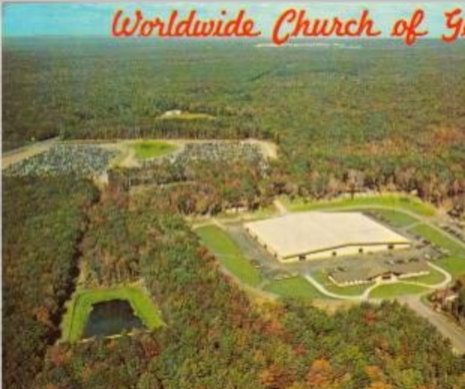
The photo below is an old scanned postcard of the Worldwide Church of God Feast of Tabernacles Feast site located in Mount Pocono, Pennsylvania (property now sold). You can see for yourself how large the site was. It held up to 4,000 people in the main building. Two very large parking lots are visible, and another large one was below the bottom of the photo at the end of the entrance road leading up to the administration building. We had two services on the two Holy Days of the Feast, and one a day on ordinary Feast days. The Feast lasted eight days, as called for in Leviticus 23. The Feast took tremendous planning on the part of all the ministry and HQ church of the Worldwide Church of God, as well as the combined faithful saving of funds by everyone who attended. Often times, vacation time was used to be able to attend. Parents and children alike had hassles with school departments for taking kids out of school for about 10 days in the fall. The cost of observing this feast was huge, in many ways, but the spiritual dividends were huge as well. As this world grows colder and colder spiritually, as Matthew 24:11-13 says it will, Christian Retreats, church services, mid-week Bible studies (not online, but actual in-person mid-week Bible studies where fellowshipping can occur) and prayer meetings are crucial periods of time for recuperation and strengthening the parts of the body of Christ we are a part of. Time is a gift of God. Use it wisely. Redeem it, as the times grow more evil.
|