




|
2nd
Samuel 5:9-25 “So
David dwelt in the fort, and called it the city of David. And David built round about from Milo and
inward. 10 And
David went on, and grew great, and the LORD
of hosts was with him. 11 And
Hiram king of Tyre sent messengers to David, and cedar trees, and carpenters,
and masons, and they built David an house. 12
And David perceived that the LORD
had established him king over Israel, and that he had exalted his kingdom for
his people Israel’s sake. 13 And
David took him more concubines and wives out of Jerusalem, after he was
come from Hebron: and there were yet
sons and daughters born to David. 14
And these be the names of those
that were born unto him in Jerusalem; Shammuah, and Shobab, and Nathan, and
Solomon, 15 Ibhar
also, and Elishua, and Nepheg, and Japhia, 16
and Elishama, and Eliada, and Eliphalet.
17 But
when the Philistines heard that they had anointed David king over Israel, all
the Philistines came up to seek David; and David heard of it, and went
down to the hold. 18 The
Philistines also came and spread themselves in the valley of Rephaim. 19
And David enquired of the LORD,
saying, Shall I go up to the Philistines? wilt thou deliver them into mine
hand? And the LORD
said unto David, Go up: for I will
doubtless deliver the Philistines into thine hand. 20
And David came to Baal-perazim, and
David smote them there, and said, The LORD
hath broken forth upon mine enemies before me, as the breach of waters. Therefore he called the name of the place
Baal-perazim. 21 And
there they left their images, and David and his men burned them. 22
And the Philistines came up yet again,
and spread themselves in the valley of Rephaim. 23
And when David enquired of the LORD,
he said, Thou shalt not go up; but fetch a compass behind them, and come
upon them over against the mulberry trees. 24
And let it be, when thou hearest the
sound of a going in the tops of the mulberry trees, that then thou shalt bestir
thyself: for then shall the LORD
go out before thee, to smite the host of the Philistines. 25
And David did so, as the LORD
had commanded him; and smote the Philistines from Geba until thou come to
Gazer.” [Audio
version: https://resources.ccphilly.org/detail.asp?TopicID=&Teaching=WED667] Introduction: David Chooses Jerusalem As Israel’s Capitol
City “2nd
Samuel chapter 5, verse 6, we came to that great verse, great place to pick up
[we actually got to verse 8], kind of where we are, the entire nation united
under David, one king, one nation under God as it were. The first time since the days of Joshua, the
whole nation gathered together. But now
with the right king, it says “And the king and his men” what a great
plaque, great bumper-sticker, what a truth, what a great statement, “the
king and his men went to Jerusalem unto the Jebusites,” this ancient city, “the
inhabitants of the land: which spake
unto David, saying, Except thou take away the blind and the lame, thou shalt
not come in hither: thinking, David
cannot come in hither.” (verse 6)
David, choosing Jerusalem, particular to his territory, Saul made a
mistake choosing Gibeon out of his own tribe, Jerusalem was central to the
highlands in Israel, central location, defendable. We’re going to see that David has other
intentions, so this is perfect, this is the city of Jebus, of Jerusalem, of
Zion, it was to be central, the capital of the nation. And it simply says, after hundreds of years
of others trying, it just says, “Nevertheless David took the strong hold of
Zion: the name is the city of
David. And David said on that day,
Whosoever getteth up to the gutter, and smiteth the Jebusites, and the lame and
the blind, that are hated of David’s soul, he shall be chief and
captain. Wherefore they said, The
blind and the lame shall not come into the house.” (verses 7-8) “and the lame and the blind” that’s what the
terms they used to mock David, because they thought that fortress of Zion was
so impregnable that they could leave the blind and the lame on the wall to
guard the city, David said ‘Whoever gets up there and smites the lame and
the blind,’ he said ‘that are hated of David’s soul, he shall be
chief and captain,’ we know Joab was the one who accomplished that, ‘wherefore
they said the blind and the lame shall not come into the house.’ “So David dwelt in the fort, and called it
the city of David. And David built round
about from Millo and inward.” (verse 9) And
he built all the settlements he wanted, anywhere, in east Jerusalem, in west
Jerusalem, and nobody challenged him. “So
David dwelt in the fort, and called it the city of David. And David build round about from Millo and
inward.” one section, if you get a map, Zion is the lower part of the city,
which is not Jerusalem today, the lower part south of the Temple Mount, which
was a threshing floor, the threshing floor of Arunah at that time. And it was steep on the east in the Kidron
and the south, Hinnom valley on the west side, the Tyropian Valley there. The only real approach was from the north, which
was easily guarded, because it’s so narrow, to try to come to that part of the
city. So, a fortress, it’s called a
fort, easily defensible, and David is going to enlarge it. In this area of Millo, they’ve uncovered some
of it, it’s like this system of stepped walls, about a thousand foot long or
so, you can see it today. It says that
David enlarged that part of the city around where Millo was and inward, “And David went on, and
grew great, and the LORD
God of hosts was with him.” (verse 10) it
just says “going and growing,” it’s kind of interesting. I pray that our lives, that would be a nice
encapsulation of our spiritual walk with him, he went “going and growing.” “David went on, and grew great,” great
notoriety, and the note, “and the LORD
God of hosts was with him.” (verse 10) “And Hiram king of Tyre sent messengers to
David, and cedar trees, and carpenters, and masons: and they built David an house.” (verse
11) And we assume that Hiram is
younger at this point in time, because Hiram will also support his son Solomon,
and David has 33 years of his reign left in Jerusalem, and he strikes up this
relationship with Hiram, who is the king of Tyre. Now Hiram no doubt heard that David had
brought together all of Israel, David had some victories down in Philistine
country, we’re not sure chronologically exactly how this falls, because it’s
going to describe two battles with the Philistines, and David then will have
continual victory over the Philistines, and the Philistines were a seafaring
people in their origins, and they were a headache to the king of Tyre [the king
of the Phoenician maritime empire of Tyre and Sidon], and no doubt David coming
to prominence, it was just good diplomacy for Hiram to pay homage to David, to
acknowledge him, and I think a genuine friendship begins, where Hiram loves
David as a man, hearing of his victory, “Hiram king of Tyre sent messengers
to David, and cedar trees, and carpenters, and masons: and they built David an house.” (verse
11) [Comment: This alliance David made with king Hiram of
Tyre, with the Phoenicians, a maritime empire would end up bringing spiritual
disaster into the 10 northern tribes of Israel after the division of the
nation, from the time of Rehoboam Solomon’s son right up to 721 BC, as this
would bring Baal worship into the ten northern tribes, now called the House of
Israel after the division at Rehoboam’s time.
To learn of the exact historic details about how this occurred, see https://www.unityinchrist.com/kings/1.html.] If you’ve ever seen a full-grown cedar, they
are breathtaking, cedrous lobani, a beautiful tree. You get to see one that’s over 100 feet tall,
150, 200-foot tall, just staggering. And
I could imagine in those days, they would only cut them down as they used them,
so you can imagine the cypress and the cedar trees, we’ll hear more about. He sent messengers to David, and cedar trees,
and carpenters, and masons, and they built David a house, a palace there in
Jerusalem. “And David perceived that
the LORD
had established him king over Israel, and that he had exalted his kingdom for
his people Israel’s sake.” (verse 12) “for Israel’s sake,” not for David’s
sake. So David, very solid place in a
sense at this point in time, he sees Hiram, he sees the victory, he sees the
nation united, and it says ‘he perceives that the LORD
had established him,’ it wasn’t his own
effort. Remember, he went 15 years
fleeing from king Saul, probably wondering at times if his kingdom would ever
be established. And now he looks at it,
he realizes it’s God’s hand that’s given it to him, “and that he” the LORD
“had exalted his kingdom for his people Israel’s sake.” He hasn’t done it for David, he realized the
LORD has done this for his
ancient people Israel, ‘he’s established me, he’s raised this kingdom
up,’ and he has this certainly in perspective. David will expand the nation of Israel from
approximately 6,000 square miles under his reign, to 60,000 square miles. David will unite the nation nationally,
civilly and religiously, awaken them spiritually. David will institute trade with the known
world of his day, David will subjugate every enemy that comes against
them. David perceives God’s hand in
these things, and that God is doing it for his people’s sake. Sadly,
David Took To Himself More Concubines And Wives And
then it says, sadly, “And David took him more concubines and wives
out of Jerusalem, after he was come from Hebron: and there were yet sons and daughters born to
David.” (verse 13) David is being
directly disobedient to the instruction in Deuteronomy 17, verse 17,
where they were told, God says ‘the day’s going to come when you’re going
to want a king like the nations around you,’ it wasn’t God’s ideal, it
was to be a theocracy, and the nation could have been ruled from God’s Word and
from the Tabernacle [“ruled by God’s Word, Law” in the sense that the Law of
God in Exodus through Deuteronomy was Israel’s Constitutional Law, for civilly
and religiously ruling a nation, but the Books of Joshua and Judges, especially
the Book of Judges show us that the spiritual part didn’t work out. Why?
Moses clearly tells us in Numbers 11:14-17, 24-29, that the vast
majority of all Israel did not possess or have the Holy Spirit indwelling them,
they were just carnal human beings that happened to know that God was real, and
was their God who had rescued them from Egyptian slavery, and that while they
had a physical knowledge of God’s Law and Word, and that God was real, they
were in no sense spiritually converted with God’s Holy Spirit in them. Those 70 elders did have God’s Holy Spirit
put in them, as Joshua did, and some of the Judges did, and as David himself
had God’s Spirit in him. But the average
Joe Israelite, and all the other inhabitants of the world never had God’s Holy
Spirit in them. This raises a lot of
questions about “the unsaved dead.” The
Body of Christ has various beliefs about the “unsaved dead,” some of them quite
conflicting. To see some of these, log
onto: https://unityinchrist.com/plaintruth/battle.htm]. ‘You’re gonna want a king, like the
nations around you, and when that happens, you shall surely not chose a
stranger, a foreigner to be king over you.
And whoever you pick to be king, I don’t want him going back to Egypt to
multiply horses,’ Solomon would do that, ‘I don’t want him to
multiplying gold and silver to himself,’ Solomon would do that, there
would be so much gold that silver would be counted as rocks, and I don’t
want him to multiply wives to himself.’ Now
Solomon definitely did that, David’s going to end up, like maybe he thinks this
is addition and not multiplication, I don’t know. But look, we watch him. In chapter 11 it’s going to tell us, “It
was the year when kings go forth to battle,” and David stayed in Jerusalem
and he saw a woman taking a bath on the next roof, Bathsheba, he looked over
and saw her. And it tells us something
about him, it was the time of the year when kings go forth to battle, and David
relaxed. We find David much more
vulnerable in his successes than on the battlefield, or even in his
failures. Charles Spurgeon said “The
seeds of our future failures are the most often sown during our successes.” The seeds of our future failures, most often
sown during our success. When you drive
your car and it’s raining or it’s foggy, you never get in an accident. That’s when you should get in an accident,
but that’s when you’re driving like this, you’re looking at everything, you
hate every truck that goes by, you watch everybody, and by the time you get
somewhere having driven a couple hours, you’re so wasted because you’ve been so
intensively watching in the rain. You
get in an accident on a nice day. You’re
listening to the radio, you’re talking to somebody in the front seat, you’re
talking when you shouldn’t be, when your guard is down. And we
see David here, raised up, perceiving God’s blessing, and his guard is down as
it were, he has some sense of entitlement that certainly he shouldn’t have, and
he’s failing here, genuinely, and he’s sowing the seeds of a future failure
that will effect him as a man, and as a father, and as a king. And it says he takes more concubines and
wives to himself, and he has sons and daughters born. There’s four places in the Old Testament that
we have a list of his wives and his kids.
And it’s kind of fast-forwarding now, it didn’t all happen now, it’s
fast-forwarding, “And these be the names of those that were born unto
him in Jerusalem; Shammuah,” it’s SeaWorld, he should never have taken more
wives and concubines, “and Shobab, and Nathan,” named after the Prophet
who would be his friend, “and Solomon, Ibhar also, and Elishua, and Nepheg,
and Japhia, and Elishama, and Eliada, and
Elishalet.” (verses 14-16) In
Two Major Battles David Destroys The Philistine Threat Contrast
now, “But when the Philistines heard that they had anointed David king over
Israel, all the Philistines came up to seek David; and David heard of it,
and went down to the hold.” (verse 17) now they hear that he has been made king, the
Philistines hear the nation is united, they may have perceived David’s still a
vassal king, when he was in Hebron they might not have been completely
threatened, possibly the Philistines at that point in time even saw him to some
degree as an ally. Remember he had lived
down there in Philistine territory for a long time. And Achish, king of Gath tried to convince
the other Philistine kings he was not a threat.
But now he’s come to Jerusalem, and all of the 12 tribes, the entire
nation from Dan to Beersheba as it were, is gathered under his reign, and now
the enemy is awakened. Listen, whenever
you have the right King in the right place, the enemy freaks out, that’s the
rule. It’s the same in our lives, you
have the right King in the heart of the land, the enemy is stirred, that’s
just, make it a rule. Write it on your
forehead backwards so you can read it in the morning on the mirror. There is never spiritual progress without
warfare, there is never spiritual progress without warfare. Now that’s governed, it’s not out of control,
it suits God’s purposes. But it tells us
here “But when the Philistines heard that they had anointed David king over
Israel, all the Philistines came up to seek David; and David heard of it,
and went down to the hold.” (verse 17) it seems he’s going down to the area
towards Engedi where he had been and was so familiar with. “And the Philistines also came and spread
themselves in the valley of Rephaim.” (verse 18) big show, big display now,
in the valley of Rephaim, several miles south[west] of Jerusalem. And notice this, “And David enquired of
the LORD,
saying, Shall I go up to the Philistines? wilt thou deliver them into mine
hand? And the LORD
said unto David, Go up: for I will
doubtless deliver the Philistines into thine hand.” (verse 19) David perceived that the LORD
had blessed him, David perceived the LORD
raised him up, David basically at this point is saying ‘LORD,
you gave us the nation, you gave us Jerusalem, you have to sustain it now. What should I do? this is all yours. The Philistines are attacking your country,
not mine, the Philistines have invaded your Kingdom,’ and
David says ‘What shall I do?’
Wonderful, at this season of his life, all of his victories are
secondary to his enquiring of the LORD,
his prayer. And David enquired of the
LORD,
saying, Shall I go up to the Philistines? wilt thou deliver them into mine
hand? And the LORD
said unto David, Go up: for I will
doubtless deliver the Philistines into thine hand.” (verse 19) “for
I will doubtless,” no big deal David, “for I will doubtless deliver the
Philistines into thine hand.” “And
David came to Baal-perazim, and David smote them there, and said, The LORD
hath broken forth upon mine enemies before me, as the breach of waters. Therefore he called the name of that place
Baal-perazim. And there they left their
images, and David and his men burned them.” (verses 20-21) they ran and left their gods, forgot that
their gods couldn’t run. If your god
can’t run, you have the wrong god, and if your god needs to run you got the
wrong god. And if you’re running and
leave your god somewhere, you got the wrong god, “there they left their
images, and David and his men burned them.” and if somebody can put your
god in piles and burn them, you got the wrong god. So, interesting, David, he says their defeat
was like a breach in the waters, maybe he’s thinking of the Red Sea or the
parting of the Jordan as they came into the land, or maybe he’s thinking about
a wall breaking and water pouring forth, we’re not told. But he sees this breach, it’s going to be
important in the next chapter, as something from the LORD’s
hand, he recognizes this is something that God has done. And he names it after that. “And the Philistines came up yet again,
and spread themselves in the valley of Rephaim.” (verse 22) now God’s
having this happen on purpose. Because
what’s going to happen is, David’s not going to say ‘Hey, I know how this one works, remember? we just,
this is Philistine’s-101, we just go back, get in the same position,’ no,
he’s going to seek the LORD
again, and the LORD’s
going to give him a completely different battle plan for the same
situation. The Philistines come and
encamp in the same place, and God’s going to tell David to approach it a
completely different way. He’s going to
give him a greater victory, and then he’s going to record that, certainly for
us tonight, because the mistake that you and I make, I speak for myself, you
all look confused, the mistake that I make sometimes, if something happens, I
think ‘Well this is the way the Lord does it, then, so here’s the formula,
here’s the method, and when it happens again I just have to do it the same way.’ Look, after any victory, as soon as that
victory is over, the next second, we’re just as dependent on the Lord as we
were the second before the victory.
And what that means, the Philistines in their camp must have said ‘Let’s
go up and get ‘em,’ and some of the Philistines said, ‘Nah, God’s with
them, they wupped us,’ and then God made the other Philistines say ‘No,
no, that was just a freak occurrence,’ and
then they said ‘Where should we go?’ and some of the Philistines said ‘Let’s
go to the valley of Rephaim,’ and the guys are going ‘Duh, we were just,
what do you mean, you’re going to go right back,’ and you realize the
counsel that must have taken place in the camp of the Philistines to make them
come back and camp in exactly the same place so God could teach us a lesson
here tonight. This is involved, just
don’t take that for granted when it says they came back here to the valley of
Rephaim. “the Philistines came up yet again, and spread themselves in the
valley of Rephaim.” Dashavu. “And
when David enquired of the LORD,
he said, Thou shalt not go up; but fetch a compass behind them,” pull
around them, flank them, “and come upon them over against the mulberry
trees.” (verse 23) that’s an important part of the plan, ‘Oh ya, attack
from the mulberry trees.’ Look,
there’s no formula, there’s enquiry of the LORD
verses methodology, ‘How do we do this?’ there’s
the Living God, not a formula. “come
upon them over against the mulberry trees.” and God says “And let it be,
when thou hearest the sound of a going in the tops of the mulberry trees, that
then thou shalt bestir thyself: for then
shall the LORD
go out before thee, to smite the host of the Philistines.” (verse 24) now I wonder if
David came back and said to the guys ‘The LORD
said when we hear the sound of a going
in the top of the mulberry trees,’ they
all said ‘What’s a going sound like in the top of the mulberry trees?’ A stirring, a rustling in the top of the
mulberry trees. The ancient rabbis said
it was the movement of angels, like the angels at Dothan when Elisha said ‘Open
my servant’s eyes,’ and he opened his eyes and saw the chariots
and the horsemen of fire (2nd Kings 6:13-17), they even make
reference to a particular Psalm, in their tradition they say was the moving of
the LORD’s
army ahead of David’s army, the rustling in the mulberry trees, “when thou
hearest the sound of a going in the tops of the mulberry trees, that then thou
shalt bestir thyself: for then shall the
LORD
go out before thee, to smite the host of the Philistines.” (verse 24)
‘the LORD will
go out before you to smite the host of the Philistines.’ Charles Spurgeon says, you know, “God may
send his angels, God may engage the battle, God may grant us the victory, but
we have to bestir ourselves, we have to bestir ourselves.” And when we listen, and we hear God
rustling, going, the rustling’s of God, the wind, it should stir us, it should
stir us. And it’s not a human sound,
it’s not heard with the human ear, but it’s heard, it’s heard. The Bible says taste and see that the Lord is
good, it’s not talking about your palate, your tongue, it’s talking about
something that’s deeper. The Bible says
we should take hold of the promises of God, it’s not with your physical
hand. It says we have a savour of death
unto those who are perishing, we smell like death to them, but that’s not a
physical smell. And this stirring, you
know, there’s a stirring that we can sense, that we can recognize, and God is
stirring. And in response to that, we
should bestir ourselves, when we sense the Lord’s stirring we should get to our
knees and say ‘Lord, here I am.’
Look, I’m preaching to myself, not to the choir, ‘Lord, here’s my
heart, I know you’re stirring, what do you want of me? I’m just a man, in of
myself Lord I’m nothing, speak, Lord, direct Lord.’ “then thou shalt bestir thyself: for then shall the LORD
go out before thee, to smite the host of the Philistines. And David did so, as the LORD
had commanded him; and smote the Philistines from Geba until thou come to
Gazer.” (verses 24b-25) the verse before said the LORD
had smote the Philistines, David went because he bestirred himself, and smote
the Philistines from Geba until thou come to Gazer, over 20 miles, deeper into
the territory. And by the way, in this
battle, taking back city after city that Saul had lost to the Philistines. [“When David
became king over all Israel,
the Philistines,
judging that he would now become their uncompromising enemy, made a sudden
attack upon Hebron,
compelling David to retire from it. He sought refuge in "the hold" at
Adullam
(2
Samuel 5:17–22), and the Philistines
took up their position in (or raided)
the valley of Rephaim,
on the west and south-west of Jerusalem.
Thus all communication between Bethlehem
and Jerusalem was intercepted. While David and his army were encamped here,
there occurred the battle narrated in 2
Samuel 5:17–25 and 1
Chronicles 14:8–12. Having obtained
divine direction, David led his army against the Philistines, and gained a
complete victory over them. The scene of this victory was afterwards called Baal-perazim. A second time, however, the Philistines
rallied their forces in this valley (2
Samuel 5:22 and 1
Chronicles 14:13–16). Again, warned by a
divine saying about hearing a marching sound in the tops of the baka
trees (הבכאים,
KJV "mulberry
trees", most modern versions
"balsam"), David led his army to Gibeon,
and attacked the Philistines from the south, inflicting on them another severe
defeat, and chasing them with great slaughter to Gezer.
There David kept in check these enemies of Israel and in consequence his fame
grew.” (Wikipedia.org)]
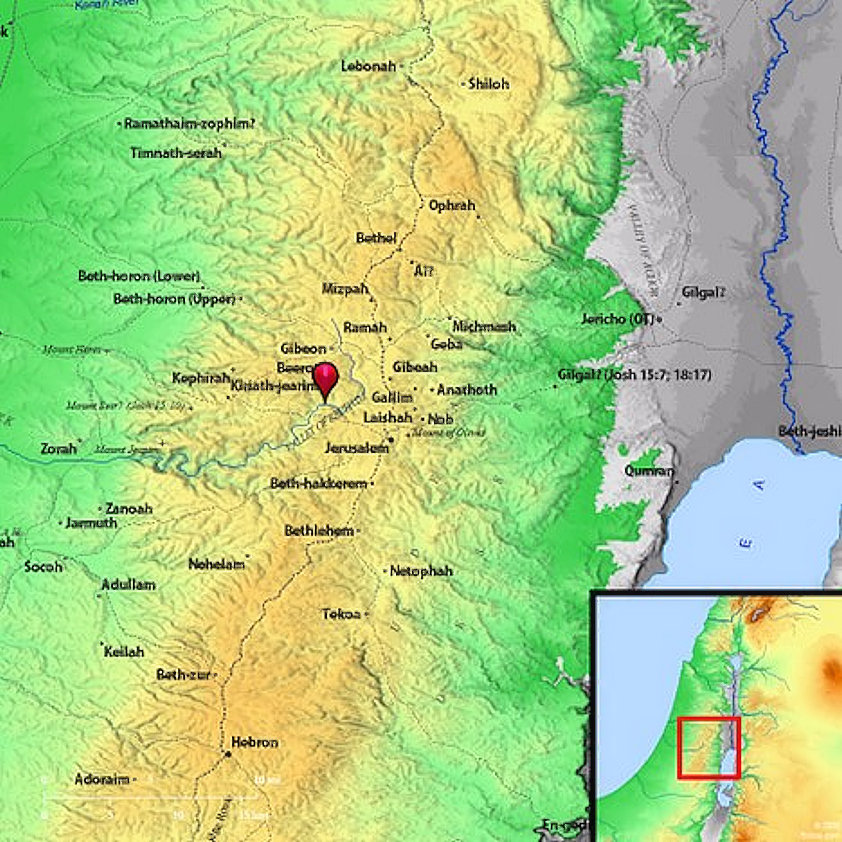
The
valley of Rephaim is west of Jerusalem, running Northeast to Southwest, as seen
in the map above. Now, this brings us to
2nd Samuel chapter 6.
2nd
Samuel 6:1-15 “Again,
David gathered together all the chosen men of Israel, thirty
thousand. 2 And
David arose, and went with the people that were with him from Baale of
Judah, to bring up from thence the ark of God, whose name is called by the name
of the LORD
of hosts that dwelleth between the cherubims. 3
And they set the ark of God upon a new
cart, and brought it out of the house of Abinadab that was in
Gibeah: and Uzzah and Ahio, the sons of
Abinadab, drave the new cart. 4 And
they brought it out of the house of Abinadab which was at Gibeah,
accompanying the ark of God: and Ahio went before the ark. 5
And David and all the house of Israel
played before the LORD
on all manner of instruments made of fir wood, even on harps, and on
psalteries, and on timbrels, and on cornets, and on cymbals. 6
And when they came to Nachon’s
threshingfloor, Uzzah put forth his hand to the ark of God, and took
hold of it; for the oxen shook it. 7
And the anger of the LORD
was kindled against Uzzah; and God smote him there for his error; and
there he died by the ark of God. 8
And David was displeased, because the LORD
had made a breach upon Uzzah: and he
called the name of the place Perez-uzzah to this day.
9 So David was afraid of the LORD
that day, and said, How shall the ark of the LORD
come to me? 10
So David would not remove the ark of the
LORD
unto him into the city of David: but
David carried it aside into the house of Obed-edom the Gittite. 11
And the ark of the LORD
continued in the house of Obed-edom the Gittite three months: and the LORD
blessed Obed-edom, and all his
household. 12 Then
it was told king David, saying, The LORD
hath blessed the house of Obed-edom, and all that pertaineth unto him,
because of the ark of God. So David went
and brought up the ark of God from the house of Obed-edom into the city of
David with gladness. 13 And
it was so, that when they that bare the ark of the LORD
had gone six paces, he sacrificed oxen and fatlings. 14
And David danced before the LORD
with all his might; and David was girded with a linen ephod. 15
So David and all the house of Israel
brought up the ark of the LORD
with shouting, and with the sound of the trumpet.” David’s
First Attempt To Bring The Ark Of The Covenant To Jerusalem David’s
Motive Was Right, Pure “Again,
David gathered together all the chosen men of Israel, thirty
thousand. And David arose, and went with
all the people that were with him from Baale” which is
Kerioth-jearim, your translation may insert the word, “of Judah, to bring up
from thence the ark of God, whose name is called by the name of the LORD
of hosts that dwelleth between the cherubims.” (verses 1-2) David now has a political capital, he wants
it also to be the spiritual capital of the nation. We’re going to watch David here do something
commendable, he’s doing the right thing, because God is only going to bless
it. But the lesson here is he’s doing the
right thing the wrong way. God will
bring before us both his motive, which is right, and his method, that is
wrong. And quite often our motive is
correct, but the methodology can be wrong.
And God will never justify the means because of the end. David wants to bring up the Ark of the
Covenant, which has been in Kerioth-jearim for over 70 years now. Remember when the Philistines sent it back to
Israel on a cart, with cows lowing and bringing it up there to
Bethshemesh. It’s been there for over 70
years. David now realizes, and God had
said in his Word that he would set up a central location where all of the
nation could come and worship, and now the nation is conjoined, they’ve come
together, David is there, he’s king. And
probably Psalm 132, most scholars feel written relative to this
situation. David says “Surely I
will not come into the tabernacle of my house,” remember Hiram had
built him this palace, David said “Surely I will not come into the
tabernacle of my house, nor go up into my bed, I will not give sleep to my eyes
or slumber to my eyelids, until I find out a place for the LORD,
a habitation for the Mighty God of Jacob.
Though we heard of it at Ephratah, we found it in the fields of the
wood,’ which is Kirioth-jearim, ‘we
will go into his tabernacle, we will worship at his footstool, Arise O LORD,
into thy rest, Thou and the ark of thy strength. Let thy priests be clothed…”
you read through, and you hear the intent of David, ‘How can I enjoy, how
can I have a palace when the LORD
is out in the field somewhere?’ And David evidently at this point constructs a
tabernacle, it is not The Tabernacle that Moses made, but he makes a tent, a
structure to bring the Ark into. The
other Tabernacle seems to be garnered and gathered finally when Solomon’s
Temple is finished, and all of the treasures, some of them seeming scattered to
some degree are finally all gathered.
But here David wants the presence of the LORD
in the midst of the nation. It says he
perceives that God is the one whose established, God is the one whose done it
all. And like us, we want Revival in our
nation, we want the presence of the Lord (see https://unityinchrist.com/prophets/Zephaniah/REVIVAL.html). And in David’s day the presence of the LORD
was there on the Mercy Seat between the Cherubim on the Ark of the Covenant, it
was the recognized place, Exodus says that’s the place where the LORD
dwells, between the cherubim, on the Ark of the Covenant. And David wants to bring it up. When they had been in the Wilderness with
Moses, and you read about the encampments, the entire encampment of Israel, and
it says ‘And these tribes camped on the east,’ on the east of
what? On the east of the Tabernacle, ‘these
tribes camped on the north,’ the entire nation was laid out relative to
the Tabernacle where the Ark of the Covenant was. And David knows that, and he wants to bring
this Ark, not only so Jerusalem’s the political capital, but so it’s the
spiritual capital of the nation also.
What he wants to do is so right, and it’s so good. He says ‘I can’t live here in a palace
until the LORD
has a habitation, I’m secondary, I’m a lieutenant governor, he’s the King, he
has to be here.’ And
his heart is right, but we’re going to watch him do a right thing the wrong
way, and there’s a powerful lesson, because we want the Lord’s presence. I don’t know about you guys, I want the
Lord’s presence, in my home, my life, in the church, in our nation, we want
revival. We’re going to hear about the
Ark 15 times in the first 17 verses here.
David sends, or he gathers first 30,000 chosen men of Israel, warriors,
he’s going to make sure when we move this nobody’s going to mess with us. And we find out there’s Levites, priests,
musicians, he’s got everybody together now, David gathers everyone together. Doing
The Right Thing With The Right Motive And The Wrong Method “And
David arose, and went with all the people that were with him from Baale”
which is Kerioth-jearim, your
translation may insert the word, “of Judah, to bring up from thence the ark
of God, whose name is called by the name of the LORD
of hosts that dwelleth between the cherubims. And they set the ark of God upon a new cart,
and brought it out of the house of Abinadab that was in Gibeah: and Uzzah and Ahio, the sons of Abinadab,
drave the new cart.” (verses 2-3) [The
Ark has been in the house of Abinadab and his sons since before both his sons
were born and toddlers, they grew up with it in their house.] Now he takes the Ark, and he throws it on a
cart. Now that’s how it got there, with
the Philistines. But God could tolerate
the Philistines doing it, because they didn’t have the Law, they put it on a
cart and drove it up to Bethshemesh. The
problem is, the Ark of the Covenant had rings hanging on the four corners,
where staves were to be inserted, and the Ark of the Covenant was to be
carried, it wasn’t to be on a cart. In Numbers
we’re told this, specifically, in chapter 4, it says “And when Aaron
and his sons have made an end of covering the sanctuary, and all the vessels of
the sanctuary, as the camp is set forward; after that, the sons of Kohath shall
come to bear it: but they shall
not touch any holy thing, lest they die.
These things are the burden of the sons of Kohath in the
tabernacle of the congregation.” Now it’s interesting, because in one more
description it says “and Moses took the wagons and the carts and gave them
unto the Levites, two wagons or carts and four oxen he gave to the sons of
Gershon according to their service, and four carts and eight oxen he gave to
the sons of Merari according to their service under the hand of Ithamar the son
of Aaron the priest. But unto the sons
of Kohath he gave none,” no cart, no wagon, “because the service of the
sanctuary belonged to them, was that they should bear it upon their
shoulders.” Now David sets out, he’s
got 30,000 men, everybody’s onboard, we’re going to find out everybody’s
excited, and when they get there, they put that Ark up on a cart. And it’s a new cart, it’s a new cart. And new carts are always attractive. Listen, in the Church today, I mean the
lesson, we want the presence of God, I want the presence of God in my life, in
my family. But we always want to throw
him on our cart, we invent a ministry, we invent a method, we invent some type
of program, and then we want to throw God on.
But you can’t drag him along, and you can’t drive him, it says ‘they
drave the new cart.’ And there’s
cart-builders everywhere today. Interesting,
one commentary I read said “Carts are nothing but boards with big wheels,” and
he went on to say “the Church is filled with boards with big wheels.” And it’s never the way God moved and it’s
not the way that God moves today. But
new carts are attractive, and the Church is filled with cart-builders, slick,
savvy, and interesting. [The latest
thing happening within the evangelical part of the Church is they want to bring
Revival into America by political means, that’s their “new cart” they’re trying
to throw God onto, forcing their religious agendas and standards onto a secular
nation. That is not how
real Revival starts. See https://unityinchrist.com/topical%20studies/America-ModernRomans6.htm] It says Abinadab’s sons were Ahio and
Uzzah. Ahio means “brotherly” or
“friendly,” Uzzah means “strength,” and it’s just a picture of the Church
wanting to use it’s own strength, wanting to be friendly. It says Ahio went first, ‘This is the new
thing, friendly, friendly goes first, strength goes last, and we’ll throw God
on our cart and we’ll drag him along, and this will be a great program, wait
till you see what happens.’ But God
will have none of it. Listen, this is
the same thing that happened with Eli and his sons, when Israel was loosing the
battle with the Philistines because they hadn’t sought the LORD,
they said ‘Let’s take the Ark, the rabbit’s foot, into battle with us,
and then we’ll have victory, and they took the Ark of the Covenant,’ because
that’s how they treated it, they treated it like it was a rabbit’s foot. If you’re old enough, you had a rabbit’s foot
when you were a kid. Animal lovers never let that happen these
days, but when I was a kid they used to cut rabbit’s feet, I don’t know what
they did with the rest of the rabbit, but I had several of those when I was a
kid, Lucky Rabbit’s Foot. That’s the way
they want to treat the Ark of the Covenant, that’s what David’s doing here, ‘Hey
man, we got the kingdom, we got Jerusalem, this is great, let’s go get the Ark,
we’ll bring it up, and everything will kind of pull together,’ so they go
down, they grab the Ark and throw it on their cart. That’s what it says. They set the Ark of God, worldly ways, the
Philistines did this, let’s consult Madison Avenue, let’s find out the best way
to do this. John Wesley said in his day “The
Church doesn’t need new things, it needs new fire.” “And they set the ark of God upon a
new cart, and brought it out of the house of Abinadab that was in
Gibeah: and Uzzah and Ahio, the sons of
Abinadab, drave the new cart.” they’re driving it, driving God on up
to Jerusalem. “And they brought it
out of the house of Abinadab which was at Gibeah, accompanying the ark
of God: and Ahio went before the
ark. And David and all the house of
Israel played before the LORD
on all manner of instruments made of fir wood, even on harps, and on
psalteries, and on timbrels, and on cornets, and on cymbals.” (verses 3-5) Imagine the scene, because the people of
Jerusalem must be waiting on the walls, ‘This is gonna be great, David,’ and he’s out there, he’s
got 30,000 men, just imagine what that looks like, warriors, and then all the
priests, then all the musicians, they’re coming up towards Jerusalem, driving
God there, got him on a cart, everybody’s excited, everybody’s onboard. Because it’s unanimous or because the
majority of the people say something should happen in a certain way does not
mean that it’s God’s leading or that it’s God’s method. Because for all intent purposes, everybody
looked at this and said it looked wonderful.
Everybody was excited, everybody wanted God’s presence, that’s right,
that’s a good thing, everybody wanted it.
But they’re doing the right thing the wrong way. Their motive is good and their method is so
wrong. And they’re coming up to
Jerusalem, imagine the scene, everybody’s excited, everybody’s watching. “And when they came to Nachon’s
threshingfloor, Uzzah put forth his hand to the ark of God, and took
hold of it; for the oxen shook it.” (verse 6) your gloss should say “they
stumbled.” “And the anger of
the LORD
was kindled against Uzzah; and God smote him there for his error;” for
his rashness, he’s brazen, “and there he died by the ark of God.” (verse 7) the anger of the LORD,
the Hebrew says “the heat of his nostrils.” You don’t want to be under those, ‘the
heat of his nostrils was kindled,’ the LORD’s
anger is kindled, it’s an interesting picture.
“Nachon” the word there, it means “to be smitten.” You don’t want to go to the place of
“smitten’s threshingfloor.” And the
threshingfloor is where you separate the wheat from the chaff, that’s what’s
going to happen on this day. And when
they get there, it says the oxen stumble, and Uzzah, which means “strength,”
puts forth his hand to steady the Ark, probably great motivation, doesn’t want
it to fall. When he takes hold of it,
the anger of the LORD is
kindled and he smites him down dead there.
Now you have to imagine the scene, because the people are going ‘Oooh,’
and Uzzah reaches out, ‘Baboom!’ he falls over and then people
are going ‘Shhh!’ and you can hear, all the people are playing
instruments, and they’re going to the musicians ‘Shut up! Shhh!’ and you just imagine, how long
does it take for 30,000 people to quiet down?
But the whole scene changes, the whole scene changes. Because, you know, we start to do something,
and when it’s not steady or it starts get a little shaky, we always want to use
our own strength to try to fix it. From
Horeb to the Jordan River that parted in front of the Ark, the seven times
around Jericho, seven days, seven times, no one had ever stumbled. In 38 years, no one who was carrying this
thing the way they were supposed to, ever stumbled. But doing it the way that wasn’t prescribed,
you know, it’s almost as though the LORD,
it’s almost as though there’s a measure of patience, ‘This is wrong, I
didn’t smite the Philistines down because they didn’t have the Word of God, you
guys, you know, you throw me on this cart and you’re driving me? you’re
dragging me along, it’s bad enough, and then you think you’re going to put
forth your hand and take hold of me like I’m a common, the Ark of the Covenant
like it’s a common piece of furniture or something?’ And Uzzah puts forth his hand and he
takes hold of it, and it says ‘for his error he died there.’ “And David was displeased, because the LORD
had made a breach upon Uzzah: and he
called the name of the place Perez-uzzah to this day.” (verse 8) “displeased” see
where it says that? That’s a shorter
form of the same word where it says, talks about the anger of the LORD,
David wasn’t just displeased, he was “angry.”
David is angry because “the LORD
made a breach upon Uzzah: and he called the name of the place
Perez-uzzah to this day.” “to
this day” interesting. And it says “And
David was afraid of the LORD
that day, and said, How shall the ark of the LORD
come to me?” (verse 9) Now that’s not necessarily bad. Look, David is angry, he’s
humiliated, his pride I believe is even at stake here, he brought together
30,000 of the best men in Israel, he has the whole of the Levites and the
priests and the musicians. He’s doing
the greatest thing the nation has seen. You
know, him being ordained as the king and anointed, that was one thing, but
bringing the Ark of the Covenant to Jerusalem, one nation under God, this was
the greatest day, and now all of his plans are smitten. Everybody stands back, he’s completely
humiliated, he’s angry, and it says he’s afraid. Now he will write, when he writes Psalm
19, ‘that the fear of the LORD
is clean, it’s clean.’ And he says, it says “the LORD
made a breach upon Uzzah:” He rejoiced when the LORD
made a breach upon the Philistines, and now there’s been a breach, the LORD
has broken forth upon Uzzah. That’s the
whole lesson, everything’s contained in that.
God is not going to allow the children of Israel or anybody else
in any generation to drag his presence, or throw him on a cart, or throw him on
a program, throw him on your own program and drag him up and try to get a
blessing out of it, no there’s got to be complete reverence. By the time the LORD
allows the Ark to come into Jerusalem, they will be sacrificing, they will be
worshipping, there will be [sacrificial] blood involved, everything will be in
perspective, that he is Holy, that he is powerful, that he is Omnipotent. David is displeased, he’s angry because the LORD
made a breach upon Uzzah, and he named the place “the breach of Uzzah,” Samuel
says “unto this day.” “And David was
afraid of the LORD
that day, and said, How shall the ark of the LORD
come to me?” (verse 9) Now
that’s the question, how shall the presence of the LORD
come to me? That’s the central question,
“How shall the ark of the LORD
come to me?”
Well we know this, you ain’t gonna drive him and you ain’t gonna drag
him. You know that much. David
Brings The Ark Of The Covenant To Jerusalem The Proper Way “So
David would not remove the ark of the LORD
unto him into the city of David: but
David carried it aside into the house of Obed-edom the Gittite.” (verse 10) Now Obed-edom we find out is a Levite, not
only that, he’s a Kohathite, of the house of Kohath. [In Numbers 4:1-21 God prescribes to Moses
the job of the Kohathites, that they were in charge of all that was inside of
the Tabernacle, and that would include the Ark of the Covenant. But whenever those items inside the
Tabernacle, including the Ark, were to be moved, they had to be covered by the
priests that were descended from Aaron himself, and that not even the
Kohathites could move these items or even see them until they were
covered. So the Kohathites were
specially selected to take care of the items, including the Ark, and the moving
of the Ark once it was covered by special drapes, wherever it had to be
moved.] “And the ark of the LORD
continued in the house of Obed-edom the Gittite three months: and the LORD
blessed Obed-edom, and all his household.” (verse 11) at
least 90 days, and look, “and the LORD
blessed Obed-edom, and all his household.
And it was told king David, saying, The LORD
hath blessed the house of Obed-edom, and all that pertaineth unto him,
because of the ark of God.” (verses 11b-12a) This is huge, because David’s got to be
thinking, ‘God has blessed the house of Obed-edom, God has blessed the house
of Obed-edom.’ And here comes David,
back on this day, everybody’s waiting on the walls, and of the musicians are
kind of, you know, walking like this, nobody’s playing their instruments,
people are saying on the wall ‘What happened? What happened?’ ‘Sshhh,’
‘Where’s the Ark?’ there’s no celebration, and David is brooding, it
says for three months. And he’s hearing ‘God
is blessing Obed-edom, he’s blessing the house of Obed-edom.’ Now it’s interesting, “Obed,”
“servant,” “edom,” “red.” It tells us
that when Samuel came to anoint David when he was 15 or 16, that he was just a
ruddy servant, he was ruddy. And David
is thinking ‘Obed-edom, before I was a king I slew a lion and a bear, when I
was just a servant I killed Goliath, God was with me, Obed-edom, Obed-edom,
just a ruddy servant. The problem must
be with me, God is still blessing his servants.’ And you can see David sitting in his
palace there, which Hiram had built him, thinking, thinking, and no doubt all
of a sudden a light comes on, we would hear out of the palace ‘Yeehaa!’
maybe not. 1st
Chronicles chapter 15, says this, “And David made him houses in
the city of David, and prepared a place for the ark of God, and pitched for it
a tent. Then David said, None ought to
carry the ark of God but the Levites:
for them hath the LORD
chosen to carry the ark of God, and to minister unto him for ever.” and
down in verse 11 it says “And David called for Zadok and Abiathar the
priests, and for the Levites, for Uriel, Asaiah, and Joel, Shemaiah, and Eliel,
and Amminadab, and said unto them, Ye are the chief fathers of the
Levites: sanctify yourselves, both ye
and your brethren, that ye may bring up the ark of the LORD
God of Israel unto the place that I have prepared for it. For because ye did it not at first, the LORD
our God made a breach upon us, for that we sought him not after the due order.”
(verses 1-3, 11-13) David
says to the priests and the Levites ‘We did not seek the LORD
after due order, this is not a democracy, it’s a kingdom, and it isn’t our
kingdom, it’s his Kingdom.’ “And the
children of the Levites bare the ark of God upon their shoulders with the
staves thereon, as Moses commanded according to the word of the LORD.”
[cf. Exodus 25:14 and Numbers 4:15]
the simplicity of the Word of God.
There’s a lot of things that we do on the horizontal, the Church is
loaded for bear on the horizontal, we got screens and we got PA systems, we got
all kinds of stuff, but there’s one thing that’s going to remain a vertical
burden. You have the Ark of the
Covenant, you have the broken Law, and you have the Mercy Seat with the blood
of the Lamb that was poured out. And
it’s as almost as though God says ‘I’ll give you every battle against the
Philistines, I’ll take care of everything else, but there’s one thing you’re
going to bare, and that is that you’re a sinner saved by grace, there’s one
thing you’re going to bare and you’re not going to forget, that’s to be borne,
there is a broken Law, there is a Holy God, and there is the blood of the Lamb
that is applied to that. Do you want my
presence? Do you want my blessing?’ I think of how the Church today is
turning away from the simplicity of that truth, of a Holy God, a broken Law,
the blood of Jesus Christ, central, to be borne, to be carried. It says “So David, and the elders of
Israel, and the captains over thousands, went to bring up the ark of the
covenant of the LORD
out of the house of Obed-edom with joy.
And it came to pass, when God helped the Levites that bare the ark of
the covenant of the LORD,”
there’s no more stumbling, he helped
them, he had helped them for 38 years.
The thing was made of gold, it was heavy, overlaid with gold, “that
they offered seven bullocks and seven rams.” (verses 25-26) It gives us the procession, it tells us back
here in 2nd Samuel 6, “And it was told the king David, saying,
The LORD
hath blessed the house of Obed-edom, and all that pertaineth unto him,
because of the ark of God.” it doesn’t give us the
details it does in 1st Chronicles 15, it just finally brings to the
conclusion “So David went and brought the ark of God from the house of
Obed-edom into the city of David with gladness.
And it was so, that when they that bare the ark of the LORD
had gone six paces, he sacrificed oxen and fatlings.” (verses 12-13) a
pace is about 5 foot, so about every 30 foot or something. This time when they come up, they’re doing it
right, the guys are carrying it, and about every 30 foot they stop and have
sacrifices, this is a bloody road by the time they get to Jerusalem, but
they’re doing it right this time, and they’re celebrating. Imagine what it was like for Obed-edom, David
comes, and here’s the king and 30,000 men, priests and musicians, ‘We’re not
taking this to Jerusalem, we’re putting this in your living room.’ Did
Obed-edom sleep that night? ‘Don’t
touch it!’ he’s saying to his wife, ‘Get away from it,’ imagine
having the Ark of the Covenant in your living room. What would you watch on your TV? Straighten a lot of that right up. Huh?
How would you talk to your wife or your husband, with the Ark of the
Covenant sitting in your living room?
Well the Ark of the Covenant is sitting in your living room, the presence
of the Lord, he said he’d never leave us or forsake us, never leave us or
forsake us. Obed-edom, whatever
conjugations went on in his heart, he must have come to a grand
conclusion. And God began to bless
everything in this man’s life, his servant, this ruddy servant. And David remembered, his heart was stirred,
and he looked back to God’s Word, and he’s bringing now the Ark of the Covenant
up to the city of Jerusalem with great joy, there’s sacrifices. Now the vertical is where it should be, the
horizontal’s there, but the vertical is where it should be, they’re baring this
Ark. “And David danced before the LORD
with all his might; and David was girded with a linen ephod. So David and all the house of Israel brought
up the ark of the LORD
with shouting, and with the sound of the trumpet.” (verses 14-15) he’s
coming up to Jerusalem with the same outfit that the Levites have on, there’s
nothing to make him distinct from the rest, yes, he is the king, but he is also
just a servant. Again, I’m convince that
David would rather have been a priest, I think, than a king. When he writes his epitaph, when he signs off
at the end of 2nd Samuel, he says “Now these be the last words of
David, David the son of Jesse said, and the man who was raised up on
high, the anointed of the God of Jacob, and the sweet psalmist of Israel, said”
(2nd Samuel 23:1) the sweet psalmist of Israel said, not the
king, not the giant-killer, not the great warrior, not the general, but the
sweet psalmist of Israel, a worshipper of God, a man who worshipped God. And I look at this and I think ‘Lord,
don’t let me, don’t let the leadership here, home-fellowship leaders, the
people working in the Sunday school,’ I think we genuinely want to do the
right thing, ‘but don’t let us ever attempt to do it the wrong way. Don’t let us have the right motive and the
wrong method, don’t let us think because we can adopt the latest and greatest,
because we can afford PowerPoint, because we can get a better PA system, don’t
let us think because we can rent this building or do this, that we can get
smoke machines in here, and colored lights, and a new set of drums and a new
keyboard. No Lord, don’t ever let us
think like that. We want to do the right thing, we want your presence, and we
want it to be real.’ It makes me
look at my heart, Lord, do I just want to teach another Bible study, or do I
want Pentecost? Lord, you changed the world with 120 in an upper room, with
this many gathered on a Wednesday night, if he poured out his Holy Spirit and
we had his presence, what might he do in this city of Philadelphia, how might
he change the world? Lord, am I baring
what I should bare in this? You know, we
got lots of stuff going on the horizontal, Lord, do I have the vertical of this
kind of severed out, am I bearing?
What’s between you and I when I’m alone, of your forgiveness, of your
bloodshed, am I still a ruddy servant there Lord? Don’t let us build carts, flip the Lord on
there and drive him on up to the latest program, the latest event. Let’s do this “in due order” Lord, according
to your Word. David, of course, gets,
we’ll finish that next week, if the Lord tarries, and gets the Ark up to Jerusalem. But, the more important question is, Lord,
you certainly recorded things for Israel of old, but you recorded things there
and preserved them and handed to us these things this evening, thousands of
years later. What did you put to the
page for us? Was it your Holy Spirit
moving through the hand of Samuel and the quill that had our address on it,
Lord? I can only answer those things for
myself as best I can. I think, Lord
forgive me, I don’t want to step into your ministry on any given day, Lord,
without coming for your presence, Lord.
I don’t want to be the director, I want to be the directed. I want my fresh marching orders, Lord, every
day, because I’ve borne as it were the one thing, that I’m a sinner saved by
grace, you’ve settled all of this with your own blood, and there’s no
entitlements in this program, I’m a ruddy servant, I’m your son, you love me,
again, but if in whatever we put our hand to on his behalf, if we’re not
bringing something from another world, we can have the snazziest carts on terra
firma, we can have all kinds of gear, but if we’re not bringing something from
another world, we’ll never touch this world, never touch this world. So let’s have the musicians come, let’s bring
our hearts before him, let’s believe that he inhabits the praises of his
people, outside of everything else we got going on, let’s lift our hearts and
say ‘Lord, this is the one thing you want me to bare Lord, our personal
relationship here.’ You’re a Holy
God, there’s a broken Law, but there’s the blood of the Lamb, Jesus
Christ. And that’s not to be touched,
not to be thrown around, not to be loaded on a program, Lord, it’s to be
carried in my heart. Let’s stand, let’s
pray…[transcript of a connective expository sermon on 2nd Samuel
5:9-25 and 2nd Samuel 6:1-15, given by Pastor Joe Focht, Calvary
Chapel of Philadelphia, 13500 Philmont Avenue, Philadelphia, PA 19116] related
links: This
alliance David made with king Hiram of Tyre, with the Phoenicians, a maritime
empire would end up bringing spiritual disaster into the 10 northern tribes of
Israel after the division of the nation, from the time of Rehoboam Solomon’s
son right up to 721 BC, as this would bring Baal worship into the ten northern
tribes, now called the House of Israel after the division at Rehoboam’s
time. To learn of the exact historic
details about how this occurred, see https://www.unityinchrist.com/kings/1.html Moses clearly
tells us in Numbers 11:14-17, 24-29, that the vast majority of all Israel did
not possess or have the Holy Spirit indwelling them, they were just carnal
human beings that happened to know that God was real, and was their God who had
rescued them from Egyptian slavery, and that while they had a physical
knowledge of God’s Law and Word, and that God was real, they were in no sense
spiritually converted with God’s Holy Spirit in them. Those 70 elders did have God’s Holy Spirit
put in them, as Joshua did, and some of the Judges did, and as David himself
had God’s Spirit in him. But the average
Joe Israelite, and all the other inhabitants of the world never had God’s Holy
Spirit in them. This raises a lot of
questions about “the unsaved dead.” The
Body of Christ has various beliefs about the “unsaved dead,” some of them quite
conflicting. To see some of these, log
onto: https://unityinchrist.com/plaintruth/battle.htm And
like us, we want Revival in our nation, we want the presence of the Lord, see https://unityinchrist.com/prophets/Zephaniah/REVIVAL.html The
latest thing happening within the evangelical part of the Church is they want
to bring Revival into America by political means, that’s their “new cart”
they’re trying to throw God onto, forcing their religious agendas and standards
onto a secular nation. That is not
how real Revival starts. See https://unityinchrist.com/topical%20studies/America-ModernRomans6.htm Audio
version: https://resources.ccphilly.org/detail.asp?TopicID=&Teaching=WED667 |