Chapter X
Barely surviving the first winter
Many die of disease; harsh weather
and fire
severely disrupt construction; then in the spring,
at last, comes the first friendly Indian welcome.
There also had been some happy moments aboard
the Mayflower while the shallop was away on the third
exploratory trip. Mourt's Relation recorded how "it
pleased God that Mistress White was brought to bed of a son,
which was called Peregrine." Susanna White's new son, whose
older brother was born in Leyden, was the first English child
born in New England.
But mostly, the waiting, anxious hours for the Mayflower
passengers were not happy ones.
The death of Dorothy Bradford was followed the next day by
the death of a victim of the General Sickness, a 57-year-old
tailor recruited by the London adventurers. Many aboard were
sick. The number of passengers would be steadily diminished.
Within a few weeks, the sickness would take the lives of both
Peregrine's father and the tailor's wife.
Indeed, when the passengers set about discussing where they
should dwell, they had already dug four graves. A memorial
to these first victims, whose adventure into the New World
in search of religious freedom and a new life had come so
quickly to an end, may be seen today in the center of Provincetown.
And soon for the dwindling band of pioneers there would be
many, many more untimely graves.
On Dec. 15, Master Jones weighed anchor and the Mayflower
left future Provincetown Harbor. When the ship came within
six miles of Plymouth Bay, the head winds made it impossible
"to fetch the harbor," and they went back. With a fair wind
the next day the Pilgrims put to sea again, and managed to
reach the harbor safely just before the winds shifted.
Jones dropped anchor just inside Beach Point, the northern
tip of the three-mile-long spit of land, now called Plymouth
Beach, that forms the eastern barrier and a natural breakwater
for Plymouth Harbor. The Mayflower was "a
mile and almost a half" from the granite boulder later christened
Plymouth Rock--an almost solitary, glacier-age deposit on
this part of the sandy and shallow shore.
The Pilgrims had arrived on Saturday--a time for preparing
food, attire and furnishings for the coming Sabbath that,
regardless of loss of time, they persisted in observing as
an occasion for religion and rest.
Still, the Pilgrims noted from shipboard that the harbor was
"a bay greater than Cape Cod" and "compassed with goodly land."
Stretching from their anchorage toward future Kingston and
Duxbury, the bay seemed to them "in fashion like a cycle or
fishhook."
No one went ashore until Monday, Dec. 18. On that morning
members of the company began explorations to decide exactly
where they should begin building. The search would consume
three days.
For hours they marched along the coast, and went seven or
eight miles through the woods without seeing any Indians.
They examined land formerly planted by the Indians, its soil
good to the depth of a spade's blade. They found a great variety
of familiar trees and vines, "and many others which we know
not." They found brooks and springs, and praised the water
as "the best...that ever we drunk." Weary from marching, they
went back that night to the Mayflower.
Some by land and some in the shallop pressed their search
the next day.
The shallop went three miles up a creek in the future town
of Kingston, and the explorers named it the Jones River after
the Mayflower's captain. The group also crossed the
bay to examine Clarks Island.
On returning that night to the Mayflower, they resolved that
next day they would "settle on some of those places" they
had just seen.
In the morning they "called on God for direction" and went
for "a better view" of just two of the places previously explored.
Clarks Island was excluded as too small. They felt keenly
the need to save time, "our victuals being much spent, especially
our beer." [This isn't like it sounds, "we're in trouble,
the beer's running out!" Beer for them was safer than the
potable water they had on board. The sooner they could settle
next to those brooks and streams, the better, was the message
here.] And so, immediately after an additional look, they
voted for the high ground they had inspected the first day--the
land back of the great rock.
Here there was everything they sought. As they reported: "There
is a great deal of land cleared, and hath been planted with
corn three or four years ago; and there is a very sweet brook
runs under the hill side, and many delicate springs...and
where we may harbor our shallops and boats exceedingly well;
and in this brook much good fish in their seasons; on the
further side of the river also much corn-ground cleared. In
one field is a great hill, on which we point to make a platform,
and plant our ordnance..."
Thus, before names had been bestowed upon them, the Pilgrims
were describing Cole's Hill, directly back of Plymouth Rock;
Town Brook on the hill's south side; Pilgrim Spring, still
flowing in Brewster Garden; and 165 feet above the sea, Burial
Hill, on which they would build a fort-meetinghouse--a hill
from which they could that day "see thence Cape Cod."
Twenty decided to spend the night right there, while those
returning to the Mayflower promised to be back in
the morning to start building houses. But harsh December weather
interfered.
That night there was a tempest of pelting rain and strong
winds. Those ashore had had insufficient daylight to build
an adequate shelter and were soaked. They "had no victuals
on land" and the winds blew so fiercely that the shallop could
not return. On the Mayflower, meanwhile, it was necessary
to "ride with three anchors ahead."
The gale made travel next day between ship and shore impossible.
It was on this day the Mary, wife of Isaac Allerton, gave
birth to a stillborn son. Mary Allerton, mother of three children
born in Leyden, would herself die in a few weeks.
Preparations for building did get under way on Saturday, Dec.
23, with as many as were able joining those ashore. First,
though, they had to dig two graves: one for the Allerton infant
and another for a youth from London who had died on shipboard
the first day of the storm.
On Saturday and the following days, even on Christmas Day,
they kept busy: "Some to fell timber, some to saw, some to
rive (split), and some to carry; so no man rested all that
day." Bradford, moreover, wrote that it was on Christmas Day
that they "began to erect the first house for common use to
receive them and their goods." The common house was atop
Cole's Hill, on its south side, and near the foot of modern
Leyden street, the first street in New England.
That Christmas Night on the Mayflower, Jones provided
"some beer, but on shore none at all." [The Pilgrims didn't
believe in celebrating Christmas, probably due to it's being
observed on the day of the old Roman Saturnalia observance,
and that the Scripture nowhere mentions the command to observe
the Lord's birthday. They were striving with all their might
for the faith once delivered, and none of the later
additions to the faith that came centuries later which weren't
a part of the Bible.] [To read an interesting historic study
of the Puritan's and Cotton Mather's belief about the observance
of Christmas, CLICK HERE.]
Foul weather occurred most days during the remainder of December,
leaving the people ashore "much troubled and discouraged".
On Dec. 28 the Pilgrims made a very practical decision, after
concluding that "two rows of houses and a fair street" along
with a platform for ordnance on the hilltop would be "easier
impaled." The decision was to have single men without wives
join families "so we might build fewer houses." Then lots
were cast for 19 "household units."
The Pilgrims were already talking about the "weakness of our
people." They recorded that many were "growing ill with colds;
for our former discoveries in frost and storms, and the wading
at Cape Cod had brought much weakness amongst us, which increased
so every day more and more." By December's end six had died.
In January eight more would follow them, and still the agony
and the dreadful toll of the General Sickness would grow.
Keen as the Pilgrims were to become acquainted with their
Indian neighbors, they worried that the reduction in their
number might invite attack. To conceal their losses, they
resorted to burials in unmarked graves on Cole's Hill.
Those doing the building saw, at a distance they judged to
be six or seven miles, smoke from Indian fires. And on Jan.
3 some who had gone to gather thatch "saw great fires of the
Indians."
A group went to the former cornfields, but saw no Indians.
The next day Myles Standish and four or five others sought
to meet the Indians. They found Indian dwellings, "not lately
inhabited"--but again, no Indians. As the 20-foot-square common
house neared completion, with about eight days more needed
to finish the thatching, the Pilgrims on Jan. 9 decided on
a new plan for building their small houses. That day they
divided the meersteads (acreage) and garden plots "after the
proportion formerly allotted," and agreed that "every man
should build his own house, thinking by that course men would
make more haste than working in common."
This sort of private initiative was a principle in which the
Pilgrims, close-knit though they were in fellowship, deeply
believed. Allegiance to it was why they had refused, when
leaving Southampton, to accede to the harsh demands of Thomas
Weston and the London adventurers. They would adhere to this
principle in the future in other crucial decisions about developing
their plantation. [The real birth of our Free Enterprise system
was taking place right here.]
The January weather was so foul that they found that "seldom
could we work half the week."
Pilgrims aboard the Mayflower were up early Sunday, Jan. 14,
to go to join those on land--by then the larger group--for
their first Sabbath meeting ashore. The wind was blowing strongly,
and as they looked toward Leyden street they suddenly "espied
their great new rendezvous (common house) on fire." A spark
had landed in the thatch and fire was rapidly spreading.
While at work three days earlier, Bradford had been stricken
with such pain in his hip and legs that there was fear he
would die. He already had a severe cold. When the thatch flared
up he and Gov. Carver lay sick in bed in the common house.
Near them were gunpowder and charged muskets.
"Through God's mercy they had no harm," reported Mourt's
Relation. The fire consumed only the thatch. The roof
still stood, but some who had transferred ashore had to resume
quarters aboard the Mayflower.
The common house, in any case, had not provided adequate quarters.
It had been "as full of beds as they could lie one by another."
So, besides repairing the roof, the Pilgrims spent two days
building a shed "to put our common provision in."
They did get to hold their first Sabbath meeting ashore the
following Sunday, Jan. 21.
THE REST OF THE MONTH,
WHEN "FROSTY weather and sleet" would let them, the Pilgrims
used the shallop and longboat to bring ashore common provisions,
like hogsheads of meal. These they carried up to storage.
The manifold tasks facing them were made more arduous by illness,
on shipboard and shore, and by the steady decline in their
numbers.
"The sickness," said Bradford, "began to fall sore amongst
them" after the fire. February would bring their greatest
loss of life, with sometimes two or three being buried in
a single night. In all, seventeen more passengers would perish
by the end of the month, and one of the small houses--briefly
endangered when a spark kindled the roof--had to be pressed
into use to help care for the increased number of the sick.
The February weather, after starting "with the greatest gusts
of wind that ever we had since we came forth," continued mostly
severe. The Mayflower, lightened now because of goods
that had been brought ashore, was "in danger." Often the weather
made work impossible. And by mid-month the Pilgrims became
deeply concerned about their security.
On Feb. 16, a fair day, one of the Pilgrims went fowling in
the reeds about a mile-and-a-half from the plantation. Suddenly
he saw a dozen Indians headed toward the plantation, and could
hear in the woods "the noise of many more." He laid low, then
ran home to give the alarm.
That same day Myles Standish and a companion left their tools
in the woods and, on returning, found that the Indians had
taken them.
Muskets that had been allowed to get out of temper--firing
condition--because of moisture were promptly put in order,
and a strict watch was set. The next day, the Pilgrims assembled
to establish "military orders among ourselves." Standish was
formally elected captain and was voted full authority to command
in military affairs.
Even as they were engaged in this activity, there appeared
two Indians atop Watson's Hill (the Pilgrims called it Strawberry
Hill), which was then much higher than it is today and was
to the south of the plantation, immediately across from Town
Brook. Standish and Stephen Hopkins hurried across the brook
and laid down a musket to show their desire to parley. The
Indians--including some who had been concealed behind the
hill--abruptly took off.
The sudden appearance of so many Indians caused the puzzled
Pilgrims to begin getting their ordnance in place.
Jones, with some crewmen, brought ashore a minion--a cannon
with a 3 1/2-inch bore. This, along with a larger bore cannon
called a saker that had been left by the shore, were lugged
to the platform on top of Burial Hill. They were mounted there
with two smaller cannon, called bases, which had a 1 1/2-inch
bore. The work was completed Feb. 21--the same day four passengers
died, among them the father of Peregrine White.
During March the General Sickness would claim thirteen more
lives. Still, it was during this month that the Pilgrims would
for the first time hear thunder and the songs of birds in
New England, and would sow some garden seeds--true signs,
all of them, of springtime and renewed hope.
"The spring now approaching," said Bradford, "it pleased God
the mortality began to cease amongst them, and the sick and
the lame recovered apace, which put as it were new life into
them, and contentedness as I think any people could do. But
it was the Lord which upheld them..."
When the General Sickness had finally run its course,
half of all Mayflower's passengers had perished.
The loss among the wives was the heaviest. Among the eighteen
couples aboard, eight of the men but only four of the women
survived. Four families were wiped out, and only in three
families did all the members survive. Six children lost one
parent and five lost both.
Children fared comparatively well, with twenty-five of thirty-two
surviving. Of the eleven young women, only one died. Among
the nine male servants, the toll was appalling: All but one
perished.
There were two doctors in the company: the Mayflower's
doctor, Giles Heale, and Samuel Fuller, a weaver while in
Leyden who functioned as the Pilgrims' "surgeon and physician."
Fuller, said Bradford, was a tender-hearted man and "a great
help and comfort to them." During the General Sickness, however,
neither doctor was mentioned. Perhaps they, like Bradford,
were among those stricken.
Accounts are far from specific as to the name or proper treatment
for the dreadful sickness. Medical techniques of that day
were so primitive that they could have brought more harm than
cure to patients unquestionably suffering from improper diet,
anxiety, overexertion, and exposure to damp and cold. Bradford
ascribed the affliction to "the scurvy and other diseases
which this long voyage and their inaccomodate condition had
brought upon them." The other diseases could have been pneumonia
or ship fever, a form of typhus.
Jones' crew did not escape. "Almost half of their company
died before they went away," said Bradford, "many of their
officers and lustiest men, as the boatswain, gunner, three
quartermasters, the cook and others." Neither the names of
the crew, beyond a few, nor their exact number have come down
to us. But their estimated loss of life must be added to the
steep figure we have of passenger deaths.
Bradford also told of the "rare example" shown during the
General Sickness by the seven Pilgrims who escaped affliction.
These, he said, "spared no pains night nor day, but with abundance
of toil and hazard of their own health, fetched them (the
sick) wood, made them fires, dressed their meat, made their
beds, washed their loathesome clothes, clothed and unclothed
them. In a word, did all the homely and necessary offices
for them which dainty and queasy stomachs cannot endure to
hear named...
"Two of these seven were Mr. William Brewster, their Reverend
Elder, and Myles Standish, their Captain and military commander,
unto whom myself and many others were much beholden in our
low and sick condition."
Since coming to the New World, all of the future leaders of
Plymouth except Brewster had been widowed--Bradford by an
accident, Winslow and Standish by the General Sickness.
From Leyden their beloved pastor, Rev. John Robinson, wrote
in June: "The death of so many of our dear friends and brethren,
oh! Oh how grievous hath it been..." But he still was confident
that God's mercy could be seen in the fact that He had spared
so many of their leaders, and that He would ensure victory
in their struggle to provide "godly and wise government."
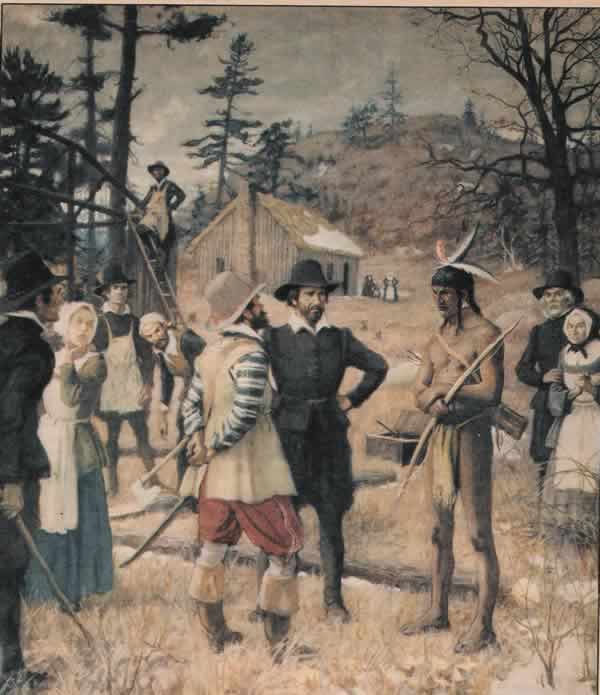
Mid-March, at last brought the beautiful greeting that the Pilgrims
had yearned to hear ever since they first caught sight of
the New England coast.
On March 16 Standish and the other men--now fewer than two
dozen--were interrupted as they sought to complete discussion
of their new military organization. A tall, straight Indian,
"stark naked, only a leather about his waist," carrying a
bow and two arrows, cause an alarm as he approached the common
house.
"He very boldly came all alone, and along the houses, straight
to the rendezvous...He saluted us in English, and bade us,
'Welcome!'"
Samoset Welcoming Pilgrims
|





